
📊 Full opportunity report: Acoustic Dampening, Placement, and the “Rig in the Closet” Setup on ThorstenMeyerAI.com — validation score, market gap, and execution plan.
TL;DR
Moving AI workstations out of the workspace into separate rooms or closets significantly reduces noise. Proper ventilation is essential when placing hardware in enclosed spaces. Acoustic foam alone is less effective than strategic placement and isolation.
Moving high-power AI workstations into separate rooms or closets can dramatically reduce noise levels in workspaces, according to recent technical guidance. This approach is increasingly popular among professionals seeking quieter environments, especially since network-based workflows often eliminate the need for proximity to the hardware. Proper placement and ventilation are key to ensuring these setups remain both quiet and safe.
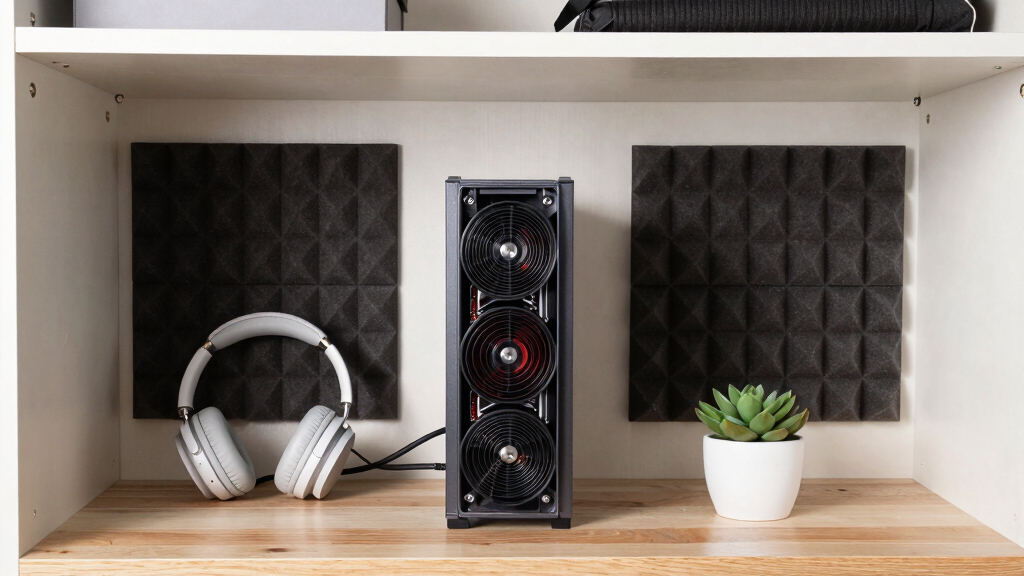
Experts emphasize that the most effective way to reduce noise from a high-power AI rig is to physically distance it from the workspace, such as placing it in another room or a dedicated closet. This method leverages the natural barrier of walls to block airborne noise, which foam and other acoustic treatments cannot fully contain.
The ‘rig in the closet’ approach involves placing the hardware in a sealed or semi-sealed space to contain noise. However, this setup requires careful ventilation. Without proper airflow, trapped heat can cause the machine to overheat, throttle, and increase fan noise, negating the benefits of placement. Active ventilation systems, including exhaust fans and ducted airflow, are recommended to dissipate heat effectively.
Acoustic foam, often purchased first by users, primarily absorbs sound reflections within a space and does little to block airborne noise or prevent structure-borne hums. Mechanical decoupling, such as rubber feet or grommets, can significantly reduce structure-borne noise transmitted through solid surfaces like desks or floors. Combining these measures with strategic placement yields the best results.
Acoustic dampening
& the rig in the closet.
The most powerful noise fix isn’t a material — it’s a floor plan. A rig you can’t hear because it’s in another room beats any amount of foam. Tap the approaches in Part 1 to see what actually works.
(another room)
(levers 1–4)
(door / barrier)
(acoustic foam)
Contain the noise, not the heat
Why Proper Placement and Ventilation Are Critical
Implementing effective placement strategies like moving the rig out of the workspace or into a ventilated closet can drastically improve working conditions by reducing noise and heat. This not only enhances comfort but also extends hardware lifespan by preventing overheating. As many AI workflows are network-based, physical proximity is less necessary, making these solutions practical and scalable for professionals and enthusiasts alike.

TroyStudio Portable Sound Proof Box, 16" x 12" x 16.2" Noise Reduction Enclosure, Light Blocking Quiet Cover, Soundproof Barrier for Ultrasonic Cleaner, Air Pump, Rock Tumbler & Generator
- Dimensions and Components: 16x12x16.2 inch enclosure with foam panels
- Noise Reduction Capability: Reduces noise up to 21.5dB, blocks frequencies above 400Hz
- Foldable and Lightweight Design: Collapsible to 16x12x10 inches, weighs 3.1 pounds
As an affiliate, we earn on qualifying purchases.
As an affiliate, we earn on qualifying purchases.
Current Best Practices for Minimizing AI Workstation Noise
Traditionally, users relied on acoustic foam and soundproof cases to contain noise. However, experts now advise that these are less effective than physical separation and proper airflow management. Moving the workstation into another room or a purpose-built soundproof cabinet with controlled ventilation is increasingly regarded as the most effective solution. This shift aligns with the understanding that airborne and structure-borne noises require different mitigation strategies.
The 'sealed closet' method has gained popularity, but only when combined with active cooling and ventilation systems. Without these, heat buildup can cause thermal throttling and increased fan noise, defeating the purpose of placement. This approach is especially relevant for high-power setups that generate hundreds of watts of heat continuously.
"The most effective noise reduction isn't acoustic foam — it's moving the rig into another room or a sealed, ventilated cabinet."
— Thorsten Meyer

VEVOR Room to Room Fan, Intake & Exhaust Dual Airflow Through-the-Wall Fan with Remote & Temperature Control, 300 CFM 10-Speed Ventilation Quiet In-Wall Vent for Living, Laundry Room Indoor
- Compatible Wall Thickness: 3.74 to 7.48 inches
- Dual Directional Airflow: 10-speed settings with temperature control
- High Performance Ventilation: Up to 300 CFM airflow
As an affiliate, we earn on qualifying purchases.
As an affiliate, we earn on qualifying purchases.
Uncertainties About Long-Term Ventilation and Heat Management
While best practices for placement and ventilation are well-established, the optimal configurations for different room sizes, hardware types, and noise levels are still evolving. The long-term reliability of various soundproof cabinets and custom ventilation solutions under continuous high load remains under study, and user experiences vary based on specific setups.

Focusound 52 Pack Acoustic Foam Panels 1" x 12" x 12" Sound Proof Foam Panles Soundproofing Noise Cancelling Wedge Panels for Home Office Recoding Studio with 300PCS Double-Side Adhesive
- Soundproofing Design: Triangular grooves for noise absorption
- Includes Adhesive Tape: 300pcs double-sided adhesive for easy installation
- Easy Shape Recovery: Reforms after soaking in water
As an affiliate, we earn on qualifying purchases.
As an affiliate, we earn on qualifying purchases.
Next Steps in Optimizing Quiet AI Workstation Setups
Developments are expected in integrated, purpose-built soundproof and ventilated enclosures that simplify setup and improve thermal management. Further research into passive cooling methods and smarter airflow control will help refine the 'rig in the closet' approach. Users should monitor advancements and consider custom solutions tailored to their hardware and environment.

Anti Slip Laptop Rubber Feet Pad Replacement for MacBook MacBook Pro 15PCS
- Self-adhesive backing: Strong adhesive for easy application
- Anti-slip design: Keeps laptop stable and in place
- Universal compatibility: Suitable for various laptops and devices
As an affiliate, we earn on qualifying purchases.
As an affiliate, we earn on qualifying purchases.
Key Questions
Is acoustic foam effective for reducing noise from AI workstations?
Acoustic foam primarily absorbs reflections within a room and does little to block airborne noise or prevent structure-borne hums. It is most effective when combined with placement and structural isolation techniques.
Can placing a rig in a closet cause overheating?
Yes, if not properly ventilated. Proper airflow, active exhaust fans, and ducted cooling are essential to prevent heat buildup and maintain safe operating temperatures.
Is a sealed soundproof cabinet a good solution?
Yes, when equipped with temperature-controlled exhaust and proper airflow, soundproof cabinets can contain noise while dissipating heat effectively. These are more expensive but highly effective for continuous high-power use.
How important is network connectivity for remote placement?
Very important. A reliable wired or strong wireless connection is necessary to access and control the rig remotely, especially when it is placed in another room or closet.
What are the main benefits of moving the rig out of the workspace?
The primary benefits are significantly reduced noise levels and improved thermal management, leading to quieter operation and longer hardware lifespan.
Source: ThorstenMeyerAI.com