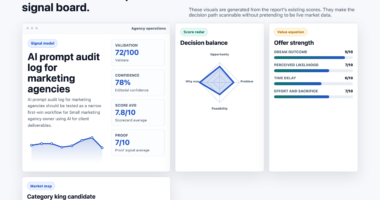
📊 Full opportunity report: The Forward-Deploy Pivot: Why Anthropic and OpenAI Are Becoming Consulting Firms in the Same Week on ThorstenMeyerAI.com — validation score, market gap, and execution plan.
TL;DR
Anthropic and OpenAI are launching new AI-native enterprise services companies, aiming to embed AI engineers directly into client operations. This shift challenges the traditional consulting industry and signals a broader move toward AI-driven outcomes in enterprise markets.
Anthropic and OpenAI have each announced the creation of new enterprise services companies that embed AI engineers directly into client organizations, marking a significant strategic shift in how AI is deployed in business.
On May 4, Anthropic disclosed the formation of a $1.5 billion AI-native enterprise services joint venture backed by major asset managers, aiming to embed its Applied AI engineers into mid-sized companies across sectors such as healthcare, manufacturing, and financial services. This firm is modeled after Palantir’s forward-deploy engineering approach.
Two days later, May 6, OpenAI announced a similar initiative called ‘DeployCo,’ backed by a consortium including TPG, Bain Capital, and others, with a valuation of $10 billion—significantly larger than Anthropic’s new entity. Both moves are seen as strategic efforts to position AI as a core component of enterprise transformation, especially in the mid-market segment.
These developments come amid reports that Anthropic is finalizing a $40-50 billion funding round, which could lead to an IPO as early as October 2026, with a valuation surpassing OpenAI’s recent $852 billion mark. The announcements are part of a broader narrative: companies are building integrated, outcome-focused AI solutions aimed at capturing a larger share of the global $1.4 trillion IT services market, challenging traditional consulting firms.
Same week.
Two consulting firms.
Anthropic and OpenAI synchronized $5.5B in commitments to rebuild the consulting industry from scratch — backed by ~$10 trillion in aggregate AUM.
May 4 · $1.5B Anthropic vehicle with Blackstone + Hellman & Friedman + Goldman Sachs as founding partners. OpenAI’s “DeployCo” announced hours earlier — $4B at $10B valuation, 6.7× larger. Both use Palantir’s forward-deployed engineering model. Captive customer pipeline through PE portfolio ownership = unprecedented enterprise software moat.
Two ventures. One opportunity.
The most concentrated assembly of private capital ever announced for AI services. Captive customer pipeline through PE portfolio ownership is the structural moat — when the PE firm owns both the services firm AND the customer, traditional buyer-seller dynamics break down.
- Anthropic$300M · founder
- Blackstone$300M · $1.3T AUM
- Hellman & Friedman$300M · $115B AUM
- Goldman Sachs AM$150M · $625B alts
- General Atlantic~$150M · $80B+
- Apollo + Leonard Green+ GIC + Sequoia
overlap
- OpenAI$500M · founder
- TPG$250B+ AUM
- Brookfield$1T+ AUM
- Bain Capital$185B+ AUM
- Advent International$90B+ AUM
- 15 unnamed investors$4B total commits
AI engineering consulting services
As an affiliate, we earn on qualifying purchases.
As an affiliate, we earn on qualifying purchases.
Four days. Four layers.
Each layer compounds the others. Compute enables deployment scale. Models provide capability. Templates productize workflows. Services firm provides delivery. PE pipeline provides customers. The blitz is coordinated IPO positioning ahead of Q4 2026.
enterprise AI deployment tools
As an affiliate, we earn on qualifying purchases.
As an affiliate, we earn on qualifying purchases.
Five tiers. Five trajectories.
The disruption is uneven by tier. Indian IT faces structural threat (cost-arbitrage labor model obsolescence). Big Four maintain Fortune 500 dominance. Strategy consultancies durable on judgment work. Palantir’s FDE model gets validation premium.

Project Management with AI For Dummies
As an affiliate, we earn on qualifying purchases.
As an affiliate, we earn on qualifying purchases.
Three scenarios. One restructuring.
Whether the captive customer model scales as projected or faces execution constraints. Both vehicles likely achieve material scale rather than one collapsing — the structural setup is overwhelming.
- 1,500-2,500 deploymentsBy end-2027 across portfolio.
- 3-6 month deliveryVs 12-18 months traditional.
- Big 4 mid-market compressesIndian IT down 30-40%.
- JV revenue $1-2B by 2028Material IPO contribution.
- Outcome: October 2026 IPO at $900B+. JV is bull case.
- 800-1,500 deploymentsBy end-2027.
- Bifurcated marketFDE entities + traditional SI both grow.
- Big 4 deepen alt-AI partnershipsAccenture+OpenAI; Deloitte+Google.
- JV revenue $400-800M by 2028Supporting narrative.
- Outcome: IPO proceeds. JV is one of several threads.
- Engineering scaling hardFDE talent the binding constraint.
- PE governance frictionMultiple sponsors create overhead.
- Big 4 defends aggressivelyPricing competition compresses.
- JV revenue $100-300M by 2028Underperforms projections.
- Outcome: IPO valuation hit. Potential 2027 delay.
This is the most aggressive enterprise distribution play in tech history, executed in synchronized fashion within hours of each other, backed by approximately $10 trillion in aggregate AUM. The captive customer move is the new structural moat for AI commercialization. Everything else is supporting infrastructure.
AI integration solutions for mid-sized companies
As an affiliate, we earn on qualifying purchases.
As an affiliate, we earn on qualifying purchases.
Four assignments. By role.
Track 90-180 day customer traction.
Anthropic IPO valuation case strengthens materially. The captive distribution channel adds structural multi-year revenue visibility worth plausibly $500M-$2B incremental ARR by Q4 2027. Q4 2026 IPO probability rises from ~50% pre-announcement to ~65-70% post-announcement. Verify execution before drawing valuation conclusions.
Form competing vehicles or cede captive economics.
KKR, Carlyle, Vista, Thoma Bravo, Silver Lake, Warburg Pincus face strategic choice. Form parallel vehicles with smaller AI labs (Mistral, Cohere, xAI) or with Microsoft/Google/Meta as model partners. Or accept structural disadvantage. The captive customer model is the new value-creation default.
Equity-aligned partnerships and vertical specialization.
Big 4 — deepen alt-AI partnerships (Accenture-OpenAI, Deloitte-Google likely). Indian IT — pivot to AI-native delivery aggressively or face 25-40% market cap compression. Mid-market integrators (EPAM, Genpact) face direct competition; vertical specialization in regulated industries (defense, government, large healthcare) is the defensible position.
PE-owned companies face accelerated AI deployment.
If your company is owned by Blackstone, H&F, Apollo, GA, Leonard Green, GIC, Sequoia — direct JV engagement arriving 12-24 months. If OpenAI DeployCo’s PE backers — same. Reskill toward judgment-intensive roles. The Atlassian template applies — workforce composition reshape, not just headcount cut. 15-25% restructuring across PE-portfolio companies over 2026-2030.
Strategic Shift Toward AI-Driven Enterprise Consulting
This move signifies a fundamental change in enterprise AI deployment, as Anthropic and OpenAI aim to replace or augment traditional consulting and systems integration firms with AI-native, embedded engineering teams. It highlights the growing importance of outcome-based AI services and signals potential disruptions in the multitrillion-dollar consulting industry, especially in the mid-market segment where traditional firms have limited reach. For investors and industry watchers, this indicates a shift toward vertically integrated AI solutions that could reshape enterprise transformation strategies and valuation models.Background of AI-Embedded Consulting and Market Dynamics
Historically, enterprise transformation has relied on large consulting firms like McKinsey, BCG, and the Big Four, with the global IT services market valued at around $1.4 trillion annually. These firms have provided strategic advice and systems integration, but their scope is limited in the fast-evolving AI landscape.
In recent years, AI companies like Anthropic and OpenAI have focused on developing foundational models such as Claude and GPT, initially for software and API services. Now, they are pivoting toward embedding AI engineers directly into client workflows, mimicking Palantir’s forward-deploy model, to deliver outcomes rather than just software. This approach aims to capture a larger share of the enterprise services market, especially in the mid-market segment, which is too small for the Big Four but too sophisticated for self-service software.
The strategic timing aligns with Anthropic’s expected IPO and the large funding rounds securing valuations that surpass OpenAI’s recent $852 billion, signaling confidence in their ability to scale these embedded services.
“The formation of these AI-native enterprise services entities marks a decisive shift toward embedding AI engineers into client operations, directly challenging traditional consulting models.”
— Thorsten Meyer
Unclear Details on Long-Term Market Impact
It remains uncertain how quickly traditional consulting firms will respond to these developments and whether AI-embedded models will achieve widespread adoption across all enterprise segments. The exact scope of the initial deployments and the competitive responses from firms like McKinsey or Accenture are still emerging.
Additionally, the long-term financial performance of these new entities and their ability to scale beyond initial mid-market clients are yet to be proven.
Next Steps in Deployment and Industry Reactions
Both Anthropic and OpenAI are expected to begin deploying their embedded engineering teams into pilot clients within the coming months, with early case studies and performance metrics likely to influence broader adoption. Industry reactions from traditional consulting firms and potential regulatory considerations are also anticipated.
Furthermore, the companies’ upcoming IPO plans and funding rounds will shed light on their valuation trajectories and strategic priorities, likely shaping the enterprise AI landscape for years to come.
Key Questions
How do these new AI services differ from traditional consulting?
They embed AI engineers directly into client operations to deliver outcomes, rather than providing only strategic advice or software deployment. This approach is more integrated and outcome-focused.
Will this shift threaten established consulting firms?
Yes, by targeting the mid-market segment with AI-native, embedded teams, these firms could capture a significant share of the revenue traditionally earned by large consulting and systems integration firms, especially as demand for AI-driven transformation grows.
What sectors are these new AI-native services targeting?
Initial focus is on healthcare, manufacturing, financial services, retail, and real estate—sectors with complex workflows and significant transformation needs.
When might these AI-embedded services become mainstream?
Deployment is expected to accelerate over the next 12-24 months, with early results and case studies influencing broader enterprise adoption and possibly prompting industry-wide shifts.
Could this impact the valuation of AI companies and their IPO prospects?
Yes, the success of these embedded service models could significantly boost valuations, as evidenced by Anthropic’s potential IPO and the high valuation of OpenAI’s DeployCo, signaling strong investor confidence in outcome-based AI enterprise models.
Source: ThorstenMeyerAI.com