
TL;DR

Get hardware and tech essentials delivered free — and shop member deals
- Fast, free delivery on millions of items
- Access to Prime Big Deal Days deals on October 6–7
- Prime Video, Amazon Music and more included
Researchers conducted a one-year outdoor test of perovskite tandem solar cells, observing a drop in efficiency from 17–18% to 13–14%. Key failure mechanisms include voltage loss and encapsulation delamination. These findings inform future stability improvements.
After one year of outdoor testing in Petten, the Netherlands, researchers confirmed that triple-junction perovskite/silicon solar cells experienced a significant efficiency decline from approximately 17–18% to 13–14%, primarily due to multi-stage degradation mechanisms. This is the first long-term outdoor performance data for such devices, which are considered promising for high-efficiency solar applications.
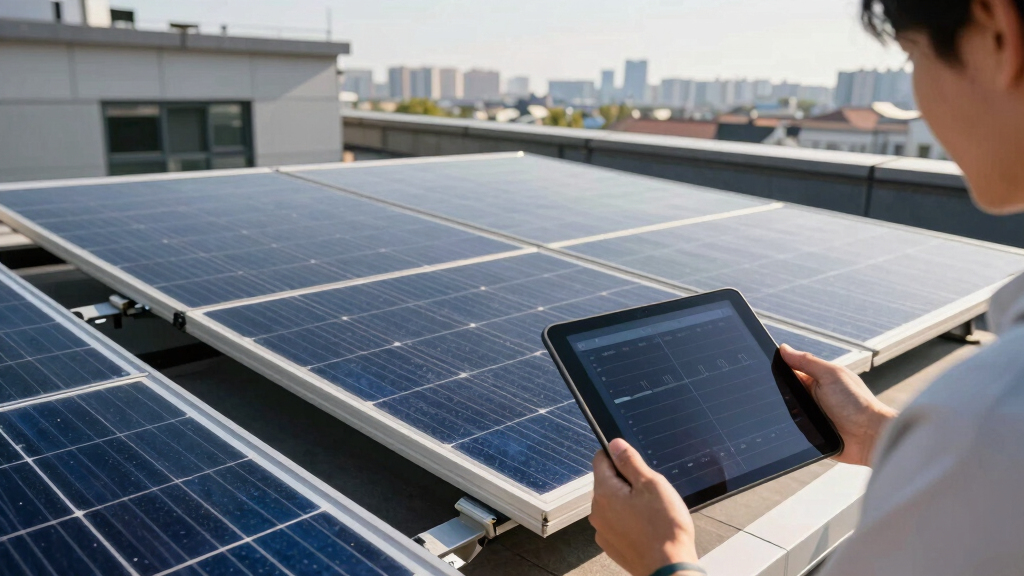
The testing involved monolithic triple-junction devices combining a silicon bottom cell with two stacked perovskite subcells, exposed under real-world conditions on a rooftop in Petten. Initial performance stabilized after a brief transient phase, but over the following months, efficiency steadily declined. The primary degradation was observed as voltage loss, with a secondary phase involving encapsulation delamination, which reduced light in-coupling and current collection. Microscopy revealed that delamination occurred within the encapsulation layers rather than at the active junctions, indicating mechanical or adhesion failures rather than moisture ingress. Spectral and electrical analyses showed that performance losses were mainly due to interface degradation and shunt pathways, not intrinsic absorber instability. Photoluminescence and electroluminescence imaging identified spatial inhomogeneities, with the middle perovskite layer maintaining current flow longer than the top junction, which weakened over time. Indoor tests confirmed good damp-heat stability but significant losses under thermal cycling and UV exposure, with UV exposure causing up to 65% degradation. Despite these issues, the devices maintained an estimated average annual efficiency of around 10%, with performance strongly influenced by irradiance and spectral conditions.
Implications for Long-Term Stability of Perovskite Tandem Cells
This study provides critical insights into the degradation pathways affecting perovskite tandem solar cells in outdoor conditions, highlighting that interface stability and encapsulation integrity are key challenges. Understanding these failure modes is essential for developing more durable devices, which is vital for commercial deployment. The findings suggest that current designs need improvements in mechanical adhesion and interface protection to achieve longer operational lifespans, influencing future research and industry standards for perovskite-based photovoltaics.
outdoor solar panel cleaning kit
As an affiliate, we earn on qualifying purchases.
As an affiliate, we earn on qualifying purchases.
Background on Perovskite Tandem Solar Cell Development
Perovskite tandem solar cells have gained attention due to their high theoretical efficiencies, with triple-junction configurations promising even greater performance. Prior to this study, most stability assessments focused on indoor or accelerated testing, with limited real-world outdoor data available. The recent testing by TNO and Fraunhofer ISE marks a significant step in understanding how these devices perform under actual environmental conditions over extended periods, which is critical for assessing their commercial viability.
“The samples achieved 80% of the initial power conversion efficiency after five months of outdoor operation, and 50% after seven months.”
— an anonymous researcher
solar panel encapsulation repair kit
As an affiliate, we earn on qualifying purchases.
As an affiliate, we earn on qualifying purchases.
Unresolved Questions on Long-Term Device Stability
It remains unclear how different encapsulation materials or device architectures might influence long-term stability. The precise mechanical failure modes and their relation to environmental stressors need further investigation. Additionally, the impact of spectral variability and real-world weather conditions on degradation pathways requires more comprehensive study to generalize these findings across different climates and deployment scenarios.
high-efficiency solar cell tester
As an affiliate, we earn on qualifying purchases.
As an affiliate, we earn on qualifying purchases.
Next Steps in Improving Perovskite Tandem Durability
Researchers plan to test modified device architectures with enhanced encapsulation and improved interface stability. Longer-term outdoor testing in diverse climates is also underway to validate these improvements. Industry efforts are expected to focus on developing scalable, mechanically robust modules capable of maintaining high efficiency over extended operational lifespans.
solar panel durability testing equipment
As an affiliate, we earn on qualifying purchases.
As an affiliate, we earn on qualifying purchases.
Key Questions
What are the main degradation mechanisms identified?
The primary failure modes include voltage loss, encapsulation delamination, and interface degradation, particularly at the charge transport layers and within the encapsulation stack.
How long do these devices maintain acceptable performance outdoors?
According to the study, devices retained about 80% of their initial efficiency after five months and roughly 50% after seven months of outdoor exposure.
Are these results typical for all perovskite tandem cells?
These results are specific to the tested triple-junction configuration and environmental conditions; different architectures or climates may yield different degradation profiles.
What can be done to improve long-term stability?
Enhancing encapsulation methods, improving interface adhesion, and developing more mechanically resilient device stacks are key strategies under investigation.
When will more durable perovskite tandem modules be available?
Further research and development are ongoing, with commercial-scale, long-lasting modules expected to require several more years of testing and optimization.
Source: PV Magazine
Fall Picks
fall essentials
As an affiliate, we earn on qualifying purchases.