📊 Full opportunity report: Parental Consent Workflows For Youth-Service Compliance on IdeaNavigator AI — validation score, market gap, and execution plan.

Get hardware and tech essentials delivered free — and shop member deals
- Fast, free delivery on millions of items
- Access to Prime Big Deal Days deals on October 6–7
- Prime Video, Amazon Music and more included
TL;DR
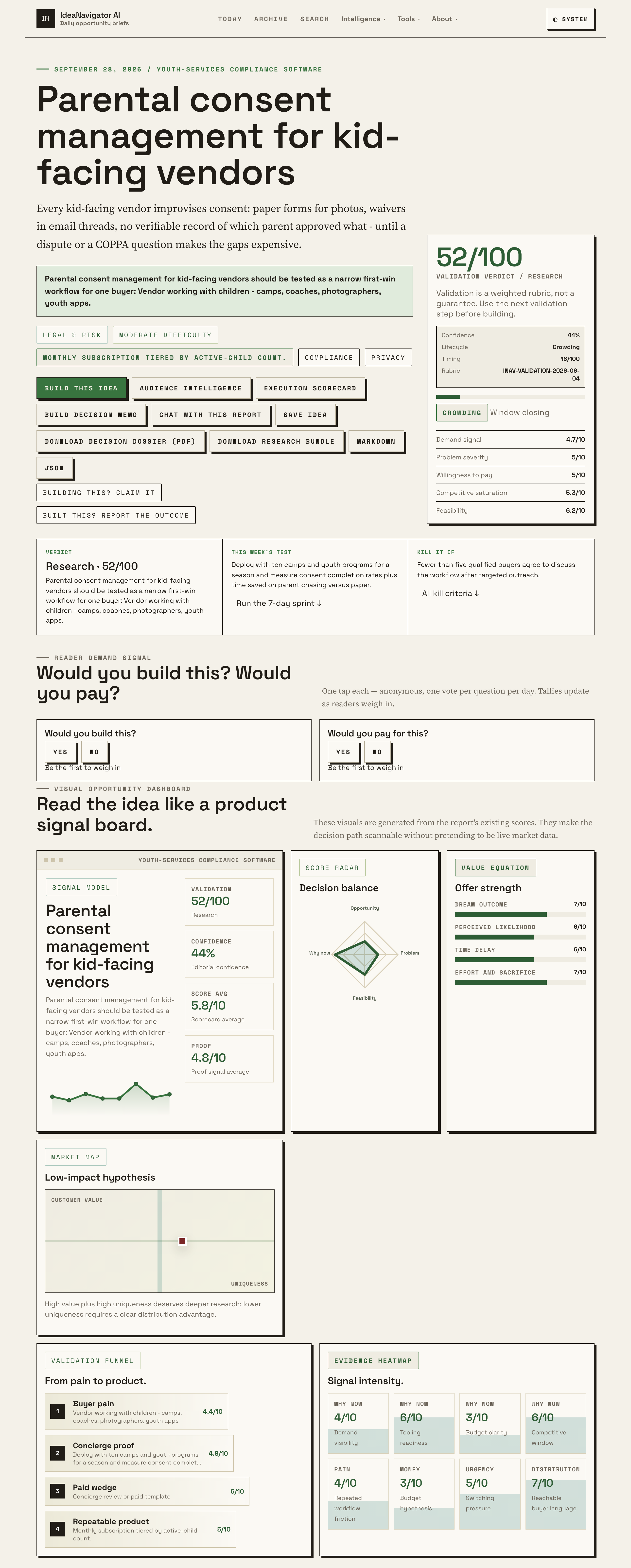
IdeaNavigator AI proposes testing a parental consent management service with camps and youth programs. The suggested pilot would track consent completion and time spent following up with parents; no deployments, results or regulatory endorsements are reported.
IdeaNavigator AI’s proposal outlines a phone-based parental consent service for camps and other vendors working with children, and suggests a pilot across ten camps and youth programs. According to the proposal, the product would record which parent approved which use. It reports no pilot launch, customer commitments or results.
IdeaNavigator AI identifies camps, coaches, photographers and youth apps as potential customers. Its proposal describes consent handling as fragmented: photo permissions may be on paper, waivers in email threads, and vendors may lack a readily verifiable record linking an approval to a parent, child and specific use. The proposal says such gaps can become costly during a dispute or a compliance question.
The suggested minimum product would let each vendor offer a branded consent form for parents to complete on a phone. The proposal lists photo use, data collection, medical information and liability as possible form topics. It also suggests identity checks matched to risk level, a per-child consent ledger, expiry tracking and an audit export. These are proposed features; IdeaNavigator AI reports no product release or independent assessment of how the checks would work.
IdeaNavigator AI proposes a monthly subscription tiered by active-child count. To test demand, it suggests deploying the service with ten camps and youth programs for one season, then measuring consent completion rates and time spent following up with parents compared with paper processes. The proposal gives no pricing, participating organizations, success thresholds or season dates.
Records for Child-Facing Services
A clear record of consent can matter to small organizations that collect information about children or use their images. As described in IdeaNavigator AI’s proposal, a ledger linking each decision to a child and a specific purpose could make it easier for staff to check permissions and answer parent questions. Its value would depend on whether records are accurate, accessible and kept current, and whether the workflow fits the organization’s legal obligations.
The proposal also points to operational costs: staff time spent collecting forms and following up with families. A season-long pilot could provide evidence on completion rates and time saved, two practical measures for vendors considering a subscription. Until such results are available, the suggested benefits remain a hypothesis rather than a demonstrated outcome.
Consent Handling Across Youth Programs
IdeaNavigator AI’s proposal responds to a familiar administrative challenge across services for children: permissions can be gathered through several channels and stored in different formats. Photo releases, health details, data collection permissions and liability waivers may involve different purposes, so a single record needs to make clear what a parent approved and whether that approval remains valid.
The proposal cites changing children’s privacy requirements, including updates to the U.S. Children’s Online Privacy Protection Rule, commonly known as COPPA, and state laws, alongside parents’ questions about image and data use. It does not identify particular statutes, jurisdictions or legal interpretations. A consent product would not by itself establish that a vendor complies with every applicable law.
Pilot Scope and Legal Fit
IdeaNavigator AI’s proposal does not say whether any camp or youth program has agreed to participate, when a pilot might begin, or whether a working product exists. It gives no baseline for current completion rates or parent-follow-up time, and sets no target for improvement. Without those details, the scale of the problem and the commercial demand remain unverified.
Several implementation questions are also open: what identity checks would be used at each risk level, how consent could be withdrawn, who could access the ledger, and how long records would be retained. The proposal does not describe security controls or explain how workflows would account for different legal requirements across locations and types of data.
A Season of Measured Testing
IdeaNavigator AI describes the next step as a one-season test with ten camps and youth programs. Participating organizations would compare consent completion and staff time spent pursuing forms against their existing paper process. The proposal does not say whether the pilot has been scheduled or identify a deadline for publishing findings.
If a pilot proceeds, its results could clarify whether vendors complete the forms more reliably and whether the time saved supports a recurring subscription. Details on participating programs, measurement methods, security practices and legal review would help readers assess the service’s readiness and relevance.
Source: IdeaNavigator AI
Key Questions
What is being proposed?
A phone-based system for vendors serving children to collect and track parent permissions for matters such as photos, data, medical information and liability.
Has the service launched?
No launch or operating product is reported. The proposal describes a minimum product and a possible pilot.
Who would test it?
IdeaNavigator AI suggests testing with ten camps and youth programs for one season. No participating organizations are named.
How would the pilot be evaluated?
The proposed measures are consent completion rates and staff time spent following up with parents, compared with paper processes.
Would using the system guarantee legal compliance?
No such guarantee is established. The proposal does not specify jurisdictions or legal requirements, and vendors would still need to meet obligations that apply to their activities.
Source: IdeaNavigator AI
Fall Picks
fall essentials
As an affiliate, we earn on qualifying purchases.