
📊 Full opportunity report: Loan covenant calendar for bootstrapped companies on IdeaNavigator AI — validation score, market gap, and execution plan.

Get hardware and tech essentials delivered free with Prime
- Fast, free delivery on millions of items
- Prime Video, Amazon Music and more included
- Member-only deals all year
TL;DR
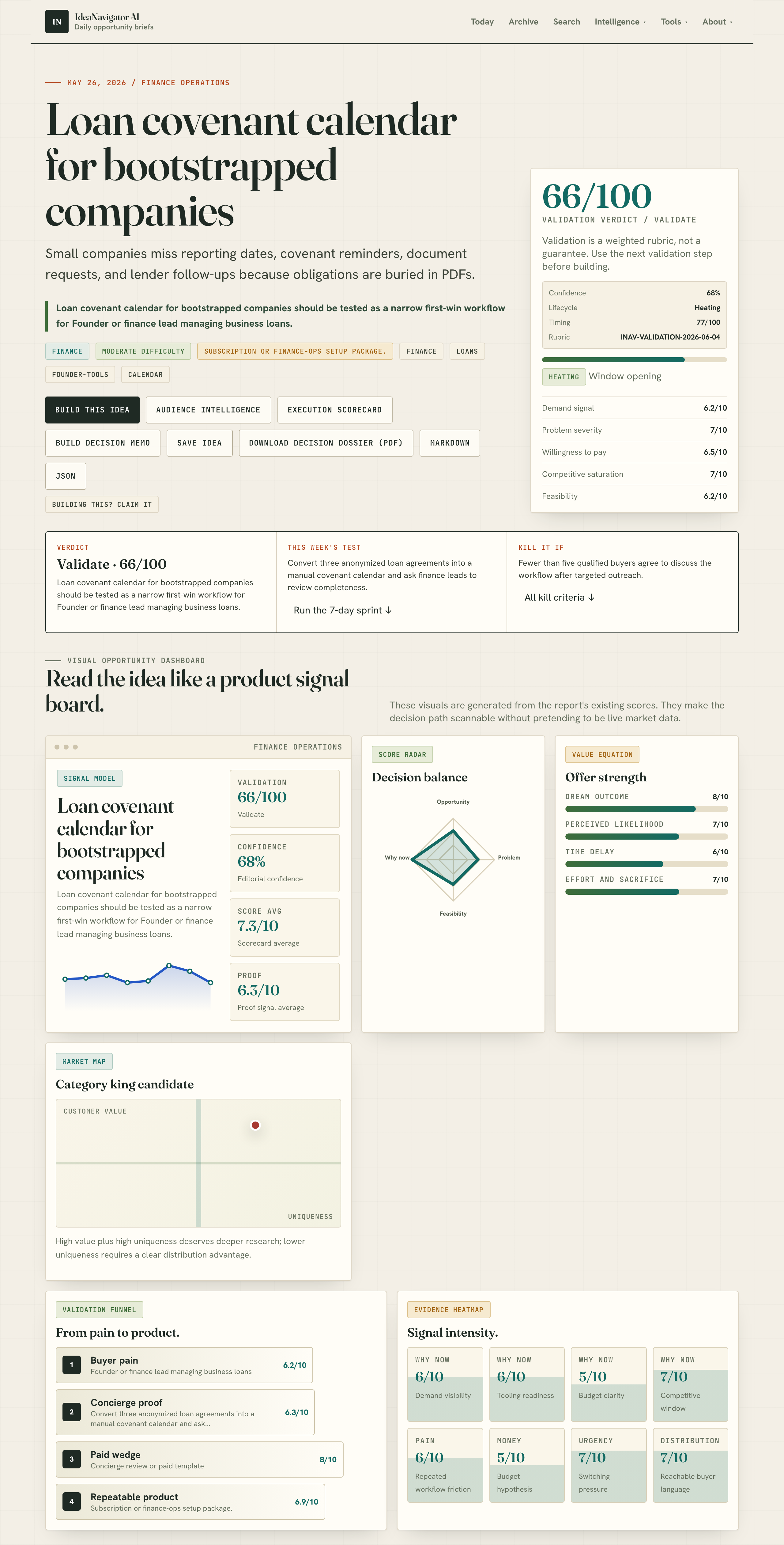
A prototype for a loan covenant calendar tailored for bootstrapped companies is entering testing. It aims to improve operational follow-up on loan obligations, addressing a key pain point for small businesses managing loans.
A new loan covenant calendar prototype is being tested specifically for bootstrapped companies to streamline the management of loan obligations, including reporting deadlines and document requests.
The initiative aims to address the common challenge small companies face in tracking loan covenants, which are often buried in PDFs and difficult to monitor manually. The prototype extracts key obligations, owners, due dates, evidence files, and lender communication history, offering a centralized workflow.
According to IdeaNavigator AI, the tool is currently in the validation stage, where three anonymized loan agreements are being converted into manual covenant calendars for review by finance leads. The goal is to assess whether the calendar captures all necessary obligations and improves operational follow-up.
Why Managing Loan Covenants Matters for Small Businesses
Effective management of loan covenants is increasingly critical for small, bootstrapped companies facing higher scrutiny from lenders. Missing reporting dates or failing to provide required documentation can lead to penalties or loan breaches, jeopardizing business stability. The proposed calendar aims to reduce these risks by automating and clarifying compliance obligations, potentially saving small companies from costly oversights.
Products Worth Considering

Apple MacBook Pro 14.2-inch with M5 Pro, 15-Core CPU, 16-Core GPU, 24GB Memory, 2TB SSD, Wi-Fi 7, Space Black

Apple MacBook Air 13-inch with M5 Chip, 16GB Memory, 512GB SSD, Midnight

Logitech MX Mechanical Wireless Illuminated Keyboard, Tactile Quiet, Graphite
As an affiliate, we earn on qualifying purchases.
Growing Financial Oversight Elevates Need for Better Covenant Management
Small businesses often rely on informal or manual methods to track loan covenants, which can lead to missed deadlines and compliance issues. As lenders tighten scrutiny and regulatory requirements increase, operational follow-through becomes more vital. The concept of a covenant calendar emerges amid this environment, seeking to automate and streamline covenant management, a pain point highlighted by recent industry feedback.
“Managing loan covenants manually is error-prone and time-consuming for small companies, especially as obligations become more complex.”
— an anonymous researcher
Uncertain Aspects of the Covenant Calendar Prototype
It is not yet clear how effectively the prototype will integrate with existing financial systems or whether it will be adopted widely by small companies. The validation process is ongoing, and results are still being analyzed to determine its potential impact on operational efficiency and compliance accuracy.
Next Steps for Developing and Validating the Covenant Tool
The next phase involves completing the review of the three converted loan agreements, gathering feedback from finance leads, and refining the calendar’s features. If successful, the tool could be offered as a subscription service or part of a finance operations setup package, with broader testing planned in the coming months.
Key Questions
What is a loan covenant calendar?
A loan covenant calendar is a tool that tracks and manages the obligations, deadlines, and documentation required by loan agreements, helping companies stay compliant and avoid breaches.
Why is this tool important for small, bootstrapped companies?
Small companies often lack dedicated compliance teams and rely on manual methods, which can lead to missed deadlines and penalties. An automated calendar simplifies this process and reduces risks.
How is the prototype being tested?
It is being tested by converting anonymized loan agreements into manual covenant calendars and reviewing their completeness and usability with finance leads.
When might this tool be available commercially?
If validation is successful, the tool could be launched as a subscription product or included in finance operations packages within the next several months.
What challenges remain for this development?
Key uncertainties include integration with existing financial systems, user adoption, and whether the tool can reliably capture all obligations across different loan agreements.
Source: IdeaNavigator AI