AI is now actively helping exploration teams uncover Antarctica’s hidden under-ice secrets. Advanced systems analyze satellite images and deploy AI-powered drones, reducing the time needed to detect and map features beneath the ice. AI also enhances the study of ice cores and models ice sheet movements, offering new insights into climate change and sea-level rise. As technology evolves, you’ll discover how these developments are transforming our understanding of Antarctica’s icy frontier.

Get hardware and tech essentials delivered free with Prime
- Fast, free delivery on millions of items
- Prime Video, Amazon Music and more included
- Member-only deals all year
Key Takeaways
- AI systems analyze surface and subsurface ice features to uncover hidden dynamics beneath Antarctica’s ice sheets.
- Advanced AI models, including C-GANs, improve image resolution for detailed under-ice exploration.
- Integration of AI with remote sensing enables real-time detection of ice melt and basal conditions.
- AI accelerates ice core analysis, revealing climate history and under-ice environmental changes.
- Machine learning decodes ice sheet movement, identifying potential instability zones beneath the ice.
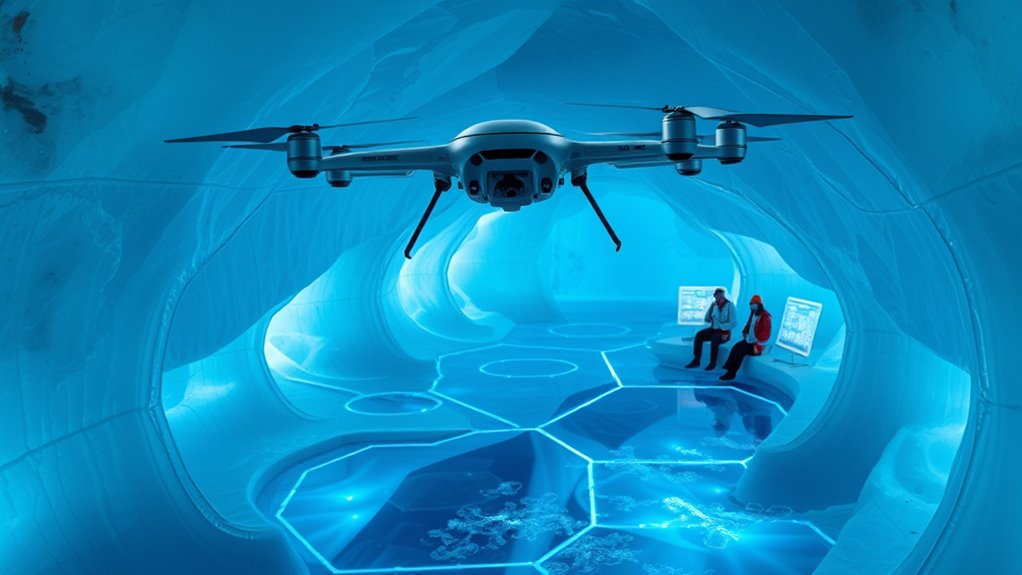
Artificial intelligence is transforming how scientists explore Antarctica’s hidden under-ice world, providing new tools to uncover its secrets. Thanks to a $300,000 NSF grant, researchers are developing advanced AI systems to analyze surface ice imagery from satellites and remote sensors. These AI tools, particularly conditional generative adversarial networks (C-GAN), improve image resolution and accuracy by modeling Antarctic-specific features like meltwater and temperature variations. This approach tackles the challenges posed by the continent’s vast size and frequent image obstructions such as blowing snow, enabling more reliable monitoring. Better data helps scientists predict ice melt patterns more precisely and understand how they influence global climate systems. The ability to generate higher quality, timely information is essential for tracking climate trends and informing policy decisions. This project also aims to establish a scalable framework for real-time ice monitoring, which could be adapted for other polar regions. Since 2023, AI has also revolutionized climate research in Antarctica through its integration with drones and remote sensing technology. Autonomous AI-powered drones deployed at Rothera Station reduce research-related CO2 emissions by up to 90%, all while collecting frequent, accurate data on atmospheric and glacial changes. AI accelerates data processing speeds well beyond what humans can accomplish, making real-time environmental monitoring feasible. This rapid analysis supports more frequent and precise observations, revealing subtle climate shifts that might otherwise go unnoticed. These insights are indispensable for breakthroughs in understanding Antarctica’s climate dynamics. Complementing these efforts, recent drilling projects have retrieved more than 1.2 million-year-old ice cores, which are now being analyzed with AI tools to provide a deeper understanding of climate variations over millennia.
AI-driven satellite imagery enhances Antarctic ice monitoring and climate predictions through advanced modeling and improved accuracy.
AI also plays a critical role in studying the seafloor ecosystems beneath the Antarctic ice. The British Antarctic Survey has developed AI systems that analyze seafloor photos and videos, reducing animal detection from hours to seconds per image. This automation allows scientists to label species in near real-time on research vessels and map habitats of over 94% of Southern Ocean species found solely in Antarctic seafloor ecosystems. Such efficiency enables broader spatial surveys, essential for identifying vulnerable species threatened by climate change and human activity. These advances greatly enhance marine biological research and conservation efforts by providing rapid, comprehensive data.
Meanwhile, researchers at Stanford are applying machine learning to decode the physics of ice sheet movements. By combining satellite and aerial data, they uncover complexities in ice dynamics that current models often overlook. Their discoveries of thawed or near-thawed basal zones in East Antarctica suggest potential instability, potentially increasing ice loss rates and contributing more substantially to sea-level rise. These insights improve projections of how Antarctic ice will respond to climate change, helping predict future global sea levels more accurately. Additionally, AI combined with geostatistics produces high-resolution winter snow depth maps of sea ice, enhancing understanding of snow distribution’s role in sea ice stability and climate interactions. All these innovations demonstrate how AI is becoming an indispensable tool for unraveling Antarctica’s under-ice mysteries, shaping our understanding of one of the planet’s most critical and least understood environments.
Frequently Asked Questions
How Does AI Analyze Sub-Ice Data Effectively?
You can see how AI analyzes sub-ice data effectively by processing vast datasets from radar sounding, satellite, and airborne observations. Machine learning algorithms identify patterns, infer ice properties, and map subglacial topography more accurately. They optimize models of subglacial hydrology and detect hidden features like lakes. AI’s ability to integrate diverse data sources helps you predict ice sheet behavior, improving understanding of under-ice conditions and future changes.
What Sensors Are Used to Gather Under-Ice Information?
You use sonar sensors to map the under-ice topography and structure, helping you visualize hidden features beneath the ice. Chemical sensors measure water chemistry, including dissolved oxygen and salinity, giving insights into sub-ice environments. Biological sensors detect microorganisms and biodiversity, while physical sensors record temperature and pressure data for environmental profiling. Recently, you’ve added sensors focused on sea ice physics and ice shelf melting to deepen your understanding of these dynamic processes.
How Does AI Improve Safety During the Expedition?
You notice how AI keeps you safe during your expedition. It forecasts sea ice and detects crevasses early, helping you avoid hazards. AI monitors environmental conditions in real-time, allowing you to adjust routes dynamically. It reduces errors by supporting decision-making and tracking fatigue among your team. Plus, AI integrates diverse data sources, giving you a clear picture of risks, so you can focus on exploration without unnecessary worry.
What Challenges Do AI Systems Face in Extreme Cold?
You face significant challenges with AI systems in extreme cold, as low temperatures degrade battery capacity and cause mechanical brittleness, risking hardware failure. Cold also affects sensor calibration and data accuracy, while prolonged darkness hampers solar power. Additionally, ice and frost can impair optical systems, and thermal stress from environmental cycles requires rugged enclosures. Managing energy efficiently and ensuring hardware resilience are vital for AI to operate reliably in these harsh conditions.
How Will Findings Impact Climate Change Understanding?
A stitch in time saves nine, and these findings will profoundly shape your understanding of climate change. You’ll see how Antarctic ice loss accelerates sea-level rise and impacts global climate systems. With new data on ice melt and shifting sea ice, your models will become more precise. Recognizing the interconnectedness of wind patterns, ocean temperatures, and ice dynamics helps you better predict future scenarios and emphasizes the urgency for action.
Conclusion
As you stand at the edge of this icy frontier, AI becomes your guiding light beneath the frozen veil, illuminating mysteries hidden in the shadowy depths. Together, you and this digital explorer dance through icy corridors, unraveling secrets locked in time. With every discovery, the Antarctic’s silent stories awaken, echoing like a heartbeat in the vast, icy wilderness. This expedition isn’t just a journey—it’s a symphony of curiosity, forging a new chapter in Earth’s frozen history.
Columbus Day / Indigenous Peoples' Day Picks
long weekend sales
As an affiliate, we earn on qualifying purchases.