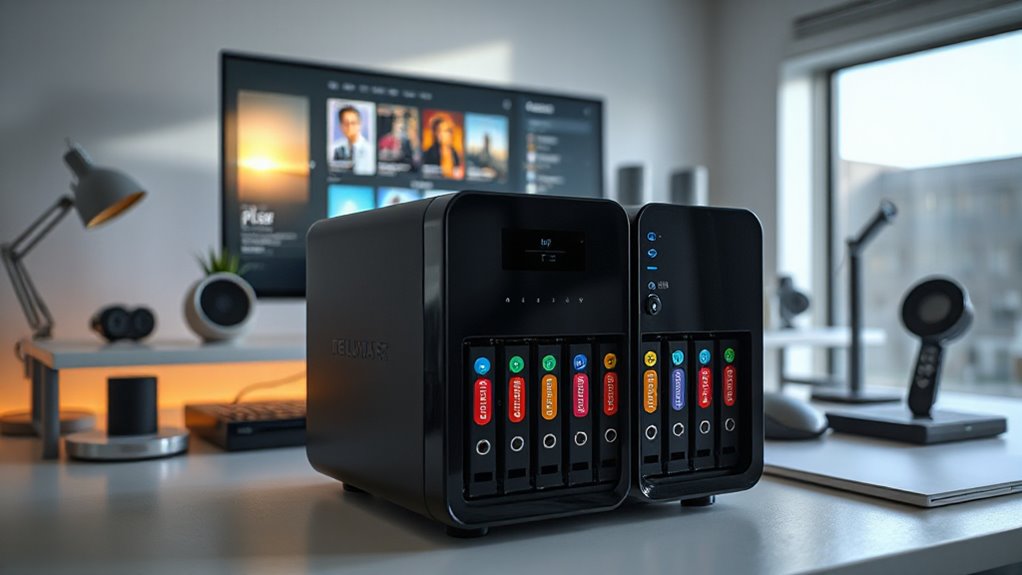

Finding the right NAS for Plex and backups involves balancing performance, storage capacity, and ease of use. The Synology DS925+ stands out as the overall best for its powerful hardware and user-friendly interface. For those on a budget, the Yxk Zero1 2-Bay offers solid features at a lower price, though it has limited expandability. The main tradeoffs in this category often involve choosing between higher performance and larger storage versus simplicity and affordability. Keep reading for a detailed breakdown of each option to find the best fit for your media and backup needs.

Get hardware and tech essentials delivered free with Prime
- Fast, free delivery on millions of items
- Prime Video, Amazon Music and more included
- Member-only deals all year
Key Takeaways
- Multiple bay configurations (2, 4, 6-bay) cater to different storage needs and scalability.
- Diskless models provide flexibility but require compatible drives, adding initial setup complexity.
- Intel-based NAS devices offer better transcoding performance for Plex streaming.
- Budget options often sacrifice advanced features but remain suitable for simple backups and media serving.
- Brand reputation and software ecosystem, like Synology DSM, significantly influence long-term usability.
| UGREEN DXP4800 Plus 4-Bay NAS for Families, Creators & Small Teams |  | Best Overall for Versatile Small-Scale Collaboration | Storage Capacity: Up to 144TB | Number of Bays: 4 | Compatibility: Windows, macOS, Linux, iOS, Android, Google services | VIEW ON AMAZON | See Our Full Breakdown |
| Yxk Zero1 2-Bay Desktop NAS for Home & Personal Storage (Diskless) |  | Best for Beginners and Personal Users | Number of Bays: 2 | Connectivity: 2.5GbE | Weight: 2kg | VIEW ON AMAZON | See Our Full Breakdown |
| Synology DS225+ Private Cloud Media Server – 2-Bay Diskless NAS with Intel CPU |  | Best for Media Streaming and Automated Backups | Storage Bays: 2 | CPU: Intel | Transfer Speed: 282 MB/s | VIEW ON AMAZON | See Our Full Breakdown |
| TERRAMASTER F2-425 Plus NAS 2-Bay Intel N150 4-Core CPU 8GB DDR5 (Diskless) |  | Best for High-Performance Data Management and Small Business Use | Number of Bays: 2 | Processor: Intel N150 Quad-Core | Memory: 8GB DDR5 | VIEW ON AMAZON | See Our Full Breakdown |
| UGREEN NAS DXP2800 2-Bay for Advanced Home Users, Remote Workers & Creators |  | Best for Power Home Users and Creators with AI Surveillance | Digital Storage Capacity: 80 TB | Hard Disk Interface: SATA | Connectivity Technology: SATA | VIEW ON AMAZON | See Our Full Breakdown |
| Synology DS225+ 2-Bay DiskStation NAS with 8TB Bundle (Intel Celeron J4125, 2GB DDR4, Dual Gigabit Ethernet) |  | Best Overall for Small Home Users and Beginners | Processor: Intel Celeron J4125 | Memory: 2 GB DDR4, expandable to 6 GB | Drive Bays: 2 | VIEW ON AMAZON | See Our Full Breakdown |
| TERRAMASTER F6-424 NAS 6-Bay, Intel N95 4-Core CPU, 8GB DDR5 (Diskless) |  | Best for Small to Medium Business Backup and Multi-User Plex Streaming | CPU: Intel N95 4-core, 3.4GHz (turbo) | Memory: 8GB DDR5 | Number of Bays: 6 | VIEW ON AMAZON | See Our Full Breakdown |
| Synology 2-Bay DiskStation DS223j (Diskless) |  | Best for Budget-Conscious Home Users and Basic Backups | Storage Type: Diskless | Number of Bays: 2 | Warranty: 2 years | VIEW ON AMAZON | See Our Full Breakdown |
| Synology 4-Bay DiskStation DS925+ (Diskless) |  | Best for Power Users Requiring High-Speed Data Transfers and Versatility | Drive Bays: 4 | Network Ports: 2 x 2.5GbE | Sequential Read/Write: 522/565 MB/s | VIEW ON AMAZON | See Our Full Breakdown |
| ACEMAGIC NAS Mini PC N3A 4-Bay Desktop Network Attached Storage |  | Best for Advanced Users Needing High Capacity and Customization | Storage Capacity: up to 136TB | Number of Bays: 4 | Supported Operating Systems: Windows 11 Pro, TrueNAS, Unraid | VIEW ON AMAZON | See Our Full Breakdown |
| Synology DS124 Personal Backup & File Hub – 1-Bay Diskless NAS |  | Best for Personal Backup & Home Security | Storage Capacity: Diskless | Number of Bays: 1 | Warranty: 2 years | VIEW ON AMAZON | See Our Full Breakdown |
| UGREEN NAS DH2300 2-Bay Personal Storage for Beginners & Personal Users |  | Best for Beginners and Personal Storage | Capacity: Up to 64TB | Number of Bays: 2 | Processor: High-performance processor | VIEW ON AMAZON | See Our Full Breakdown |
| Asustor Drivestor 4 Gen 2 AS1204T 4-Bay NAS |  | Best for Home & Small Office Data Management | Processor: Realtek RTD1619B 1.7GHz Quad-Core | RAM: 1GB DDR4 | Network: 2.5GbE port | VIEW ON AMAZON | See Our Full Breakdown |
| UGREEN NAS DXP4800 GT 4-Bay Network Storage for Creators and Office Teams |  | Best for Power Users and Small Businesses | Processor: AMD Ryzen Embedded R2514, 4 cores | RAM: 8GB DDR4, expandable to 64GB | Storage Capacity: Up to 144TB | VIEW ON AMAZON | See Our Full Breakdown |
More Details on Our Top Picks
UGREEN DXP4800 Plus 4-Bay NAS for Families, Creators & Small Teams
The UGREEN DXP4800 Plus stands out as the most flexible option for small teams, families, and creators who need substantial storage and advanced features like Docker and virtual machines. Compared with the Synology DS225+, it offers higher capacity and faster transfer options, making it more suitable for demanding tasks. However, its reliance on wired Ethernet and the absence of included drives mean setup is less straightforward and requires additional investment. The support for multiple OS and secure encryption makes it ideal for those who prioritize privacy and multi-device access. The main tradeoff is that it demands a more complex setup and higher initial costs, but its performance and scalability justify these for active users.
Pros:- Up to 144TB of storage capacity for growing data needs
- High transfer speeds with 10GbE and USB 3.2 ports
- Supports Docker, virtual machines, and secure private cloud access
- Reliable encryption for data security
Cons:- Hard drives are not included, increasing initial setup costs
- Supports wired Ethernet only, no integrated Wi-Fi
- Transfer speeds can vary depending on network setup
Best for: Small businesses, creative teams, or tech-savvy families needing high capacity and advanced virtualization features
Not ideal for: Casual home users or those seeking plug-and-play simplicity, since drives are not included and setup is more involved
- Storage Capacity:Up to 144TB
- Number of Bays:4
- Compatibility:Windows, macOS, Linux, iOS, Android, Google services
- Transfer Speed:10GbE network port or 10Gbps USB ports
- Encryption:Advanced encryption
- Warranty:2 years
Our verdict“This NAS makes the most sense for users who need robust performance with room to grow and are comfortable with more complex setup processes.”
Yxk Zero1 2-Bay Desktop NAS for Home & Personal Storage (Diskless)
The Yxk Zero1 provides an accessible, straightforward solution for personal storage and home backups. Compared to the Synology DS225+, it offers similar high-speed 2.5GbE connectivity but with a more simplified setup aimed at beginners. Its compact, quiet design makes it ideal for home environments, and support for RAID and snapshots enhances data protection. The downside is that you must purchase hard drives separately, which may complicate initial setup for less tech-savvy users. It lacks advanced virtualization or media features but excels at providing reliable, easy-to-use storage for personal files and backups without the need for extensive configuration.
Pros:- Easy to set up and operate for beginners
- High-speed 2.5GbE connectivity supports fast data transfer
- Compact, quiet, and space-efficient design
- Supports RAID and snapshots for data protection
Cons:- Requires separate purchase of hard drives
- Limited to personal and home use, lacking advanced features
- No included drives, so initial setup can be more costly
Best for: Home users, families, or casual tech users seeking simple, reliable backup and media storage
Not ideal for: Power users or small teams requiring virtualization, high throughput, or extensive multi-device access, due to its basic feature set
- Number of Bays:2
- Connectivity:2.5GbE
- Weight:2kg
- Compatibility:Windows, macOS, iOS, Android
- Supports:Docker, RAID modes, snapshots
- Warranty:2 years
Our verdict“This NAS is perfect for users who want a simple, reliable solution for personal backups and media without complex features or enterprise capabilities.”
Synology DS225+ Private Cloud Media Server – 2-Bay Diskless NAS with Intel CPU
The Synology DS225+ offers a balanced mix of media capabilities and data protection, making it well-suited for users who want seamless media streaming alongside reliable backups. Its support for 4K media and AI-driven surveillance features makes it stand out from competitors like the Yxk Zero1, which lacks media streaming. While being diskless adds flexibility, it also means additional investment for drives and a more complex setup process. Its three-year warranty and robust software ecosystem provide peace of mind, but beginners may find the initial setup somewhat daunting. Overall, this model excels at private cloud storage with media capabilities for households or small offices that need multi-purpose functionality.
Pros:- Supports 4K media streaming and private cloud storage
- Automated, multi-layered backups for data security
- Supports up to 30 IP cameras with AI detection
- Three-year warranty and strong software support
Cons:- Requires separate hard drives, adding to cost and setup time
- More complex initial setup for beginners
- Limited to 2 bays, restricting future expansion
Best for: Home users or small offices prioritizing media streaming, surveillance, and automated backups
Not ideal for: Users seeking plug-and-play simplicity or needing high scalability, due to its 2-bay design and setup complexity
- Storage Bays:2
- CPU:Intel
- Transfer Speed:282 MB/s
- Warranty:3 Years
- Supports:4K media, AI surveillance
- Additional Features:Automated backups, remote access
Our verdict“This NAS is ideal for multimedia-focused users who want integrated surveillance and reliable cloud backups but are comfortable with initial configuration.”
TERRAMASTER F2-425 Plus NAS 2-Bay Intel N150 4-Core CPU 8GB DDR5 (Diskless)
The TERRAMASTER F2-425 Plus offers a compelling blend of high performance and expandability for users who need fast data access and versatile applications. Its quad-core Intel N150 CPU and 8GB DDR5 RAM outperform many small NAS units like the Yxk Zero1, especially in multitasking and data throughput. Triple M.2 SSD slots provide flexible caching options, while dual 5GbE ports support link aggregation for maximum speeds. It’s best suited for small businesses or power users comfortable with technical configuration who want robust hardware and future-proof features.
Pros:- Dual 5GbE LAN ports support link aggregation for faster transfers
- Triple M.2 SSD slots enable caching or storage expansion
- Robust, durable aluminum chassis with hot-swappable HDD trays
- High-performance quad-core CPU and 8GB DDR5 memory
Cons:- Moderate customer ratings indicate some software or setup issues
- No included disks, requiring separate purchase
- Setup complexity may challenge beginners
Best for: Small business owners, creative teams, or advanced home users needing high throughput and flexible caching
Not ideal for: Casual users or those seeking simple plug-and-play solutions, due to its complex setup and higher price point
- Number of Bays:2
- Processor:Intel N150 Quad-Core
- Memory:8GB DDR5
- Storage Capacity:Up to 84TB (2× HDD + 3× M.2 SSD)
- Network Interfaces:2× 5GbE LAN ports
- M.2 Slots:3
Our verdict“This NAS suits tech-savvy users who need high-speed data handling and extensive customization options for small business or demanding home environments.”
UGREEN NAS DXP2800 2-Bay for Advanced Home Users, Remote Workers & Creators
The UGREEN DXP2800 is designed for users who demand high performance and security at home, blending powerful hardware with AI surveillance and multi-device data management. Its support for up to 80TB of storage and compatibility with various OS makes it versatile, especially for creators and remote workers needing reliable backups and media hosting. Compared to the Yxk Zero1 or Synology DS225+, it offers more advanced security features and hardware power, but at the cost of more complex setup and higher purchase price for drives. Its rugged design and AI features distinguish it from simpler NAS options, making it ideal for those who need both high capacity and security.
Pros:- Supports up to 80TB storage capacity for extensive data needs
- Powerful hardware suited for media, virtual machines, and heavy workloads
- Includes AI-powered surveillance features for enhanced security
- Compatible across multiple OS and devices
Cons:- HDDs and SSDs are sold separately, increasing initial costs
- Requires selecting compatible storage devices and configuring setup
- Advanced features can be overwhelming for casual users
Best for: Advanced home users, remote workers, or creators needing large storage with AI surveillance and heavy workloads
Not ideal for: Casual users or those seeking straightforward, plug-and-play solutions, as it involves more complex setup and extra hardware costs
- Digital Storage Capacity:80 TB
- Hard Disk Interface:SATA
- Connectivity Technology:SATA
- Shock Resistance:Yes
- Hardware Connectivity:Ethernet, SATA 6.0 Gb/s, USB
- Hardware Platform:x86
Our verdict“This NAS is tailored for power users who need high capacity, security, and performance in a home or creative environment willing to handle a more involved setup.”
Synology DS225+ 2-Bay DiskStation NAS with 8TB Bundle (Intel Celeron J4125, 2GB DDR4, Dual Gigabit Ethernet)
The Synology DS225+ stands out for its user-friendly DSM OS combined with flexible storage management via Synology Hybrid RAID, making it ideal for home users who want reliable Plex streaming and backups without complexity. Compared with the Synology DS223j, it offers better expandability and performance, though at a slightly higher price and with a more involved setup process. The included 8TB Seagate IronWolf drives provide ready-to-use storage, and the upgrade path to 6GB of RAM boosts multitasking for Plex and backups. However, it’s limited to only two drive bays, which constrains long-term growth, and it lacks additional accessories or advanced backup features out of the box. This pick makes the most sense for users seeking a straightforward, expandable, and reliable NAS for multimedia and backups at home.
Pros:- Easy-to-use DSM interface with excellent app support
- Supports third-party drives with latest DSM 7.3
- Includes reliable 8TB IronWolf drives for immediate use
- Expandable RAM up to 6GB enhances multitasking
Cons:- Limited to 2 drive bays, restricting storage expansion
- No advanced backup or virtualization features included
Best for: Small home users or beginners who prioritize ease of use, reliable media streaming, and basic backups.
Not ideal for: Power users needing large-scale storage or enterprise-level redundancy, due to its limited bays and feature set.
- Processor:Intel Celeron J4125
- Memory:2 GB DDR4, expandable to 6 GB
- Drive Bays:2
- Included Drives:2 x 4TB Seagate IronWolf
- Network Ports:1 x 2.5 GbE, 1 x 1 GbE RJ-45
- Supported Drives:Third-party drives with DSM 7.3
Our verdict“This NAS suits small-scale home users who want a dependable, user-friendly Plex and backup solution with room to grow within its two-bay limit.”
TERRAMASTER F6-424 NAS 6-Bay, Intel N95 4-Core CPU, 8GB DDR5 (Diskless)
The TERRAMASTER F6-424 offers a robust 6-bay platform with a powerful Intel N95 quad-core CPU and 8GB DDR5 RAM, making it well-suited for demanding Plex media serving and comprehensive backups in small business environments. Unlike the Synology DS925+ which excels in high-speed transfers, the F6-424 emphasizes flexibility with multiple RAID options, including RAID 5/6 for redundancy and performance. Its dual 2.5G Ethernet ports support fast network speeds, and the tool-free SSD slots simplify upgrades. Still, it’s a bare-bones case without drives included, which adds to initial costs, and the setup process may challenge less technical users. This NAS makes the most sense for users who want a high-performance, scalable storage solution with advanced RAID and backup options, but who are comfortable with DIY assembly and configuration.
Pros:- High-performance CPU and DDR5 memory for fast processing
- Multiple RAID options support redundancy and performance
- Easy SSD installation with tool-free design
- Dual 2.5G Ethernet ports for fast, redundant network connectivity
Cons:- No included disks, increasing initial setup cost
- Complex setup may be challenging for less experienced users
Best for: Small business owners or advanced users needing flexible, high-capacity storage with strong redundancy for Plex and backups.
Not ideal for: Beginners or those seeking an all-in-one solution with minimal setup, as it requires additional drives and technical knowledge.
- CPU:Intel N95 4-core, 3.4GHz (turbo)
- Memory:8GB DDR5
- Number of Bays:6
- RAID Support:RAID 0/1/5/6/10/JBOD/Single
- Ethernet Ports:Dual 2.5G
- Form Factor:Diskless
Our verdict“This NAS is best for users needing a scalable, high-performance backup and Plex server with advanced RAID options and comfort with assembly.”
Synology 2-Bay DiskStation DS223j (Diskless)
The Synology DS223j offers a straightforward, cost-effective solution for small households seeking secure private cloud storage and simple media sharing. Its diskless design means users must purchase drives separately, which can increase total cost but allows tailored storage capacity. Compared with the DS225+ bundle, it lacks the same processing power for media transcoding but shines in affordability for basic backup tasks. The device supports automated backups across multiple platforms and can be integrated into a home security setup with supported cameras. Its limited to two bays, however, making it less suitable for growing storage needs or intensive Plex streaming. This NAS makes sense for users prioritizing budget, simplicity, and reliable backups over advanced features.
Pros:- Affordable entry point into private cloud storage
- Supports automated backups for multiple devices
- Good for basic media sharing and security camera integration
- Synology’s user-friendly DSM interface
Cons:- Requires additional drives, increasing initial cost
- Limited to 2 bays, restricting storage expansion
Best for: Home users or small households needing affordable, secure backups and basic media sharing.
Not ideal for: Power users or media enthusiasts requiring high-speed streaming or large storage capacity.
- Storage Type:Diskless
- Number of Bays:2
- Warranty:2 years
Our verdict“This NAS is ideal for budget-conscious users seeking simple, reliable backups and private cloud access without advanced features.”
Synology 4-Bay DiskStation DS925+ (Diskless)
The Synology DS925+ delivers strong performance with up to 565 MB/s sequential read/write speeds, making it suitable for heavy Plex streaming, virtualization, and multitasking. Its four bays provide more scalability than the DS225+, and dual 2.5GbE ports ensure fast network throughput. Compared with the Terramaster F6-424, it offers a more refined software ecosystem and better support for a range of applications, though at a higher price point. Setting up and managing this NAS might be complex for beginners, especially with advanced features like virtualization. It’s best suited for users who need high-speed media serving, multiple applications, and have some experience with NAS management, rather than those seeking plug-and-play simplicity.
Pros:- High sequential transfer speeds up to 565 MB/s
- Dual 2.5GbE ports for fast, redundant connectivity
- Supports virtualization, surveillance, and extensive file management
- Four bays for scalable storage options
Cons:- Diskless configuration requires separate drive purchase
- Complex setup for those unfamiliar with NAS configuration
Best for: Advanced home users or small offices needing high-speed Plex streaming, virtualization, and extensive data management.
Not ideal for: Beginners or users who prefer a plug-and-play experience, due to its more complex setup and management.
- Drive Bays:4
- Network Ports:2 x 2.5GbE
- Sequential Read/Write:522/565 MB/s
- Warranty:3 years
Our verdict“This NAS is geared toward power users needing fast, flexible storage with advanced management features, despite a steeper learning curve.”
ACEMAGIC NAS Mini PC N3A 4-Bay Desktop Network Attached Storage
The ACEMAGIC NAS N3A combines a mini PC form factor with 4 bays, offering impressive capacity support up to 136TB, and multiple OS options like Windows 11 Pro, TrueNAS, and Unraid. This flexibility makes it attractive for users who want a highly customizable NAS for Plex, backups, and even media editing. Its connectivity options include dual 2.5G Ethernet and HDMI output, supporting local display and high-speed transfers. Compared with the Synology DS925+, it offers greater capacity and OS choices but requires more technical skill to set up and maintain. The device does not come with drives, adding to initial costs and setup complexity. It’s best for tech-savvy users who want maximum control and capacity in a versatile, desktop form factor.
Pros:- Supports up to 136TB of storage capacity
- Multiple OS options for customization (Windows, TrueNAS, Unraid)
- Includes high-speed dual Ethernet and HDMI for local display
- Versatile connectivity including USB-C and audio jack
Cons:- No included drives, increasing initial investment
- Requires technical knowledge for OS installation and setup
Best for: Power users or small business owners needing large, customizable storage with multi-OS support for Plex and backups.
Not ideal for: Less technical users or those seeking a simple, all-in-one NAS appliance—this requires hands-on configuration.
- Storage Capacity:up to 136TB
- Number of Bays:4
- Supported Operating Systems:Windows 11 Pro, TrueNAS, Unraid
- Connectivity:2.5G Ethernet, HDMI 2.0, USB-A, USB3.2 Gen2
- Processor:Embedded processor
- RAM:8GB DDR4
Our verdict“This NAS suits advanced users seeking maximum capacity and OS flexibility for Plex, backups, and media editing, with a higher setup complexity.”
Synology DS124 Personal Backup & File Hub – 1-Bay Diskless NAS
The Synology DS124 stands out for offering comprehensive personal backup and security features in a compact, diskless design. Compared to larger multi-bay options like the Asustor Drivestor 4, it prioritizes simplicity and data ownership without subscription fees, making it ideal for home users who want control over their data. However, its single-bay setup limits scalability, requiring an external drive for storage expansion, and its setup can be complex for non-technical users. The AI-powered home security and remote file access are attractive for those seeking integrated security without ongoing costs, yet advanced users might find the lack of internal storage limiting. Overall, this device is best suited for individuals needing secure, straightforward backups and remote access, not for those with large or growing storage needs.
Pros:- Automatic backups for multiple devices
- Secure remote file access from anywhere
- AI-powered home surveillance with instant alerts
Cons:- Requires additional hard drive to operate
- Limited to 1-bay storage, restricting scalability
Best for: Home users who prioritize data privacy, security, and simple remote access without ongoing fees
Not ideal for: Users with extensive storage needs or those wanting multi-drive redundancy in a single device
- Storage Capacity:Diskless
- Number of Bays:1
- Warranty:2 years
- Features:Phone & computer backup, remote file access, AI home security
Our verdict“Best for individuals seeking secure, easy-to-manage personal backup and security without complex setup or ongoing costs.”
UGREEN NAS DH2300 2-Bay Personal Storage for Beginners & Personal Users
The UGREEN NAS DH2300 is tailored for newcomers seeking easy, reliable personal storage and backup. Its 2-bay configuration supports up to 64TB and offers straightforward setup, making it a step above single-bay models like the Synology DS124 for expanding capacity. Its user-friendly interface and AI-powered photo organization appeal to users who want automated management without technical hassle. However, it doesn’t support Wi-Fi without an external adapter, limiting flexibility in placement, and it’s not designed for heavy multitasking or enterprise use. While affordable for long-term storage, it lacks advanced features like Docker support or virtual machines, which restricts its use to basic personal needs. This makes it ideal for home users prioritizing simplicity and automatic backups over advanced networking or virtualization.
Pros:- Simple setup and intuitive interface
- Supports automatic backups across devices
- AI-powered photo tagging and organization
Cons:- No Wi-Fi support without external USB adapter
- Limited to personal and basic use, no virtualization support
Best for: Beginners and home users wanting reliable, easy-to-use backup and personal storage
Not ideal for: Power users or those needing enterprise-grade features or Wi-Fi support without adapters
- Capacity:Up to 64TB
- Number of Bays:2
- Processor:High-performance processor
- Network:1GbE port
- File Transfer Speed:125MB/s
- Security Features:RAID modes, two-factor authentication, encrypted transfers
Our verdict“Perfect for beginners seeking straightforward, automated storage and backup solutions without advanced features.”
Asustor Drivestor 4 Gen 2 AS1204T 4-Bay NAS
The Asustor Drivestor 4 offers a balanced mix of performance and expandability, making it suitable for small offices and demanding home users. Its quad-core processor and 2.5GbE port provide faster data transfers than typical 1GbE models like the UGREEN DH2300. Support for multiple RAID configurations enhances data redundancy, and its 4 bays allow more storage, although you need to purchase drives separately. The device supports 4K media streaming and remote access, aligning well with users needing media and backup in one package. However, its 1GB RAM can limit multitasking, and its diskless setup means additional investment in drives. Compared to the high-end UGREEN DXP4800, it’s less powerful but more straightforward, ideal for those who want reliable storage without complex enterprise features. It’s best for users who want a simple, expandable NAS with decent media capabilities.
Pros:- Fast 2.5GbE network for quicker file transfers
- Supports multiple RAID configurations for redundancy
- Supports 4K media streaming
Cons:- Limited RAM for intensive multitasking
- No included hard drives, additional purchase needed
Best for: Home or small office users seeking reliable, expandable storage with media streaming
Not ideal for: Power users needing virtualization or extensive multitasking capabilities
- Processor:Realtek RTD1619B 1.7GHz Quad-Core
- RAM:1GB DDR4
- Network:2.5GbE port
- Number of Bays:4
- Support:Supports RAID, 4K streaming
- Disks:Diskless setup
Our verdict“Ideal for users who need expandable, reliable storage with media playback and simple remote access.”
UGREEN NAS DXP4800 GT 4-Bay Network Storage for Creators and Office Teams
The UGREEN DXP4800 GT is engineered for demanding environments, combining high performance with extensive expandability. Powered by an AMD Ryzen Embedded R2514, it supports multitasking, virtual machines, and advanced media processing, dwarfing smaller or less capable NAS like the Asustor Drivestor 4. Its dual 10GbE ports enable lightning-fast transfers, ideal for creators or small teams with large data workflows. The extensive drive bays and support for NVMe SSDs allow up to 144TB of storage, with optional high-speed caching. Its advanced security features and broad app ecosystem make it suitable for complex setups. The main tradeoffs are its complexity and higher cost, plus the need for additional drives and RAM upgrades. It’s best suited for tech-savvy users who require maximum power, storage, and network speed in a single device, not for casual or small-scale users.
Pros:- Powerful multitasking with AMD Ryzen embedded CPU
- Expandable storage up to 144TB with multiple drive options
- Dual 10GbE ports for rapid data transfer
Cons:- Drives not included, additional purchase required
- Complex setup for advanced features like Docker and VMs
Best for: Small businesses, content creators, or tech-savvy teams needing high-performance, expandable storage
Not ideal for: Less experienced users or those with limited budgets seeking simple backup solutions
- Processor:AMD Ryzen Embedded R2514, 4 cores
- RAM:8GB DDR4, expandable to 64GB
- Storage Capacity:Up to 144TB
- Network:Dual 10GbE ports
- Drive Bays:4 SATA, 2 NVMe SSD, 2 M.2 SSD
- Additional Features:Surveillance, Docker, VMs
Our verdict“Best for users requiring maximum performance, extensive expandability, and multitasking capabilities in a NAS for professional or creative workflows.”

How We Picked
These NAS devices were evaluated based on their performance with Plex streaming, backup capabilities, expandability, ease of setup, and value for money. Devices with robust hardware, efficient transcoding support, and flexible storage options ranked higher. We also considered user interface design, software features, and build quality, as these impact daily usability and maintenance. The ranking reflects a balance between cost and features, prioritizing options that suit different user profiles—from beginners to power users—while emphasizing real-world applicability for media streaming and backups.Factors to Consider When Choosing Nas For Plex And Backups
Choosing a NAS for Plex and backups depends on several critical factors. Understanding your storage needs, performance expectations, and technical comfort level helps narrow down options. It’s also worth considering future expandability, network speed requirements, and the software ecosystem. Making informed decisions prevents overspending on unnecessary features or ending up with a device that underperforms with your media library. Here are key factors to guide your choice:Performance and Transcoding Capabilities
For smooth Plex streaming, especially on 4K content, look for NAS devices with hardware transcoding support. Intel and AMD processors generally handle this better than ARM-based models. This ensures your media plays seamlessly across devices without buffering. If you primarily stream to a few devices or use lower resolutions, less powerful hardware may suffice, saving cost without sacrificing performance.
Storage Capacity and Scalability
Assess your current storage needs and future growth potential. Multi-bay NAS units allow drive expansion or replacements with larger disks, providing flexibility. Diskless models are cheaper upfront but require purchasing drives separately. Consider if RAID support is important for redundancy; this can protect your media library and backups from drive failures.
Ease of Use and Software Ecosystem
User-friendly interfaces like Synology DSM or Asustor ADM make setup and ongoing management easier, especially for less technical users. Reliable software features such as automated backups, media indexing, and remote access add value. Keep in mind that some brands offer better app ecosystems and consistent updates, which extend the device’s lifespan and security.
Network Connectivity and Speed
Gigabit Ethernet is standard, but for larger media libraries and multiple streams, 2.5GbE or 10GbE support can drastically improve transfer speeds. Ensure your network infrastructure supports these speeds if needed. Wired connections always outperform Wi-Fi for large data transfers, especially when streaming high-bitrate media or backing up large files.
Price and Long-Term Value
High-performance, feature-rich NAS units tend to cost more upfront but can save time and frustration later. Cheaper models may lack transcoding or have slower processors, limiting their media-serving capabilities. Consider the total cost of ownership, including drives, expansion options, and software support, to find the best long-term value for your specific needs.
Frequently Asked Questions
Can a NAS handle multiple simultaneous Plex streams in 4K?
Yes, but only if it has sufficient processing power and hardware transcoding support. Devices with Intel or AMD processors typically handle multiple 4K streams smoothly, especially if they support hardware acceleration. Cheaper NAS units or those with ARM chips may struggle with multiple high-resolution streams, leading to buffering or degraded quality. Always check the specifications for transcoding capabilities before choosing a NAS for multi-device streaming.
Is it better to get a diskless NAS or one with pre-installed drives?
Choosing a diskless NAS offers more flexibility, allowing you to select drives based on your needs and budget, and upgrade as required. However, it adds initial setup time and requires some technical know-how. Pre-installed drives are simpler to set up but often come at a higher cost and less flexibility for future upgrades. Your choice depends on your comfort with hardware, your current storage needs, and whether you plan to expand later.
How important is processor speed for Plex transcoding?
Processor speed directly impacts a NAS’s ability to transcode media on-the-fly. Faster CPUs with hardware transcoding capabilities enable smooth streaming of high-resolution content to multiple devices simultaneously. If you primarily store and serve media without transcoding, a lower-tier processor may suffice. However, for real-time transcoding of complex 4K files, investing in a higher-performance CPU is advisable.
Should I prioritize a larger number of bays or better hardware for Plex?
This depends on your current and future storage needs. More bays provide greater expandability and redundancy options, ideal for large media libraries and backups. However, without good hardware, the device may not perform well with Plex streaming, especially with transcoding requirements. For media serving, a balance of decent hardware and sufficient bays tends to deliver the best overall experience.
Are NAS devices suitable for backing up multiple devices and cloud storage integration?
Many NAS units support automated backups for multiple devices and can integrate with cloud services for off-site backups. Features like multi-user support, scheduled backups, and cloud sync improve data safety and management. However, the effectiveness depends on the NAS’s hardware and software ecosystem. Choosing a model with comprehensive backup options ensures reliable, seamless data protection across your devices.
Conclusion
For users seeking the best overall experience, the Synology DS925+ offers a powerful, reliable platform with excellent Plex transcoding and backup features. Budget-conscious buyers should consider the Yxk Zero1 for its affordability and simplicity, despite some limitations. Power users and media enthusiasts will find the Ugreen DXP4800 Plus or Ugreen DXP4800 GT ideal for large libraries and demanding streams. Beginners or those prioritizing ease of setup should lean toward models with intuitive software ecosystems like Synology or Asustor. Ultimately, selecting the right NAS depends on your specific storage, streaming, and backup needs—matching features to your use case ensures a smooth media experience in 2026.