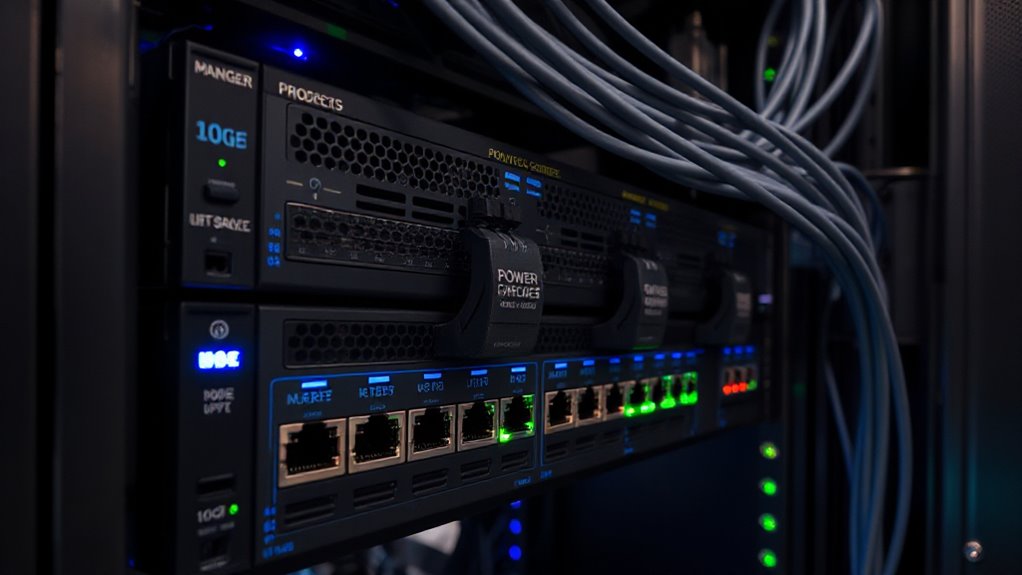

Choosing a managed switch with PoE and 10GbE uplinks involves balancing high-speed connectivity, PoE power capacity, and management features. For those seeking an all-rounder, the NETGEAR GS752TXP offers a robust mix of 48 PoE ports and 10GbE uplinks at a reasonable price, making it ideal for growing networks. Meanwhile, the Juniper EX2300 stands out with its modular design and scalable architecture, suited for environments that anticipate expansion. The Cisco Meraki MS250-24P-HW is perfect for cloud-managed setups requiring simplicity and cloud control, though it comes with some limitations on licensing and warranty. These choices reveal key tradeoffs: higher capacity, ease of management, and scalability versus upfront cost and complexity.

Get hardware and tech essentials delivered free with Prime
- Fast, free delivery on millions of items
- Prime Video, Amazon Music and more included
- Member-only deals all year
Key Takeaways
- Managed switches with PoE and 10GbE uplinks balance high-speed connectivity with power delivery for network devices.
- Choice depends heavily on network size, management preferences, and future scalability.
- High port density and uplink options are critical for expanding network performance.
- Tradeoffs include complexity of setup, licensing costs, and support availability.
- Price and support vary significantly; premium models often include better management features and scalability.
| Dell Networking N2048P 48-Port 1GbE PoE+ Switch (Renewed) |  | Best for High-Performance Layer 3 Networking | Number of Ports: 48 | Port Speed: 1GbE | PoE+: Yes | VIEW ON AMAZON | See Our Full Breakdown |
| EnGenius Fit EWS7952P-FIT 48-Port Gigabit PoE+ Managed Switch |  | Best for Small Business Power and Management Control | Number of Ports: 48 | PoE+ Power Budget: 410W | Uplink Ports: 4 SFP | VIEW ON AMAZON | See Our Full Breakdown |
| NETGEAR 52-Port PoE Gigabit Ethernet Smart Managed Switch (GS752TXP) |  | Best for High Port Density and 10GbE Uplinks | Number of Ethernet ports: 48 | PoE+ ports: 48 | Total PoE power budget: 380W | VIEW ON AMAZON | See Our Full Breakdown |
| Cisco Meraki MS250-24P-HW 24-Port PoE Cloud Managed Switch |  | Best for Cloud Management and Scalability | Ports: 24 x 10/100/1000BASE-T Ethernet | Uplink Ports: 4 x SFP+ | Switching Capacity: 128 Gbps | VIEW ON AMAZON | See Our Full Breakdown |
| Juniper EX2300 Ethernet Switch – 48 Ports |  | Best for Modular and Scalable Deployment | Total Network Ports: 48 | Modular: Yes | Stack Port: No | VIEW ON AMAZON | See Our Full Breakdown |
| managed switch with poe and 10gbe uplink | Switching Capacity |
|---|---|
| Dell Networking N2048P 48-Port | — |
| EnGenius Fit EWS7952P-FIT 48-P | 104 Gbps |
| NETGEAR 52-Port PoE Gigabit Et | Flexible |
| Cisco Meraki MS250-24P-HW 24-P | 128 Gbps |
| Juniper EX2300 Ethernet Switch | — |
More Details on Our Top Picks
Dell Networking N2048P 48-Port 1GbE PoE+ Switch (Renewed)
The Dell N2048P excels in delivering high-bandwidth Gigabit Ethernet with PoE+ support across 48 ports, making it suitable for enterprise environments or growing networks needing robust routing features. Its Layer 3 capabilities, including static routing and IPv6 support, enable advanced network segmentation. Compared to other options, this switch stands out for its flexibility and interoperability, especially when paired with open standard protocols. However, as a renewed product, it might carry limited warranty and support, and its complex setup can be daunting for less experienced users.
Pros:- Supports high-bandwidth, full-duplex Gigabit Ethernet connections
- PoE+ capability powers compatible devices directly
- Layer 3 features enable advanced routing and segmentation
- Supports open standard protocols for interoperability
Cons:- Renewed product may have limited warranty
- Configuration complexity requires advanced network knowledge
Best for: Large-scale enterprise networks needing advanced Layer 3 features and PoE+ capacity.
Not ideal for: Small businesses or users seeking plug-and-play simplicity without advanced routing.
- Number of Ports:48
- Port Speed:1GbE
- PoE+:Yes
- Power Supply:80PLUS-certified
- Layer 3 Support:Yes
- IPv4/IPv6:Yes
Our verdict“A powerful choice for enterprises needing scalable Layer 3 routing with PoE+ support, but less suited for beginners.”
EnGenius Fit EWS7952P-FIT 48-Port Gigabit PoE+ Managed Switch
The EnGenius Fit EWS7952P-FIT is tailored for small business networks that require reliable PoE+ power and flexible management. Its sizeable 410W power budget allows powering multiple access points, cameras, and VoIP phones simultaneously. The switch supports Layer 2+ features, improving network performance without the complexity of Layer 3 routing, making it easier to manage for small teams. Its cloud and on-premises management options add flexibility, but it may lack some advanced features needed for larger, more complex networks. Setup is straightforward but might require some technical familiarity.
Pros:- High PoE power budget supports multiple devices simultaneously
- Flexible management options including cloud and local control
- Advanced Layer 2+ features improve network performance
- Reliable and secure with security features
Cons:- Designed primarily for small environments
- Lacks advanced Layer 3 routing features
- Setup may require technical skills
Best for: Small businesses needing a reliable PoE switch with flexible management options.
Not ideal for: Large networks requiring extensive Layer 3 routing or high uplink capacity.
- Number of Ports:48
- PoE+ Power Budget:410W
- Uplink Ports:4 SFP
- Switching Capacity:104 Gbps
- Management Options:Cloud and on-premises
- Layer:Layer 2+
Our verdict“An excellent choice for small businesses prioritizing PoE power and flexible management, with some limitations on growth potential.”
NETGEAR 52-Port PoE Gigabit Ethernet Smart Managed Switch (GS752TXP)
The NETGEAR GS752TXP combines a high port count with 10GbE fiber uplinks, making it ideal for expanding networks needing PoE+ and high-speed backbone connectivity. Its 48 PoE+ ports support powering a multitude of devices, while the 4 SFP+ ports provide flexible uplink options. Its smart management interface offers remote access and easy configuration, suitable for users comfortable with managed switches. However, its complexity might be challenging for those unfamiliar with network management, and the price can be higher compared to simpler models.
Pros:- High port density with PoE+ support
- Includes fiber optic connectivity with 10GbE SFP+ ports
- Easy management interface with remote access
Cons:- May be complex for users inexperienced with managed switches
- No clear price info, potentially costly
- Requires compatible cables for full performance
Best for: Networks requiring dense PoE port support with high-speed uplinks for expansion.
Not ideal for: Small or simple networks where extensive management features are unnecessary.
- Number of Ethernet ports:48
- PoE+ ports:48
- Total PoE power budget:380W
- SFP+ ports:4
- Management:SNMP, NETGEAR Insight
- Switching Capacity:Flexible
Our verdict“Best suited for expanding networks that need dense PoE coverage and high-speed uplinks, with some management complexity.”
Cisco Meraki MS250-24P-HW 24-Port PoE Cloud Managed Switch
The Cisco Meraki MS250-24P-HW excels in environments prioritizing cloud management, offering 24 PoE ports, 4 SFP+ uplinks, and a high switching capacity. Its cloud-based dashboard simplifies network management, making it accessible for users without extensive technical backgrounds. The stacking capability allows for future expansion, and PoE+ supports device power needs. However, the product is renewed, which might limit warranty support, and additional licensing costs are involved, making it less appealing for tightly constrained budgets.
Pros:- High switching capacity with 128 Gbps
- Supports PoE+ for powering network devices
- Multiple uplink options and stacking for scalability
Cons:- No license included, additional purchase needed
- Renewed product may have limited warranty
- Limited detailed info on local management features
Best for: Organizations seeking easy-to-manage, scalable, cloud-controlled networks.
Not ideal for: Budget-conscious users or those requiring extensive Layer 3 routing features.
- Ports:24 x 10/100/1000BASE-T Ethernet
- Uplink Ports:4 x SFP+
- Switching Capacity:128 Gbps
- PoE Power:370 W
- Management:Cloud, SNMP
- Stacking:Yes
Our verdict“A smart choice for cloud-driven networks needing scalability and ease of use, but at a higher cost and with licensing considerations.”
Juniper EX2300 Ethernet Switch – 48 Ports
The Juniper EX2300 offers a highly flexible solution with 48 Gigabit Ethernet ports and 4 10GbE uplink slots. Its modular design supports expansion for growing networks, and its Layer 3 routing and virtual chassis technology enable scalable deployment in small to medium environments. While it provides excellent performance and future-proofing, it lacks a stack port, limiting inter-switch connectivity, and may be overkill for very small networks. Its management interface is comprehensive but could be complex for new users.
Pros:- High-density 48-port Gigabit Ethernet switching
- Supports 10GbE uplinks for high-speed connectivity
- Modular design enables expansion and flexibility
- Supports Layer 3 routing and virtual chassis
Cons:- No stack port for inter-switch linking
- Limited to small-to-medium deployments
- Requires dedicated power supply
Best for: Mid-sized networks requiring modular design and future scalability.
Not ideal for: Very small networks or users prioritizing plug-and-play simplicity.
- Total Network Ports:48
- Modular:Yes
- Stack Port:No
- Expansion Slots:4 x 10GbE SFP+
- Media Types Supported:Optical Fiber, Twisted Pair
- Layer Supported:4
Our verdict“Ideal for networks expecting growth needing modularity and high-speed uplinks, with some complexity and size considerations.”

How We Picked
Our selection process focused on a combination of port count, uplink capabilities, PoE power budget, management features, and scalability. We prioritized switches that are suitable for small to medium networks but could also scale for larger deployments. Each product was assessed for its balance of performance, ease of use, and value, with a keen eye on how well they support 10GbE uplinks and PoE in a managed environment. We included options across different price points and management styles—cloud-based, smart, and traditional—so buyers can find a fit for their specific needs.
Factors to Consider When Choosing Managed Switch With Poe And 10gbe Uplinks
When selecting a managed switch with PoE and 10GbE uplinks, it’s vital to evaluate your network’s size, future growth plans, and management preferences. Consider how many devices need PoE power, the speed of uplinks required for your backbone, and whether cloud or local management suits your team. Compatibility with existing infrastructure, security features, and budget constraints also play significant roles. Understanding these factors helps narrow down options that deliver the best value and scalability for your specific environment.
Port Count and Uplink Speed
The number of Ethernet ports determines your device capacity, while 10GbE uplinks provide the high-speed backbone needed for data-heavy or expanding networks. Look for switches with enough PoE ports to power all your devices and uplinks that match your bandwidth requirements. For larger networks, higher port density and multiple uplinks support seamless scalability.
PoE Power Budget
The total PoE power budget affects how many devices you can support simultaneously. Higher budgets allow powering more access points, cameras, or VoIP phones without additional power supplies. Balance your power needs against cost, and consider future expansion to avoid upgrading too soon.
Management and Scalability
Decide between cloud-managed, smart, or traditional managed switches. Cloud solutions often simplify setup and remote management but may involve ongoing licensing costs. Modular and stackable switches support future growth, especially for medium to large deployments, while simpler models suit smaller environments with limited management needs.
Additional Features and Support
Security features, redundancy, and support options influence long-term reliability. Opt for switches with features aligned to your security policies and network resilience plans. Support and warranty are also critical, especially for business-critical networks.
Frequently Asked Questions
What is a managed switch with PoE and 10GbE uplinks?
A managed switch with PoE and 10GbE uplinks is a network device that allows you to control and configure network traffic, power connected devices through PoE, and connect to high-speed uplinks for backbone connectivity. These switches are essential for modern networks needing both power provisioning and data bandwidth for high-performance applications.
Why is 10GbE uplink support important?
10GbE uplinks provide significantly higher bandwidth compared to standard Gigabit uplinks, allowing your core network to handle larger data loads, reduce bottlenecks, and support high-speed devices or servers. They are especially vital in environments with heavy data traffic or future expansion plans.
How does PoE support impact my network deployment?
PoE support simplifies network cabling by enabling power and data over a single cable, reducing infrastructure costs and complexity. It allows powering devices like IP cameras, access points, and VoIP phones directly from the switch, which is convenient and neat, especially in locations where power outlets are limited.
Should I prioritize port count or uplink speed?
The choice depends on your network size and data flow. If you have many devices, prioritize port count to ensure sufficient connections. If your network requires high-speed data transfer between switches or to servers, focus on uplink speed, like 10GbE, to prevent bottlenecks and support future growth.
Are cloud-managed switches better for small businesses?
Cloud-managed switches are often easier to deploy and manage remotely, making them attractive for small businesses with limited IT staff. They provide centralized control, simplified updates, and remote troubleshooting, but they may involve ongoing licensing costs and less control over local management features.
Conclusion
For small businesses seeking straightforward management and PoE support, the EnGenius Fit EWS7952P-FIT makes a strong case. Larger enterprises or data centers that require scalable, high-capacity solutions should consider the NETGEAR GS752TXP or the Juniper EX2300 for their modularity and uplink capabilities. Organizations prioritizing cloud control and future growth will find the Cisco Meraki MS250-24P-HW appealing, despite higher costs. Ultimately, your choice hinges on your network’s size, management style, and scalability needs.