🔍 Read the full analysis: 10 Best NVMe SSDs To Consider For AI Workloads In 2027 on ThorstenMeyerAI.com

Get hardware and tech essentials delivered free with Prime
- Fast, free delivery on millions of items
- Prime Video, Amazon Music and more included
- Member-only deals all year
TL;DR
The supplied source names 10 NVMe SSDs and discusses speed, capacity, endurance and cooling, but it does not provide an independently verifiable 2027 test report or AI workload benchmarks. Treat the list as a preliminary buying guide, not proof that any drive is best for AI; check current specifications, pricing and compatibility before choosing.
A buyer’s guide attributed to ThorstenMeyerAI.com names 10 NVMe SSDs for readers to consider for AI workloads, led by the Samsung 990 PRO 2TB as its overall pick and the Kingston NV3 1TB as its budget option. The supplied material describes general storage tradeoffs, but provides no model-by-model test results or AI workload measurements, so its rankings cannot be independently verified from the information available.
The listed drives are the Samsung 990 PRO 2TB, Kingston NV3 1TB, Samsung 9100 PRO, Bestoss 1TB, and SanDisk Optimus 5100, along with five models the source does not identify. That gap makes it impossible to reproduce the promised 10-drive comparison or check every selection against the same criteria.
The source says it weighed sustained sequential throughput, random read/write performance, thermal behavior, endurance and warranty coverage. It warns that entry-level drives can slow after their SLC cache fills and that 1TB models may be less consistent than higher-capacity versions during large transfers. No test setup, benchmark figures, prices, firmware versions, or controlled comparison data are included in the supplied text.
The guide characterizes the Samsung 990 PRO 2TB as a balance of speed and power efficiency, the Kingston NV3 as a lower-cost PCIe 4.0 option, the Samsung 9100 PRO as an efficient choice for laptops, the Bestoss 1TB as a heatsink-equipped option, and SanDisk Optimus 5100 as a DRAM-less drive for general use. Those descriptions are the source’s assessments, not independently confirmed findings.
The 10 picks
- 1
 Samsung 990 PRO 4TB PCIe 4.0 NVMe M.2 2280 SSDView on Amazon →
- 2
 Gigastone Game Turbo 4TB M.2 NVMe PCIe 4.0 Internal SSDView on Amazon →
- 3
 Gigastone 1TB Game Turbo PCIe Gen4x4 M.2 NVMe SSD (2-Pack)View on Amazon →
- 4
 Samsung 9100 PRO 2TB Internal SSDView on Amazon →
- 5
 Samsung 990 PRO 2TB PCIe 4.0 M.2 2280 NVMe SSDView on Amazon →
- 6
 Bestoss 1TB PCIe 4.0 NVMe M.2 2280 SSD with HeatsinkView on Amazon →
- 7
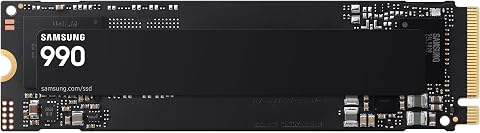 Samsung 990 1TB PCIe 4.0 NVMe Internal SSDView on Amazon →
- 8
 SanDisk Optimus 5100 1TB NVMe SSD, PCIe 4.0, M.2 2280View on Amazon →
- 9
 Kingston NV3 1TB M.2 2280 PCIe 4.0 NVMe SSDView on Amazon →
- 10
 SanDisk Optimus 5100 500GB NVMe SSD, PCIe 4.0, M.2 2280View on Amazon →
Storage Choices for AI Systems
Storage can affect how quickly a system loads datasets, checkpoints, applications and model files, but the source does not establish that any drive on this list improves AI training or inference. For readers building a workstation, the practical choice depends on the workload: large transfers may expose sustained-write limits, while repeated writes can make endurance ratings relevant. An SSD is only one part of system performance; processor, memory, GPU, software and data access patterns also matter.
The distinction between burst and sustained performance is especially relevant when moving large datasets or saving checkpoints. A high advertised peak speed does not, by itself, show how long that speed can be maintained. Readers should compare published specifications and independent tests using workloads close to their own, rather than treating a general-purpose ranking as an AI benchmark.
Products Worth Considering

Ledger Nano Gen5 Crypto Wallet, Black

LG UltraGear 24-Inch Full HD IPS Gaming Monitor, 120Hz (144Hz Overclocked), 1ms MBR, G-SYNC Compatible, FreeSync, HDR10

Logitech MX Vertical Wireless Ergonomic Mouse
As an affiliate, we earn on qualifying purchases.
How the Guide Compares Drives
The source’s selection method prioritizes measures it says reflect day-to-day use: sequential speeds during sustained workloads, random I/O for application responsiveness, heat under load, and TBW endurance ratings. It also distinguishes drives with onboard DRAM from DRAM-less designs that use Host Memory Buffer, which borrows some system memory for address mapping. The text presents DRAM-less drives as possible budget or secondary-storage options, not as an automatic poor fit.
It also discusses PCIe generation and cooling. The guide calls PCIe 4.0 a practical choice for many systems and notes that a drive’s speed can be limited by the motherboard slot it uses. It says PCIe 5.0 drives may run hotter, but the material does not provide comparative temperature readings. Heatsinks and motherboard thermal pads can help manage heat, though actual results depend on system design and airflow.
“The primary tradeoff in this category often lies between raw peak performance and sustained write consistency.”
— ThorstenMeyerAI.com buyer’s guide
Missing Tests and Model Details
The supplied material does not name five of the 10 promised drives, identify when the guide was published, or confirm that every listed model remains available in 2027. It also provides no measured AI workload results, benchmark data, price comparisons, full warranty terms, or exact endurance figures. The guide’s descriptions and rankings should therefore be read as attributed editorial judgments, not verified product findings.
“AI workload” can mean storing training datasets, loading models, caching data, or writing checkpoints, and those tasks can stress storage differently. The source does not define which tasks its recommendations target. It is also unclear which capacities, firmware versions, test systems or competing drives were used in its evaluation. Buyers should check current manufacturer specifications and independent testing before relying on a specific performance claim.
Checks Before Choosing a Drive
Before buying, verify the exact model and capacity, the motherboard’s M.2 and PCIe support, and whether the system has adequate cooling. Compare sustained-write testing, random I/O results, TBW ratings and warranty terms for the specific capacity being considered; specifications can differ between capacities within the same product family. For a laptop, confirm physical fit and power and thermal constraints.
The source gives no upcoming test date or follow-up announcement. The next useful step for readers is to consult current manufacturer documentation and independent reviews that disclose their test methods and include the other five models. SSD prices and availability can change, and storage performance depends on the wider system. This article is reporting on a buyer’s guide, not a recommendation to purchase a particular drive.
Key Questions
Does the source prove these are the best SSDs for AI?
No. The supplied material contains general product assessments but no AI-specific benchmarks or disclosed model-by-model test results.
Which SSDs are actually named?
The source names the Samsung 990 PRO 2TB, Kingston NV3 1TB, Samsung 9100 PRO, Bestoss 1TB and SanDisk Optimus 5100. It does not identify the other five entries in the promised 10-drive list.
Why can sustained speed differ from advertised peak speed?
The guide says some drives rely on an SLC cache for short bursts. Once that cache is exhausted, write speeds may fall; the supplied source does not quantify the drop for the named models.
What should buyers check before choosing an NVMe SSD?
Check motherboard compatibility, capacity, sustained performance, cooling needs, endurance and warranty. Match testing to the intended workload, and confirm current specifications because model details and availability may change.
Source: ThorstenMeyerAI.com