
📊 Full opportunity report: AI Agent Security: Guardrails To Safeguard Your Infrastructure on IdeaNavigator AI — validation score, market gap, and execution plan.
TL;DR
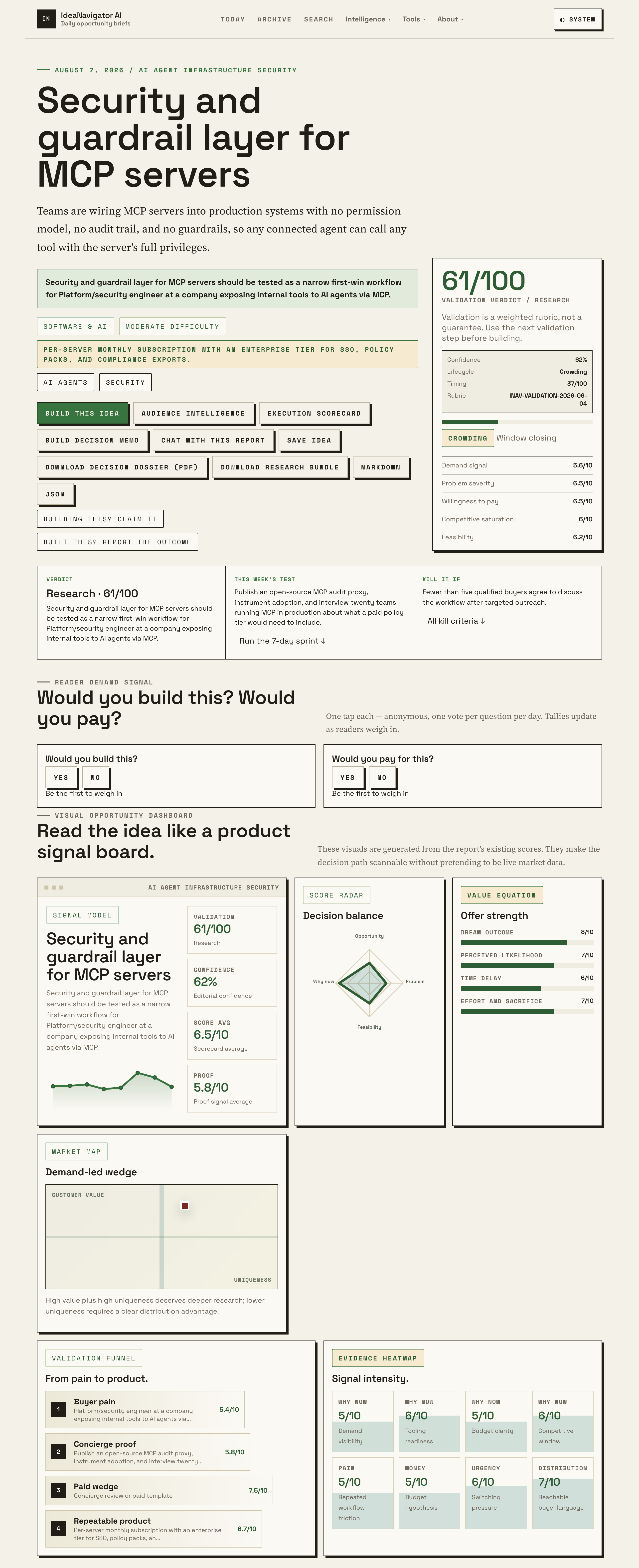
A new security layer for MCP servers is being developed to add permission controls, audit logs, and human approval gates. This initiative responds to rising risks as enterprises rapidly deploy AI agents without sufficient safeguards.
A security guardrail layer for MCP servers is being developed and tested to address vulnerabilities arising from rapid enterprise deployment of AI agents. This initiative aims to add permission controls, audit trails, and approval mechanisms, responding to increased security risks as companies integrate internal tools with AI agents via MCP.
According to sources familiar with the project, the guardrail is a proxy layer that sits in front of existing MCP servers, introducing features such as per-tool allowlists, per-agent identity verification, human approval gates for destructive actions, rate limiting, and searchable audit logs. These measures are designed to prevent unauthorized or malicious tool calls that could compromise internal systems.
The development is targeted at platform/security engineers at companies exposing internal tools to AI agents through MCP, a standard that has become widespread since 2025-2026. The initiative is currently in a testing phase, with plans to publish an open-source MCP audit proxy to facilitate adoption and gather feedback from early users.
Market analysts note that this guardrail layer is a response to documented attack vectors such as prompt injection and tool abuse, which have increased as enterprise deployment outpaces security reviews. The subscription-based model will offer per-server pricing, with enterprise options for SSO, policy management, and compliance reporting.
Why This Security Layer Is a Critical Development
This development is significant because it addresses a growing security gap in enterprise AI infrastructure. As companies rapidly deploy MCP servers to enable AI agents to interact with internal tools, the lack of permission controls and audit trails creates vulnerabilities that could be exploited by malicious actors or accidental misuse.
Implementing these guardrails could prevent data leaks, unauthorized tool execution, and system disruptions, making AI deployment safer and more controllable. The open-source proxy aims to set a standard for security in AI agent infrastructure, influencing future best practices across the industry.
enterprise security audit logs software
As an affiliate, we earn on qualifying purchases.
As an affiliate, we earn on qualifying purchases.
Background on MCP Adoption and Security Challenges
The MCP (Managed Cloud Platform) standard gained prominence in 2025-2026 as the preferred method for integrating AI agents with internal enterprise tools. Its rapid adoption has outpaced the development of comprehensive security measures, leading to concerns about potential abuse and system compromise.
Previously, many companies wired MCP servers directly into production environments without permission models or audit mechanisms, increasing the risk of malicious or accidental misuse. Documented attack methods include prompt injections and tool abuse, which can lead to data breaches or operational failures. Security experts have called for better controls, prompting the current development of a guardrail proxy.
This initiative builds on ongoing efforts to improve AI infrastructure security, emphasizing the need for scalable, easy-to-deploy safeguards that can keep pace with enterprise deployment speeds.
“The new proxy layer aims to introduce essential permission and audit controls without disrupting existing MCP workflows.”
— an anonymous researcher
As an affiliate, we earn on qualifying purchases.
Remaining Questions About Deployment and Effectiveness
It is not yet clear how widely the MCP audit proxy will be adopted or how effective it will be in preventing sophisticated attacks. The open-source release is still in preparation, and feedback from early testing is ongoing. Additionally, the scope of enterprise features like policy management and compliance reporting remains to be fully defined.
As an affiliate, we earn on qualifying purchases.
Next Steps for Development and Industry Adoption
The open-source MCP audit proxy is scheduled for release in the coming months, with pilot programs underway in select enterprises. Feedback from early users will inform further feature development, including enhanced policy controls and integration with existing security tools. Industry experts anticipate broader adoption as companies seek scalable security solutions for AI infrastructure.
As an affiliate, we earn on qualifying purchases.
Key Questions
What is MCP, and why is it important?
MCP stands for Managed Cloud Platform, a standard for integrating AI agents with internal enterprise tools. Its importance lies in enabling scalable AI workflows but also introduces security risks if not properly controlled.
How does the new security proxy improve MCP security?
The proxy adds permission controls, audit logging, human approval gates, and rate limits, reducing the risk of unauthorized or malicious tool calls and enabling better oversight.
When will the MCP audit proxy be available for wider use?
The open-source version is expected to be released in the next few months, with initial pilot programs already underway in some enterprises.
Will this guardrail layer prevent all types of attacks?
While it aims to mitigate common attack vectors like prompt injection and tool abuse, its effectiveness against highly sophisticated or zero-day exploits remains to be seen.
What are the costs associated with implementing these guardrails?
The solution will be offered as a per-server subscription, with enterprise tiers providing additional features such as SSO, policy management, and compliance reporting.
Source: IdeaNavigator AI