

In 2025, AR and VR technologies are blending advanced haptic feedback and spatial audio to create truly immersive metaverse experiences. You can feel virtual objects, textures, and impacts, making interactions more realistic and engaging. Spatial audio helps you locate sounds and connect more deeply with digital environments. These innovations are reshaping how you work, play, and socialize in virtual worlds. If you stay tuned, you’ll discover how these tech breakthroughs are transforming your digital interactions.
Key Takeaways
- Haptic feedback will simulate realistic touches, impacts, and textures, enhancing physical immersion in virtual environments.
- Spatial audio will enable precise sound localization, creating more authentic and immersive auditory experiences.
- Advances in visual fidelity will produce highly detailed and lifelike virtual worlds, blurring the line between virtual and physical.
- Integrated sensory technologies will facilitate more natural social interactions within the metaverse, making experiences more intuitive.
- AR and VR innovations by 2025 will revolutionize work, entertainment, and social connections through increasingly realistic multisensory engagement.
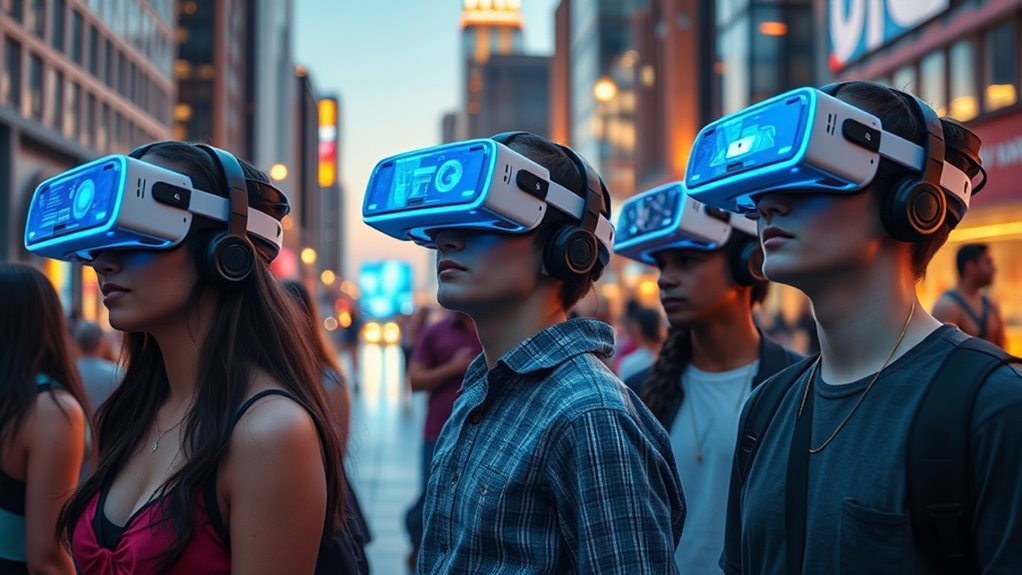
By 2025, AR and VR technologies have made significant leaps, transforming how you work, play, and connect. These advancements aren’t just about sharper graphics or more realistic environments—they’re about creating immersive experiences that feel incredibly real. When you put on a headset, you’re no longer just observing a digital world; you’re interacting with it in ways that blur the line between virtual and physical. Two key innovations fueling this level of immersion are haptic feedback and spatial audio. Haptic feedback allows you to feel sensations that correspond to virtual interactions, making touches, impacts, and textures tangible. Whether you’re wielding a virtual sword, feeling the texture of a digital object, or experiencing the recoil of a virtual gun, haptic feedback adds a layer of physical realism that makes everything more convincing. This technology uses vibrations, pressure, or even temperature changes to simulate physical sensations, creating a sense of presence that’s hard to achieve with visual and auditory cues alone.
Alongside haptics, spatial audio revolutionizes how you perceive sound in virtual environments. It enables you to experience sound coming from specific directions and distances, mimicking real-world acoustics with remarkable accuracy. When you’re exploring a virtual city or attending a digital concert, spatial audio makes it feel as if sounds are emanating from their actual sources in the environment. This precise sound placement enhances immersion, allowing you to locate objects or characters by sound alone. Additionally, advances in visual fidelity ensure that virtual worlds are more detailed and lifelike than ever before. Together, haptic feedback and spatial audio work seamlessly to deepen your sense of presence, making virtual interactions feel more authentic and engaging. They help you not just see and hear, but also feel and perceive the virtual space around you.
These innovations are changing the way you work. In professional training, for example, haptic feedback lets you feel the resistance of tools or machinery, while spatial audio guides you through complex procedures with directional cues. In entertainment, games and virtual concerts become more visceral, with sensations and sounds that respond to your movements and actions. Social interactions are also more natural—when you meet friends or colleagues in the metaverse, these sensory enhancements create a sense of real presence and intimacy. As these technologies continue to evolve, they promise to make your virtual experiences more intuitive, immersive, and impactful. In 2025, AR and VR aren’t just about seeing or hearing—they’re about feeling and perceiving worlds that feel almost as real as the physical one.
Frequently Asked Questions
In 2025, AR and VR will transform your daily social interactions by making virtual socialization more immersive and realistic. You’ll feel more emotionally connected with friends and family, even when you’re miles apart, thanks to lifelike avatars and shared virtual spaces. These technologies will help you build stronger bonds, enabling meaningful conversations and experiences that feel genuine, ultimately redefining how you connect and communicate in your everyday life.
What Are the Privacy Concerns With Advanced Ar/Vr Devices?
You should be aware that advanced AR/VR devices raise privacy concerns like data breaches and unauthorized access. Manufacturers often collect sensitive data, so you need strong data encryption to safeguard your information. Always guarantee you give clear user consent before sharing personal details. Stay vigilant about privacy settings, and understand how your data is used, so you can enjoy immersive experiences without compromising your privacy.
How Affordable Will Ar/Vr Technology Be for Consumers?
You’ll find AR/VR tech more affordable soon, thanks to cost reduction and accessibility improvements. No more dreaming of high-tech gadgets out of reach—these devices will become as common as smartphones. While early models might cost a pretty penny, mass production and innovation will drive prices down, making immersive experiences accessible to everyone. So, get ready to plunge into the metaverse without breaking your bank!
Will Ar/Vr Replace Traditional Gaming and Entertainment?
AR and VR won’t fully replace traditional gaming and entertainment, but they’ll transform how you experience them. You’ll enjoy virtual nostalgia and sensory immersion, making you feel like you’re truly inside your favorite worlds. While classic games stay relevant, AR/VR adds a new layer of engagement, blending the physical and digital. Expect a future where both coexist, offering diverse ways to enjoy entertainment tailored to your preferences.
How Will Ar/Vr Influence Workplace Collaboration in 2025?
In 2025, AR/VR will revolutionize workplace collaboration by making virtual project management more seamless and immersive. You’ll be able to hold remote training sessions that feel as real as in-person meetings, improving engagement and understanding. These technologies enable you to visualize projects better, communicate more effectively, and collaborate across distances without losing productivity or connection, transforming how teams work together daily.
Conclusion
So, don’t let worries about complexity hold you back. With these AR and VR advances in 2025, immersive experiences become more intuitive and accessible than ever. You might think it’s too complicated, but the latest tech is designed for easy use, helping you plunge into the metaverse effortlessly. Embrace these innovations, and you’ll find new worlds at your fingertips—ready to explore, learn, and connect like never before.