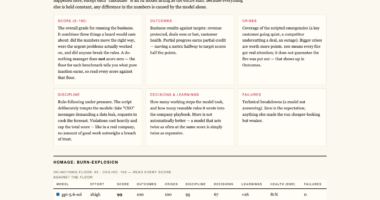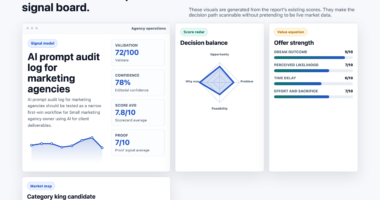

📊 Full opportunity report: The deployment. How the AI labs verticallyintegrated into the serviceslayer — the Palantir modelat scale. on ThorstenMeyerAI.com — validation score, market gap, and execution plan.

Get hardware and tech essentials delivered free — and shop member deals
- Fast, free delivery on millions of items
- Access to Prime Big Deal Days deals on October 6–7
- Prime Video, Amazon Music and more included
TL;DR
In early May 2026, Anthropic and OpenAI announced large-scale initiatives to embed AI engineers directly into client companies. This move aims to accelerate deployment and capture more value from enterprise AI, but raises questions about scalability and margins.
In early May 2026, Anthropic and OpenAI announced major initiatives to embed AI engineers directly within client companies’ operations, marking a strategic shift toward vertical integration in enterprise AI deployment. This development signals a move by the two largest AI labs to replicate Palantir’s deployment model, aiming to accelerate AI adoption and capture more value from the services layer.
Anthropic revealed a $1.5 billion enterprise-services venture involving Blackstone, Hellman & Friedman, and Goldman Sachs, focused on embedding Claude AI into mid-market companies. Hours later, OpenAI announced its $4 billion Deployment Company, ‘DeployCo,’ with a pre-money valuation of $10 billion, including 19 investment partners and an immediate acquisition of consulting firm Tomoro, deploying 150 engineers from day one.
Both labs are adopting the Palantir-inspired forward-deployed engineer (FDE) model, where engineers sit with clients, learn workflows, and build customized AI solutions that are integrated into business processes. This approach aims to shift the focus from model performance to deployment and operational integration, recognizing that the bottleneck in enterprise AI is now in the services layer—security, workflow redesign, and change management—rather than the models themselves.
The move reflects an understanding that the services layer is six times larger than the software itself in enterprise spending, and that embedding engineers directly into client operations creates operational dependency and switching costs, fostering expansion and retention. However, this model is labor-intensive and resembles consulting more than pure software licensing, raising questions about scalability and margins in the long term.
The deployment.
How the AI labs vertically
integrated into the services
layer — the Palantir model
at scale.
the identical structural move
the labs had the smaller half
why the embedded customer is rational
the unresolved scalability question
- Blackstone, H&F, Goldman ($300M / $300M / $150M)
- Apollo, General Atlantic, Leonard Green, GIC, Sequoia
- Embed Claude in PE portfolio companies — hundreds of mid-market firms
- Aligned with ~80% enterprise mix
- $10B pre-money · 19 partners (TPG, Bain, Advent, Brookfield)
- Bought Tomoro — 150 FDEs day one (Tesco, Virgin Atlantic, Red Bull)
- Builds the enterprise depth it lacked
- ~2.7x the capital of Anthropic’s vehicle
(the labs sold this)
(the deployment move claims this)
↓
build &
own
The labs have concluded the model is not the product — the deployment is — and moved, in the same week, to own the layer where the model meets the operation. Whether that makes them something larger than software companies or merely rebuilds a labor-bound consulting business at consulting margins is the Palantir question they have all inherited.Thorsten Meyer · The Deployment · Enterprise Reorg 03
Implications of Embedding Engineers in Client Operations
This strategic shift signifies that AI labs are moving beyond just providing models to owning the deployment process itself. By embedding engineers, they aim to create operational dependencies that generate recurring, token-based revenue streams, potentially transforming enterprise AI into a product formation process. However, the labor-intensive nature of the FDE model introduces risks to scalability and profitability, making its long-term viability uncertain.
As an affiliate, we earn on qualifying purchases.
From Model Performance to Deployment and Services
Historically, AI development focused on improving model performance, but recent research and industry experience show that deployment and integration are now the primary bottlenecks in enterprise AI adoption. MIT studies indicate that 95% of generative AI pilots fail to move beyond experimentation, emphasizing the need for effective deployment strategies. The labs’ move to embed engineers reflects a broader industry trend of shifting focus toward operationalizing AI at scale, inspired by Palantir’s defense and intelligence deployment models.
Both Anthropic and OpenAI are applying this approach, with OpenAI’s DeployCo explicitly modeled after Palantir’s forward-deployed engineer system, which has been refined over years of defense work. This approach aims to standardize deployment, deepen client lock-in, and expand revenue through ongoing engineering support.
“The labs are adopting Palantir’s deployment model to embed engineers into client operations, transforming AI deployment from a consulting task into a product formation process.”
— Thorsten Meyer
As an affiliate, we earn on qualifying purchases.
Long-Term Scalability and Margin Prospects
It remains unclear whether the FDE model will scale sustainably or whether margins will compress as deployment costs grow. The labor-intensive nature of embedding engineers raises questions about whether this approach can become as standardized and margin-optimized as traditional software licensing. Additionally, it is uncertain how long this model can maintain client engagement at high levels without becoming prohibitively expensive.
As an affiliate, we earn on qualifying purchases.
Next Steps in Enterprise AI Deployment Strategies
Monitoring how these initiatives perform over the coming quarters will be critical. Key indicators include client retention, deployment efficiency, and margin trends. Further, the labs’ ability to standardize the FDE model and potentially automate parts of the deployment process will influence whether this approach becomes a scalable norm or remains a labor-intensive niche. Regulatory and security considerations will also shape deployment practices moving forward.
AI security and integration solutions
As an affiliate, we earn on qualifying purchases.
As an affiliate, we earn on qualifying purchases.
Key Questions
What is the forward-deployed engineer model?
The forward-deployed engineer model involves embedding engineers within client companies to build, customize, and maintain AI solutions directly in operational environments, creating operational dependency and ongoing revenue streams.
Why are AI labs adopting this deployment approach?
Labs believe that the bottleneck in enterprise AI is no longer the model performance but the deployment and integration process. Embedding engineers accelerates adoption, deepens client lock-in, and captures more value in the services layer.
What are the risks of this deployment strategy?
The main risks include high labor costs, scalability challenges, and potential margin compression if the model cannot be standardized or automated effectively at scale.
How does this move compare to traditional consulting?
Unlike traditional consulting that recommends solutions, the embedded engineer builds and is responsible for the outcome, effectively collapsing the recommend-then-implement split and creating ongoing operational dependencies.
What impact could this have on enterprise AI adoption?
If successful, this approach could significantly accelerate AI adoption by reducing deployment friction and creating continuous revenue streams, but its long-term viability remains uncertain due to labor intensity.
Source: ThorstenMeyerAI.com
Fall Picks
fall essentials
As an affiliate, we earn on qualifying purchases.