
TL;DR

Get hardware and tech essentials delivered free — and shop member deals
- Fast, free delivery on millions of items
- Access to Prime Big Deal Days deals on October 6–7
- Prime Video, Amazon Music and more included
A published report says Huawei trained Pangu Pro with 505 billion parameters without Nvidia accelerators, while suggesting supply-chain evidence complicates that account. The available material provides no hardware inventory, technical report, supplier records or independent verification, leaving both assertions unsubstantiated.
A published report claims Huawei Pangu Pro was trained with 505 billion parameters and without Nvidia accelerators, while indicating that unspecified supply-chain evidence may complicate that account. The available material contains no technical report, hardware inventory or independent audit, so the reported training achievement and the conflicting supply-chain account remain unverified.
The report presents two related assertions: that Pangu Pro reached a 505-billion-parameter scale, and that its main training run used no Nvidia hardware. It does not identify the accelerators, cluster size, training duration, computing budget, data volume or evaluation results behind those claims.
The parameter figure also lacks a technical definition. The material does not say whether 505 billion refers to all parameters in a dense model, the total capacity of a mixture-of-experts system, or the smaller number activated for each token. Those configurations can require very different amounts of computing power and memory.
The phrase “without Nvidia” is similarly undefined. It may refer only to accelerators used in the final training run, or it could mean Nvidia equipment was absent from experiments, evaluation and deployment. Without a documented hardware inventory, readers cannot determine which interpretation applies.
Huawei Pangu Pro: 505 Billion Parameters Without Nvidia?
A published report links Pangu Pro to a 505-billion-parameter, Nvidia-free training run. Yet the available material provides no model report, hardware inventory, supplier records or independent verification. The headline is consequential—but the evidence remains incomplete.
505B
Reported parameter count, with no definition of total versus active parameters.
“No Nvidia”
Reported training claim, but its technical and operational boundary is undefined.
Unverified
Neither the training achievement nor the alleged supply-chain conflict is documented.
What the headline says—and what it leaves open
The story combines a scale claim, a hardware claim and a supply-chain qualification. Each requires different documentation, and none is established by the supplied material.
505 billion parameters
The figure could describe a dense model, total mixture-of-experts capacity or only another architectural measure. Those meanings imply very different memory and compute demands.
Without Nvidia
It is unclear whether this covers only the main training run or also experiments, evaluation, inference and deployment. No accelerator list or cluster configuration is supplied.
A different story
No component, supplier, purchase record or dependency is identified. The alleged discrepancy could sit anywhere from fabrication to software—or may reflect a narrower definitional dispute.
One number and one phrase conceal several possibilities
Parameter count alone does not reveal training cost. Likewise, an Nvidia-free accelerator claim does not automatically establish a fully independent computing supply chain.
What could 505B mean?
A dense 505-billion-parameter model would use every parameter for each token. A mixture-of-experts system may advertise 505 billion in total while activating only a fraction per token. The two configurations can have radically different computing and memory requirements.
What could “without Nvidia” mean?
The phrase may apply only to accelerators in a final training run. It might—or might not—exclude Nvidia hardware from prototyping, testing, evaluation, data preparation, networking, inference or the wider development process.
“The central technical and supply-chain claims still require documentation.”
Thorsten Meyer AI source summary
The records needed to turn a report into a finding
A claim can be plausible and still remain unverified. The decisive issue is whether primary records make the architecture, hardware boundary and supply-chain qualification testable.
| Evidence item | What it would establish | Available? | Current implication |
|---|---|---|---|
| Technical model report | Architecture, total and active parameters, training method | ✗ No | 505B remains undefined |
| Cluster inventory | Accelerator type, count, networking and system topology | ✗ No | “Without Nvidia” lacks a testable boundary |
| Training logs and compute budget | Duration, utilization, data volume and completion | ✗ No | Main-run achievement cannot be reproduced |
| Benchmarks and evaluations | Model capability, quality and comparative performance | ✗ No | Scale is not connected to demonstrated results |
| Supplier or component records | Location and nature of external dependencies | ✗ No | Supply-chain conflict remains unspecified |
| Attributable company response | Huawei or Nvidia position on the reported claims | ~ Not supplied | No direct clarification is available |
| Independent audit | Third-party validation of hardware and training claims | ✗ No | Both assertions remain reported, not established |
Status reflects only the material supplied for this infographic.
An accelerator is only one link in the training stack
A domestically branded processor can still rely on foreign-linked tools, intellectual property or components elsewhere in the system. Such dependencies would narrow—but not necessarily disprove—an Nvidia-free accelerator claim.
Key distinction: Evidence of outside dependencies would not automatically show that Nvidia accelerators powered the main training run. It would instead clarify how narrowly—or broadly—“hardware independence” should be understood.
The confidence gap is the story
The supplied account offers a strong headline but little observable evidence. Documentation, reproducibility and independent verification all remain near the starting line.
Documentation is the next meaningful test
Future reporting should identify the model architecture, the training cluster and the exact scope of the Nvidia-free claim before drawing conclusions about supply-chain independence.
The Hardware Claim at Stake
If verified, the report would show that Huawei trained a very large model without relying on Nvidia accelerators for the main run. That would be relevant to developers and policymakers tracking whether advanced AI systems can be built on alternative computing platforms.
The supply-chain qualification matters because an accelerator is only one part of a training system. Fabrication, high-bandwidth memory, advanced packaging, networking, software, power and cooling can involve separate suppliers and technologies. Evidence of outside dependencies would not automatically disprove an Nvidia-free accelerator claim, but it could narrow what hardware independence means in practice.
As an affiliate, we earn on qualifying purchases.
One Label, Many Dependencies
Large-model training relies on a connected stack that includes processors, memory and networking as well as compilers, kernels and distributed-training software. A processor carrying a domestic brand can still depend on foreign-linked manufacturing tools, intellectual property or components elsewhere in that stack.
The available headline does not identify where the reported discrepancy lies. It could involve accelerator design, fabrication, packaging, memory, networking equipment, software or hardware used during earlier experiments. None of those possibilities is established by the supplied source material, which offers no underlying records.
“Trains 505 billion parameters without Nvidia”
— Tech Times headline, as reproduced in the supplied material
As an affiliate, we earn on qualifying purchases.
Missing Records Block Verification
It is not yet clear which accelerators were used, how many were deployed, or whether the claimed training run was completed as described. No architecture paper, training logs, benchmark results or third-party audit appears in the available material.
The alleged supply-chain conflict is also unexplained. No chips, suppliers, purchase records or component origins are identified. The material does not establish whether the issue concerns Nvidia products, another foreign dependency or a narrower dispute over how the training system was described.
There is also no supplied response from Huawei or Nvidia. Until supporting documents or attributable statements emerge, the 505-billion-parameter claim and the Nvidia-free description should be treated as reported assertions rather than established technical facts.
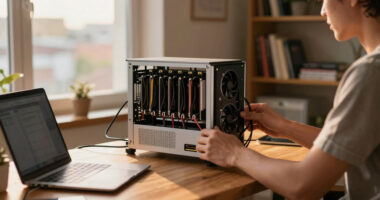
high performance AI server hardware
As an affiliate, we earn on qualifying purchases.
As an affiliate, we earn on qualifying purchases.
Documentation Is the Next Test
The next meaningful development would be publication of a technical model report, a cluster inventory or supplier documentation identifying the hardware used. Independent researchers would also need enough information to examine the architecture, training method and performance results.
Any later reporting should clarify whether Nvidia equipment was absent only from the final training run or from the broader development process. Until that boundary is defined, the headline remains an open evidence question, not confirmation of full supply-chain independence.
As an affiliate, we earn on qualifying purchases.
Key Questions
Did Huawei confirm training a 505-billion-parameter model?
The supplied material reports the claim but provides no direct Huawei statement, technical paper or independent audit. The 505-billion figure is not verified by the available evidence.
Does 505 billion describe the model’s active parameters?
That is unknown. The number could describe total model capacity rather than the parameters active during each inference step, especially if Pangu Pro uses a mixture-of-experts architecture.
What does training without Nvidia mean?
The report does not define the phrase. It may cover only main-run accelerators, or it may claim a wider absence across development and deployment. A hardware inventory is needed to distinguish those meanings.
What supply-chain evidence challenges the account?
No specific evidence is identified. The reported issue could involve manufacturing, memory, packaging, networking or software, but the source supplies no named component or supplier.
Source: Thorsten Meyer AI
Fall Picks
fall essentials
As an affiliate, we earn on qualifying purchases.