For most small and midsize network racks, I’d start with the CyberPower CPS1215RM: its 10 outlets, 1U horizontal form, and long 15-foot cord suit straightforward 15A setups. The Tripp Lite PDUV15 is a standout when preserving horizontal rack space matters, while the Tripp Lite PDUMH20 adds metering for buyers who need visibility into load. The main tradeoffs are outlet count versus outlet spacing, 1U versus 0U mounting, and basic distribution versus surge protection or control features. I compare all 14 options by those practical differences below, so you can match a PDU to your rack, devices, and electrical circuit.

Get hardware and tech essentials delivered free with Prime
- Fast, free delivery on millions of items
- Prime Video, Amazon Music and more included
- Member-only deals all year
Key Takeaways
- The CyberPower CPS1215RM is the strongest general-purpose starting point in this lineup: it combines a familiar 1U layout, 10 outlets, and a 15-foot cord, but it does not provide metering or remote switching.
- Vertical 0U models address rack-space pressure: the Tripp Lite PDUV15 offers 14 outlets without taking a horizontal rack unit, while the 20A Tripp Lite PDU adds a higher-capacity input format that must match the circuit and plug.
- Outlet count is not the same as usable capacity: the 19-outlet Tecmojo and 16-outlet StarTech can serve many devices, but crowded plugs, power bricks, and total circuit load still limit what fits safely.
- Metering and switching solve different problems: the PDUMH20 provides load visibility, while the TRENDnet TPI-06 and CyberPower PDU41001 are the picks to examine for managed or switched control.
- Surge protection and outlet layout vary widely: the StarTech 8-outlet and 16-outlet models, CyberPower CPS1215RMS, and compact 10-inch unit prioritize surge protection, while the Tecmojo wide-spaced model gives bulky plugs more room.




| network rack power distribution unit pdu | Outlets | Mounting | Voltage |
|---|---|---|---|
| CyberPower CPS1215RM Basic PDU | 10 rear NEMA 5-15R | 1U rackmount; versatile mounting options | 100–125V |
| 1U Horizontal Rackmount Power | 10 NEMA 5-15R | 1U horizontal rackmount | — |
| Tecmojo 1U Rack Mount 19 Outle | — | 1U rackmount with mounting ears | — |
| CyberPower CPS1215RMS Surge Pr | 12 surge-protected outlets | — | 120V |
| Tecmojo 1U Rackmount Network-G | 12 NEMA 5-15R, wide-spaced and right-angle | 1U horizontal rack, wall, or under-counter | 125V |
| Tripp Lite Basic PDU 1.44kW Si | 14 NEMA 5-15R | 0U vertical rack-mount or horizontal | 120V |
| StarTech 8-Outlet 1U PDU | 8 | — | 120V |
| Tripp Lite PDU Basic 120V 20A | 14 NEMA 5-15/20R | Zero-U vertical rack-mount | 120V |
| 10 inch Rack PDU | 6 | 1U rack-mount for 10-inch rack | 125V |
| Tecmojo 9-Outlet Rack Mount PD | 9 | 1U horizontal rack-mount | — |
| TRENDnet 6-Outlet Managed PDU | — | 19-inch rackmountable | 120V AC |
| Tripp Lite Metered PDU | 12 NEMA 5-15/20R | 1U rackmount | — |
| CyberPower PDU41001 Switched P | 8 switchable NEMA 5-15R | — | — |
| StarTech 16-Outlet 1U Rackmoun | 16 | 1U rackmount | 120V |
More Details on Our Top Picks
CyberPower CPS1215RM Basic PDU, 100-125V/15A, 10 Outlets, 15ft Power Cord, 1U Rackmount
The CPS1215RM is a straightforward choice when cord reach and rack-ready construction matter more than surge protection or remote control. Its 15-foot cord can accommodate a rack positioned away from a nearby outlet, while the retention tray helps keep the connection secure. Compared with the CyberPower CPS1215RMS, this model gives up surge protection and two outlets; its advantage is a simpler basic-PDU setup. The 10 rear outlets suit equipment that stays connected, but are less convenient than the Tecmojo model’s front-and-rear outlet layout when access is tight. It is a fit for a standard North American 15A circuit, not a way to add capacity beyond that limit. I would skip it if equipment needs surge protection or per-outlet management.
Pros:- 15-foot power cord offers more placement flexibility than the 6-foot cords listed for several alternatives.
- Ten rear NEMA 5-15R outlets support a simple, consistent rack setup.
- Metal housing and cord retention tray support a secure rack installation.
- Versatile mounting options suit different rack arrangements.
Cons:- No surge suppression is specified.
- 15A limit rules it out for loads that require a higher-capacity PDU.
- No remote monitoring or individual outlet control.
Best for: Rack owners who need a basic 10-outlet PDU and extra cord reach to connect a 1U rack to a more distant outlet.
Not ideal for: Buyers protecting sensitive equipment from power surges, needing more than 15A, or seeking remote monitoring.
- Outlets:10 rear NEMA 5-15R
- Voltage:100–125V
- Maximum current:15A
- Power plug:Type B, North American 3-pin
- Power cord:15 ft
- Mounting:1U rackmount; versatile mounting options
- Housing:Metal
- Weight:5 lb
- Warranty:3 years
Our verdict“Choose this basic CyberPower when a long cord and secure rack mounting matter more than surge protection or advanced control.”
1U Horizontal Rackmount Power Strip with Overload Protection
This PDU’s defining feature is independent LED switches for each of its 10 outlets, which let a rack owner cut power to a selected device without unplugging it. That makes it more hands-on and adjustable than the CyberPower CPS1215RM, whose listed features focus on basic distribution and cord retention. It also adds a resettable circuit breaker and overcurrent protection in a metal, fire-resistant housing. The tradeoff is a 6-foot cord, much shorter than the CPS1215RM’s 15-foot lead, so placement depends more on the rack’s proximity to its power source. No surge suppression is specified, and the breaker requires manual resetting after a trip. I would choose it for switched outlet control, not for surge protection or a long-distance rack connection.
Pros:- Independent LED switches allow control of individual outlets.
- Resettable circuit breaker provides overcurrent protection.
- Industrial-grade metal housing is described as fireproof.
- Fits standard 19-inch racks.
Cons:- Six-foot cord offers less placement flexibility than the CyberPower CPS1215RM’s 15-foot cord.
- No surge protection is specified.
- Breaker trips require manual reset.
Best for: Small network or AV rack owners who want to switch individual connected devices at the PDU and have a nearby power outlet.
Not ideal for: Buyers who need a long power cord, surge suppression, or a PDU designed for loads above a 15A outlet rating.
- Outlets:10 NEMA 5-15R
- Power cord:6 ft
- Rack compatibility:Universal 19-inch racks
- Mounting:1U horizontal rackmount
- Housing:Industrial-grade metal; described as fireproof
- Circuit breaker:Yes, with reset function
- Overcurrent protection:Yes
- Outlet controls:Independent LED switches
- Wiring:Pure copper wire
Our verdict“Pick this model for per-outlet switching and breaker protection when a short cord and manual reset suit your rack.”
Tecmojo 1U Rack Mount 19 Outlet PDU Power Distribution Unit with Circuit Breaker
With 19 outlets in a 1U chassis, this Tecmojo is the lineup’s choice for packing connections into a short rack space. Its 16 rear and three front outlets offer a practical split: leave fixed equipment connected at the back while keeping a few ports accessible from the front. The four USB ports add charging options for small accessories, but they do not replace standard AC outlets for rack equipment. Compared with the 10-outlet CyberPower CPS1215RM, this model offers many more connection points in the same listed rack height; compared with the 12-outlet Tecmojo 13111201, it prioritizes outlet count and front access rather than widely spaced AC receptacles. Its 12A circuit breaker is a real capacity constraint, and surge protection is not specified.
Pros:- Nineteen AC outlets provide a high connection count in 1U.
- Combination of 16 rear and three front outlets improves access options.
- Four USB ports can power compatible small accessories.
- Built-in 12A circuit breaker provides overload protection.
Cons:- 12A breaker limit is lower than the 15A rating listed for the CyberPower CPS1215RM.
- Surge protection is not specified.
- 19-inch rack compatibility limits its fit to standard-width racks.
Best for: Network, server, or AV rack owners with many lower-load devices and limited 1U space who can make use of front-facing outlets and USB charging.
Not ideal for: Buyers running loads near or above 12A, needing wide spacing for bulky adapters, or requiring specified surge protection.
- AC outlets:19 total
- Outlet arrangement:16 rear, 3 front
- USB ports:4
- Circuit breaker:12A
- Mounting:1U rackmount with mounting ears
- Rack compatibility:19-inch racks
- Housing:Heavy-duty metal
Our verdict“Choose this Tecmojo when 1U outlet density and front access take priority over a higher current limit or surge protection.”
CyberPower CPS1215RMS Surge Protector
Among these five options, the CPS1215RMS is the clearest pick for buyers who want surge protection built into a rackmount unit. Its 12 outlets and stated 1,800 joules of protection distinguish it from the basic CPS1215RM and the two Tecmojo PDUs, for which surge protection is not specified. Front and rear access also gives more placement flexibility than a unit whose outlets are all listed at the back. The tradeoff is a 15A ceiling and 120V application, so it is not a substitute for a higher-capacity PDU or a different electrical setup. At five pounds, it may also take more care to position during installation than lighter, simpler strips. Choose it for surge protection, not USB ports, monitoring, or outlet-level control.
Pros:- Specified 1,800-joule surge protection differentiates it from the basic CyberPower CPS1215RM.
- Twelve outlets provide more connections than the CPS1215RM’s 10.
- Front and rear outlet access supports flexible rack layouts.
- Metal housing and versatile mounting options suit rack installation.
Cons:- Limited to 120V applications and 15A maximum current.
- At 5 lb, it may be cumbersome to handle during installation.
- No USB ports or additional port types are included.
Best for: Home-office, network-closet, or small-rack owners who want specified surge protection and 12 outlets on a 120V, 15A setup.
Not ideal for: Buyers needing more than 15A, USB connections, remote monitoring, or a PDU for non-120V applications.
- Outlets:12 surge-protected outlets
- Surge protection:1,800 joules
- Voltage:120V
- Maximum current:15A
- Power plug:Type B, North American 3-pin
- Housing:Industrial-grade metal
- Dimensions:4.75 in L × 17.25 in W
- Weight:5 lb
- Warranty:3-year limited
Our verdict“Choose the CPS1215RMS if specified surge protection matters more than advanced controls or capacity above 15A.”
Tecmojo 1U Rackmount Network-Grade PDU, 12 Wide-Spaced Right Angle Outlets, Circuit Breaker 12A (UL Certified 12A), 6ft Cord with 5-15P Plug
The 13111201 is aimed at a specific rack problem: bulky power adapters crowding adjacent outlets. Its 12 wide-spaced, right-angle NEMA 5-15R outlets leave more room for transformer-style plugs than the closely grouped outlets on the 10-outlet CyberPower CPS1215RM. It also offers a UL-listed 12A circuit breaker and a lighted reset/power switch, with wall, under-counter, and 1U rack mounting listed. Compared with the Tecmojo 19-outlet model, this one sacrifices total outlet count and USB ports in favor of spacing for larger plugs. The 6-foot cord may restrict placement, and its 12A rating is below the 15A limit listed for both CyberPower options. The breaker is not the same as specified surge suppression; no joule rating is provided.
Pros:- Twelve wide-spaced, right-angle outlets accommodate bulky adapters better than closely grouped outlets.
- UL-listed 12A circuit breaker provides a stated protection rating.
- Lighted reset/power switch makes the unit’s on/off state visible.
- Supports 1U rack, wall, and under-counter installation.
Cons:- 12A maximum current is lower than the 15A listed for the CyberPower rack PDUs.
- Six-foot cord can limit placement compared with the CPS1215RM’s 15-foot cord.
- Surge suppression is not specified despite the product description’s reference to AC surges or spikes.
Best for: Network-closet or server-room owners using bulky adapters who need separated outlets and a UL-listed 12A breaker in a compact rack or wall installation.
Not ideal for: Buyers who need more than 12A, a long cord, high outlet density, or documented surge suppression.
- Outlets:12 NEMA 5-15R, wide-spaced and right-angle
- Voltage:125V
- Maximum current:12A
- Power plug:Type B, 5-15P
- Power cord:6 ft
- Circuit breaker:12A, UL listed
- Mounting:1U horizontal rack, wall, or under-counter
- Dimensions:19 in L × 3.7 in W
- Weight:4.5 lb
Our verdict“Pick this Tecmojo when bulky adapters need outlet spacing and a 12A limit fits the rack’s electrical load.”
Tripp Lite Basic PDU 1.44kW Single-Phase 120V, 14 Outlets, 0U Vertical Rack-Mount (PDUV15)
I’d choose the Tripp Lite PDUV15 when a rack needs many standard 120V connections without using a rack unit. Its 14 NEMA 5-15R outlets and vertical 0U mounting leave front rack space available for switches and servers, unlike the horizontal 1U StarTech 8-Outlet PDU. The 15-foot cord also gives more placement flexibility when the rack is not close to its power source. A built-in 15A breaker adds basic overload protection, but this is a straightforward distribution unit: there is no metering, surge rating, or remote management specified. Its 1.44kW capacity also makes it a fit for typical 120V/15A distribution, not a higher-capacity 20A setup. I’d pick it for outlet density and rack-space savings, not monitoring or advanced control.
Pros:- 14 NEMA 5-15R outlets provide many connections for standard rack equipment.
- 0U vertical mounting preserves rack space for active equipment.
- 15-foot cord allows more flexibility in positioning the rack.
- Built-in 15A circuit breaker provides basic overload protection.
Cons:- No metering or remote management is specified.
- Its 15A input and 1.44kW capacity do not suit higher-capacity 20A requirements.
- No surge-protection rating is listed.
Best for: Network closet operators who need to power numerous standard 120V devices while keeping horizontal rack units free.
Not ideal for: Teams that need outlet-level monitoring, remote switching, or a 20A input; this is a basic 15A PDU.
- Power capacity:1.44kW
- Phase:Single-phase
- Voltage:120V
- Amperage:15A
- Outlets:14 NEMA 5-15R
- Input plug:NEMA 5-15P
- Cord length:15 ft.
- Mounting:0U vertical rack-mount or horizontal
- Circuit protection:Circuit breaker
Our verdict“Choose the PDUV15 for dense, basic 120V distribution and saved rack space; choose a managed or metered unit if you need visibility or control.”
StarTech 8-Outlet 1U PDU, 120V/15A, Surge, 6ft Cord, TAA
The StarTech 8-Outlet 1U PDU is a sensible pick when a rack needs a compact horizontal strip with surge protection, rather than the outlet count of a vertical unit. Its 1U format suits standard 19-inch racks, while LED indicators, a circuit breaker, and a reset switch make basic power status and recovery more accessible. Compared with the 0U Tripp Lite PDUV15, it uses rack space and offers fewer outlets, but adds specified surge protection in a front-mounted form factor. The six-foot cord is shorter than the Tripp Lite’s 15-foot lead, so placement depends more on nearby power access. It remains a fixed 120V/15A device with no smart control or remote monitoring listed; I’d favor it for straightforward protection, not advanced rack power management.
Pros:- Surge protection is specified for added protection against power disturbances.
- 1U design fits standard 19-inch server racks.
- LED indicators, circuit breaker, and reset switch support straightforward local operation.
- TAA designation is stated in the product title.
Cons:- Eight outlets offer less capacity than the 14-outlet Tripp Lite PDUV15.
- Six-foot cord may limit placement compared with longer-cord alternatives.
- No smart or remote control features are listed.
Best for: Small IT teams with a standard 19-inch rack that want a horizontal 1U PDU with surge protection and local status indicators.
Not ideal for: Rack owners who need to preserve every rack unit, connect more than eight devices, or manage power remotely.
- Outlets:8
- Voltage:120V
- Current:15A
- Cord length:6 ft.
- Design:1U rack-mount
- Surge protection:Included; rating not specified
- Indicators and protection:LED indicators, circuit breaker, and reset switch
- Rack standard:ANSI/EIA RS-310-D
Our verdict“Pick this StarTech when surge protection and a conventional 1U installation matter more than outlet count or remote control.”
Tripp Lite PDU Basic 120V 20A 5-15/20R 14 Outlet L5-20P Vertical 0URM
For a rack provisioned with a 120V/20A circuit, this Tripp Lite’s listed 2.4kVA capacity and 14 combination NEMA 5-15/20R outlets offer a higher-capacity alternative to the 15A PDUV15. Its zero-U vertical mounting also keeps horizontal rack space clear, making it relevant for equipment-dense cabinets. The product title identifies an L5-20P input, so buyers need a compatible 20A receptacle; it is not a plug-in replacement for an ordinary 15A outlet. Product details here are sparse: cord length, circuit protection, metering, and remote features are not given. Compared with the StarTech 1U strip, this model prioritizes capacity and outlet count over a horizontal installation and stated surge protection. I’d select it only after confirming the rack’s power feed and plug compatibility.
Pros:- Listed 2.4kVA capacity and 20A rating exceed the 15A Tripp Lite PDUV15.
- 14 NEMA 5-15/20R outlets accommodate compatible 15A and 20A plugs.
- Zero-U vertical format keeps horizontal rack units free.
Cons:- L5-20P input requires a compatible 20A receptacle and may not fit common 15A outlets.
- The provided product data does not specify cord length or circuit protection details.
- Metering and remote management are not listed.
Best for: IT staff with a compatible 120V/20A L5-20R supply who need 14 outlets and vertical mounting in a rack.
Not ideal for: Small offices with only standard 15A receptacles or buyers who require confirmed cord length, metering, or remote controls before purchase.
- Capacity:2.4kVA
- Voltage:120V
- Current:20A
- Outlets:14 NEMA 5-15/20R
- Input plug:L5-20P
- Mounting:Zero-U vertical rack-mount
Our verdict“Choose this Tripp Lite for a verified 20A rack feed and vertical outlet density, but skip it if your power source or plug compatibility is uncertain.”
10 inch Rack PDU, 1U 6 Outlets Surge Protected, 14AWG, 6ft Cable, 1020J, 15A Overload Switch & 2 USB-A Ports
This compact PDU is aimed at 10-inch racks, where a standard 19-inch strip may not fit at all. Its six outlets, 1U form factor, and metal housing suit a small network cabinet or compact equipment build, while the 2 USB-A ports can power accessories without taking up AC outlets. The listed 1020J surge protection and 15A overload switch give buyers more protection detail than the Tecmojo 9-Outlet PDU, whose surge rating is not specified. The tradeoff is limited outlet capacity: it has fewer AC connections than the StarTech 8-Outlet model and fewer still than the 14-outlet Tripp Lite units. It is rated for 125V/15A, and the supplied data does not give exact dimensions or weight. I’d choose it for a small-format rack, not a growing server cabinet.
Pros:- Designed for compact 10-inch racks in a 1U format.
- Listed 1020J surge protection and a 15A overload switch.
- Two USB-A ports can power small accessories without using AC outlets.
- Metal housing is described as impact-resistant.
Cons:- Six AC outlets provide less capacity than the StarTech 8-Outlet PDU and 14-outlet Tripp Lite models.
- 125V/15A rating does not meet higher-capacity rack power needs.
- Exact weight and dimensions are not provided.
Best for: Owners of 10-inch network racks who need a compact 1U PDU with surge protection and USB charging.
Not ideal for: Administrators fitting standard 19-inch racks or powering many devices; six AC outlets may be restrictive.
- Outlets:6
- Voltage:125V
- Maximum current:15A
- USB ports:2 USB-A
- Plug type:Type A, 2-pin North American
- Cable length:6 ft.
- Mounting:1U rack-mount for 10-inch rack
- Surge protection:1020J
- Overload protection:15A overload switch
Our verdict“Choose this model for a small 10-inch rack that benefits from USB charging and specified surge protection, not for high outlet demand.”
Tecmojo 9-Outlet Rack Mount PDU, 1U Horizontal with USB and Type-C Ports
The Tecmojo stands out for combining nine AC outlets with individual switches and four charging ports, making it useful when staff need to control connected devices locally and keep small accessories off the AC outlets. Its wide spacing is intended to make larger plugs easier to fit than on a tightly packed strip. Compared with the StarTech 8-Outlet 1U PDU, it adds one outlet, individual switching, and USB-A and Type-C ports, but the StarTech explicitly lists surge protection while this Tecmojo does not give a surge rating. The 1U horizontal design also uses rack space and requires a standard 19-inch rack, unlike the vertical Tripp Lite PDUV15. The six-foot cord and overload protection suit basic rack distribution, but there is no stated remote management. I’d choose it for local control and charging, not surge-sensitive deployments.
Pros:- Nine outlets provide more AC connections than the StarTech 8-Outlet 1U PDU.
- Individual outlet switches allow local control of connected equipment.
- Two USB and two Type-C ports support charging small devices.
- Wide outlet spacing is intended to accommodate larger plugs.
Cons:- No surge-protection rating is specified, unlike the StarTech 8-Outlet PDU.
- Horizontal 1U mounting consumes rack space.
- Requires a standard 19-inch rack and offers no stated remote management.
Best for: Small server-room teams using a 19-inch rack who want individually switched outlets and charging ports for accessories.
Not ideal for: Buyers who need a documented surge rating, a zero-U installation, or remote switching and monitoring.
- Outlets:9
- Mounting:1U horizontal rack-mount
- Rack compatibility:Standard 19-inch rack
- Cord length:6 ft.
- USB ports:2
- Type-C ports:2
- Outlet control:Individual switches
- Overload protection:Yes
Our verdict“Pick the Tecmojo for local outlet switching and accessory charging in a 19-inch rack, but choose a unit with a documented surge rating if that protection is a priority.”
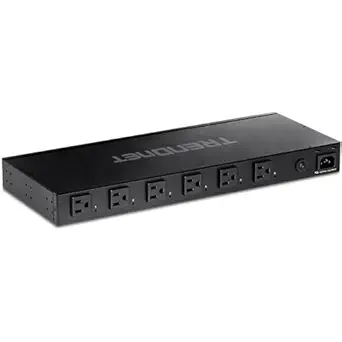
TRENDnet 6-Outlet Managed PDU, UL Certified, TPI-06
The TPI-06 suits a rack where remote power cycling matters more than maximizing outlet count. Its six managed outlets can be controlled individually, with scheduling and energy monitoring helping an administrator manage attached devices without visiting the rack. A separate bypass outlet adds a connection that is outside that managed group. Compared with the CyberPower PDU41001, TRENDnet adds surge and overload protection and a fanless design, while CyberPower offers eight switchable outlets and a local LCD with power readings. The tradeoff is that TRENDnet’s Hive cloud management requires an additional fee, and its supply is limited to 120V AC. I would choose it for a small, remotely managed network rack, but not when the priority is the most outlets or a metered 20A distribution setup like the Tripp Lite PDUMH20.
Pros:- Individual outlet control supports targeted remote restarts.
- Scheduling and energy monitoring add useful management options.
- Fanless construction avoids adding PDU fan noise to a rack.
- Overload and surge protection are specified.
Cons:- Hive cloud management requires an additional fee.
- Six managed outlets may be limiting in a growing rack.
- 120V AC operation does not suit higher-voltage deployments.
Best for: IT administrators managing a small 120V rack who want individual outlet control, scheduling, and remote access through TRENDnet Hive.
Not ideal for: Buyers who need more than six managed outlets, need 20A distribution, or do not want cloud-management fees.
- Managed outlets:6
- Bypass outlets:1
- Maximum current:15A per outlet
- Voltage:120V AC
- Connectivity:Gigabit port
- Mounting:19-inch rackmountable
- Certification:UL 62368-1
- Management features:TRENDnet Hive, outlet control, scheduling, energy monitoring, email notifications
Our verdict“Choose the TPI-06 for a quiet, compact rack where remote control of individual devices outweighs outlet count and cloud-management cost.”
Tripp Lite Metered PDU, 20A, 12 Outlets, PDUMH20
The PDUMH20 is the practical pick for rack operators who want more outlet capacity and a clear local load readout, rather than remote switching. Its two-digit meter reports current draw, giving staff a way to watch the PDU load as equipment is added. Twelve NEMA 5-15/20R outlets and a 15-foot cord offer more connection flexibility than the six managed outlets on the TRENDnet TPI-06; unlike TRENDnet, however, this Tripp Lite model does not provide individual outlet control. The 20A input is agency derated to 16A continuous, so buyers need to plan around the lower continuous-load figure. A rugged all-metal housing and 1U rack mounting suit a fixed installation, but the attached L5-20P plug means the rack must have a compatible receptacle or an appropriate power arrangement.
Pros:- Twelve outlets accommodate more rack devices than the six-outlet TRENDnet TPI-06.
- Built-in digital meter displays current draw locally.
- 15-foot cord can simplify placement relative to the power source.
- All-metal housing and included rack-mount hardware support a fixed rack installation.
Cons:- No individual outlet switching or remote management is specified.
- Continuous load is limited to 16A despite the 20A input rating.
- L5-20P input plug requires a compatible power connection.
Best for: Rack owners with a compatible 20A circuit who need 12 outlets and an at-a-glance local current reading as equipment is added.
Not ideal for: Administrators who need remote outlet switching, cloud monitoring, or a PDU that plugs into a standard 5-15R receptacle without a compatible 20A connection.
- Outlets:12 NEMA 5-15/20R
- Input plug:NEMA L5-20P
- Input voltage:110–127V
- Load display:Two-digit visual meter showing current in amps
- Cord length:15 ft
- Mounting:1U rackmount
- Warranty:2-year limited
Our verdict“Pick the PDUMH20 when local current visibility and twelve outlets matter more than remote controls, provided your rack has a compatible 20A supply.”
CyberPower PDU41001 Switched PDU
The PDU41001 balances outlet-level control with useful front-panel visibility. It has eight switchable NEMA 5-15R outlets, with local and network-based control, while the multifunction LCD shows readings such as amperage, voltage, power, and IP address. That makes it more informative at the rack than the Tripp Lite PDUMH20, whose display focuses on current, and it avoids TRENDnet TPI-06’s stated Hive cloud-management fee by offering a management console over Ethernet. The main limit is capacity: its 15A input is derated to 12A, so it is not a substitute for a higher-capacity 20A PDU. Its switch-free design also helps prevent accidental shutdowns, though buyers should confirm the control interface and network setup suit their environment before relying on remote power actions.
Pros:- Eight outlets can be switched individually or collectively.
- LCD presents amperage, voltage, kilowatts, and IP address locally.
- Remote monitoring and control are available through Ethernet.
- Event notifications can be sent by email, SMS, or SNMP traps.
Cons:- 15A input is derated to 12A, limiting continuous load capacity.
- Eight outlets provide fewer connections than the Tripp Lite PDUMH20’s twelve.
- Remote management depends on network configuration and is not cloud service.
Best for: Small IT teams that want to control individual 120V rack devices locally or over Ethernet and see several power readings on the PDU.
Not ideal for: Rack operators who need more than eight outlets, continuous loads above 12A, or a 20A input such as the Tripp Lite PDUMH20 provides.
- Outlets:8 switchable NEMA 5-15R
- Input voltage:100–120V
- Input current:15A, derated to 12A
- Input plug:NEMA 5-15P
- Cord length:12 ft
- Management:Local LCD controls and network management over Ethernet
- Monitoring and alerts:LCD readings; email, SMS, and SNMP event notifications
- Mounting and enclosure:1U rackmount; metal housing
- Warranty:3-year limited
Our verdict“Choose the PDU41001 for a compact rack that benefits from switchable outlets and detailed local and network monitoring, while keeping load within 12A.”
StarTech 16-Outlet 1U Rackmount Power Distribution Unit, 120V/15A
When rack space is tight and the goal is to connect many devices from one 1U unit, this StarTech stands out for its 16 outlets and straightforward installation. It also includes surge protection and LED indicators for ground and surge status, giving a basic visual check without adding a network-management layer. Compared with the CyberPower PDU41001, it trades switchable outlets, remote monitoring, and an LCD for twice the outlet count. The compromise is a more basic operating model: the provided details do not specify per-outlet control or load monitoring, so it suits distribution more than active power management. Its 120V/15A rating also sets a firm limit; buyers should confirm total rack draw and outlet spacing against their equipment before choosing it over lower-outlet managed options such as the TRENDnet TPI-06.
Pros:- Sixteen outlets provide high connection density in a 1U rack space.
- Surge protection is included.
- Ground and surge LED indicators provide local status cues.
- Six-foot cord suits racks positioned near a power source.
Cons:- No smart or remote management features are specified.
- No load meter or per-outlet switching is specified.
- Limited to 120V/15A applications.
Best for: IT staff outfitting a standard 19-inch rack with many low-to-moderate-load devices and prioritizing outlet density over remote management.
Not ideal for: Teams that need individual outlet switching, detailed load readings, or a supply above 120V/15A.
- Outlets:16
- Voltage:120V
- Current:15A
- Cord length:6 ft
- Mounting:1U rackmount
- Protection:Surge protection
- Indicators:Ground and surge LED indicators
- Standard:ANSI/EIA RS-310-D
Our verdict“Select this StarTech when fitting many devices into 1U matters more than outlet-level control or network monitoring.”

How We Picked
I ranked these network rack PDUs by fit for real rack decisions, not by outlet count alone. I weighed mounting style and rack compatibility, input voltage and amperage, outlet quantity and spacing, cord length and plug type, plus the presence of overload protection, surge protection, metering, or remote control. I also looked at whether a feature changes the buying decision: for example, 0U mounting can free a rack unit, but only if the rack has a suitable vertical mounting position.
The CPS1215RM leads as the most broadly useful basic 1U option, while the Tripp Lite vertical and metered models rank higher for buyers whose rack layout or monitoring needs justify their specialized formats. Managed models earn a place for control functions, not as default choices for a simple rack. Compact and high-outlet-count products rank lower for general use because their form factor, spacing, or electrical details call for closer compatibility checks. I treat each stated capacity and plug type as a constraint to verify against the site circuit and equipment load, rather than assuming a PDU increases available power.
Factors to Consider When Choosing Network Rack Power Distribution Unit Pdu
Before choosing a rack PDU, I’d start with the electrical supply and rack layout, then narrow the field by control and protection features. These decisions prevent common mismatches that an outlet count or product label alone cannot reveal.
Match the PDU Input to the Circuit
Check the circuit’s voltage, breaker rating, receptacle, and available amperage before comparing models. A 15A unit and a 20A unit are not interchangeable just because both can power rack equipment; the input plug and branch circuit must be compatible. Add up the expected draw of connected devices, including equipment that may run at peak load, and leave headroom rather than planning around the breaker limit. A PDU distributes power but does not create more capacity than the wall circuit supplies. If the outlet type or circuit rating is unclear, confirm it with a qualified electrician before ordering. This check matters especially for the Tripp Lite 20A vertical and PDUMH20 models, which use input arrangements that differ from basic 15A units.
Choose 1U or 0U Around the Rack Layout
A horizontal 1U PDU is straightforward to install and keeps outlets accessible at the front or rear, but it uses a rack unit that could otherwise hold equipment. A vertical 0U model frees that horizontal space, though it needs a compatible rack side or rear mounting position and enough clearance for plugs and cables. Measure the rack depth and the route from PDU to device before choosing based on the mounting label alone. In shallow cabinets, a long PDU body or protruding cords can interfere with doors and airflow. Think about where technicians will reach the outlets, not only where the unit physically fits. That planning can make a lower-outlet-count PDU easier to live with than a crowded high-density strip.
Plan for Plug Size and Outlet Access
Count the devices you need to power, then account for bulky adapters that can block neighboring receptacles. Wide-spaced outlets can be more useful than a larger raw outlet count when switches, power bricks, or transformer plugs share a row. Right-angle receptacles may help keep cables close to the unit, but their orientation must match the cable path and rack depth. Leave room for labeling and unplugging individual devices; a fully occupied strip can be difficult to service during maintenance. Avoid assuming USB ports replace properly rated outlets for network hardware. For dense racks, sketch the outlet plan using actual plugs or adapter dimensions before buying.
Decide Whether Surge Protection Is Needed
Basic PDUs distribute power, while models with surge protection add a layer intended to limit certain transient voltage events. That feature does not replace a properly grounded circuit, an uninterruptible power supply, or site-level electrical protection. Check whether the rack’s UPS already provides the protection and power conditioning your setup requires; stacking devices without a clear plan can add complexity without solving a specific risk. Also distinguish overload protection, which responds to excessive current, from surge suppression, which addresses voltage transients. A breaker or overload switch should not be treated as a substitute for a surge protector. Choose the protection type based on the installation’s electrical plan rather than the feature list alone.
Pay for Monitoring or Remote Switching Only When It Helps
Metering is useful when you need to track rack load, plan capacity, or identify changes in power draw, but it adds little value if nobody will review the readings. Switched outlets can let an administrator power-cycle selected equipment remotely, which may help with unattended sites or recovery procedures. They also introduce setup, network access, and security considerations that a basic PDU avoids. Confirm whether controls operate per outlet or across the whole unit, and check that the management features suit your monitoring environment. A managed PDU is not a replacement for redundant power feeds or a tested recovery plan. For a small rack with hands-on access, a simple unit may be easier to maintain; remote sites have a stronger case for control features.
Check Cord Length, Plug Type, and Cable Routing
The PDU cord must reach the intended receptacle without tension, unsafe extensions, or blocking airflow. A longer cord can simplify installation when the rack sits away from a wall outlet, but excess length needs a safe, tidy route. Verify the plug type as well as the cord length: a 5-15P, 5-20P, or L5-20P connection signals different electrical compatibility requirements. Do not rely on an adapter to make an incompatible PDU fit a circuit. Plan strain relief and cable management so the cord cannot be pulled loose when equipment is serviced. In a crowded rack, routing space can be as decisive as the PDU’s outlet count.
Frequently Asked Questions
Can I use a 20A rack PDU with a standard 15A wall outlet?
Do not assume that a 20A PDU can connect safely to a standard 15A receptacle. The plug, circuit rating, and PDU input must all match, and a 20A model may use a different connector such as an L5-20P. A plug adapter does not raise the circuit’s capacity and may create an unsafe mismatch. Check the outlet and breaker specifications before purchase, and ask an electrician if the circuit type is uncertain. If your rack has a 15A supply, select a PDU rated and fitted for that supply instead.
Does a higher outlet count mean I can power more equipment?
It means the PDU has more places to connect devices, not that the circuit can supply more total power. The combined load must remain within the rating of the PDU, its input connection, and the branch circuit. Large adapters can also block adjacent outlets, reducing the number you can use in practice. Compare both the electrical capacity and the physical outlet layout with your device list. If you need additional circuit capacity, that requires an appropriate electrical change, not a PDU with more receptacles.
Should I choose a 0U vertical PDU instead of a 1U horizontal model?
Choose 0U when freeing horizontal rack space is valuable and your rack has a suitable vertical mounting location. A 1U model may be easier to access or fit better in a small cabinet, but it occupies space that could hold equipment. Check rack depth, side clearance, outlet access, and the path of device cords before deciding. A vertical unit can still be a poor fit if the mounting channel is crowded or plugs interfere with the door. The right format depends on the cabinet layout, not just the number of rack units saved.
Is surge protection on a rack PDU a replacement for a UPS?
No. Surge protection and a UPS serve different purposes: surge suppression is intended to limit certain voltage transients, while a UPS can provide battery-backed power and may offer additional power-management features. Neither feature removes the need for correct grounding and an appropriately rated circuit. If your equipment needs time to ride through outages or shut down cleanly, select a UPS sized for the load. A surge-protected PDU may still be useful downstream, but check the UPS and PDU manufacturers’ guidance for the intended arrangement. Do not treat either device as a fix for an overloaded circuit.
When is a managed or switched PDU worth choosing over a basic model?
A managed or switched PDU makes more sense when remote visibility or controlled power cycling solves a recurring operational problem, particularly at a site without staff nearby. Metering can help track load and plan capacity, while switching can support remote recovery of selected devices. Those features do not automatically improve reliability if the network connection, access controls, and recovery procedures are not maintained. For a small rack that is easy to reach, a basic PDU may require less setup and be simpler to troubleshoot. Compare the exact management functions before paying for control you will not use.
Conclusion
Best overall: I’d choose the CyberPower CPS1215RM for a straightforward 1U rack that needs a familiar 15A distribution strip and a long cord. Best value: the 1U Horizontal Rackmount Power Strip with Overload Protection is a sensible basic direction for buyers who need simple distribution, provided its exact outlet layout and electrical ratings fit the installation. Best premium: the Tripp Lite PDUMH20 suits buyers who want metering and need its 20A input format; confirm the circuit and receptacle before selecting it. Best for beginners: the CPS1215RM is the clearest starting point for a conventional 15A rack, while the CyberPower CPS1215RMS is worth comparing if surge protection is a priority. Best for specific needs: choose the Tripp Lite PDUV15 to preserve horizontal rack space, the TRENDnet TPI-06 or CyberPower PDU41001 when managed or switched control is the goal, and a wide-spaced or high-outlet-count model when plug fit drives the choice. My final check would be circuit compatibility, rack clearance, and actual device load—not outlet count alone.