
📊 Full opportunity report: Best Quiet Case Fans + the Airflow Setup That Actually Works on ThorstenMeyerAI.com — validation score, market gap, and execution plan.
TL;DR
This article identifies the best quiet case fans for 2026 and explains the airflow configuration that ensures efficient cooling without noise. It emphasizes large, slow-moving fans and proper placement for optimal results.
Three leading manufacturers—Noctua, Arctic, and be quiet!—offer new models of quiet case fans in 2026, optimized for high-performance, low-noise operation. These fans, combined with a proven airflow setup, can significantly reduce noise levels in powerful workstations without sacrificing cooling efficiency.
The article reviews the top quiet case fans of 2026, focusing on models like the Noctua NF-A12x25, Arctic P12 Pro, and be quiet! Silent Wings 4. These fans are distinguished by their large size, slow RPM operation, and high airflow capacity, which collectively produce less noise while maintaining effective cooling. The recommended airflow setup emphasizes using larger fans (140mm preferred) on case intake and exhaust, configured on low fan curves to maximize silence. Static-pressure fans, such as the Arctic P12 Pro or Noctua NF-F12, are advised for radiators or dense heatsinks, where airflow resistance is higher. This approach aligns with the principle that moving a larger volume of air at lower speeds yields quieter operation and better thermal performance, especially for sustained AI workloads.Best quiet case fans
+ the airflow that works.
The best fan won’t help if it’s pointed the wrong way. The whole recipe: big fans, running slowly, in a clean front-to-back path, with slightly more intake than exhaust. Build a config in Part 2 and watch the pressure balance respond.
Why Quiet, Efficient Cooling Matters in 2026
Reducing noise in high-performance workstations enhances user comfort and productivity, especially in office or shared environments. The use of larger, slower fans not only minimizes acoustic disturbance but also improves reliability and longevity of components, as fans operate under less stress. Proper airflow configuration ensures that powerful AI rigs stay cool without the need for noisy, high-RPM fans, making quiet operation feasible even under heavy workloads. This development is particularly relevant as AI and data processing demands grow, requiring effective cooling solutions that do not compromise workspace comfort.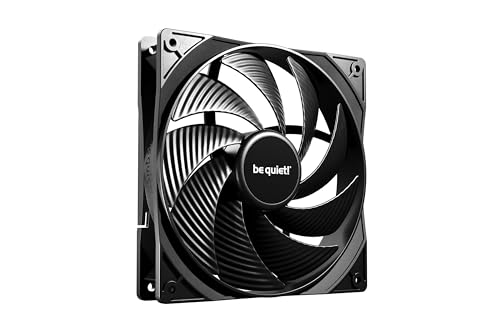
be quiet! Pure Wings 3 140mm Quiet PWM High-Speed Case Fan | Speed-regulating Closed Loop Motor| Extraordinary Air Pressure | BL109
- Optimized Frame Design: Peak performance on radiators
- Enhanced Airflow Blades: Reduce noise and boost performance
- Quiet Operation: Operates at very low RPM
As an affiliate, we earn on qualifying purchases.
As an affiliate, we earn on qualifying purchases.
Advances in Quiet Fan Technology and Airflow Principles
Historically, achieving quiet operation in high-performance PCs involved trade-offs between noise and cooling. Recent improvements by manufacturers like Noctua and Arctic have produced fans that move large volumes of air at low RPMs, significantly reducing noise. The guiding principle remains: larger fans spinning slowly generate less noise than smaller, faster fans for equivalent airflow. Additionally, proper airflow setup—placing larger intake and exhaust fans at the case front and rear, respectively, and using static-pressure fans on radiators—has proven effective in maintaining optimal thermal performance while keeping noise levels minimal. These practices build on longstanding principles but are now supported by advanced fan engineering and testing."Moving more air at lower RPMs is the key to quiet, effective cooling. Larger fans like 140mm models are essential for high-performance workstations aiming for silence."
— Thorsten Meyer, expert in PC cooling

DARKROCK 3-Pack 120mm Black Computer Case Fans
- High Performance Cooling: Nine blades, 1200 RPM speed
- Low Noise Operation: Maximum 32.1 dBA noise level
- Hydraulic Bearing: Stable, quiet, 30,000-hour lifespan
As an affiliate, we earn on qualifying purchases.
As an affiliate, we earn on qualifying purchases.
Remaining Questions About Long-Term Performance
It is not yet clear how these fans perform under extreme or prolonged workloads, or how their noise and cooling efficiency hold up over several years of continuous operation. Real-world testing beyond initial specifications is ongoing, and user experiences in diverse setups may vary.
ARCTIC P12 Pro PST - Powerful Premium Fan, 120 mm PWM Fan, 600-3000 RPM
- High Static Pressure: Efficient airflow through dense obstacles
- PWM Speed Control: Adjusts from 600 to 3000 RPM
- Quiet and Smooth Operation: Minimal vibrations for longevity
As an affiliate, we earn on qualifying purchases.
As an affiliate, we earn on qualifying purchases.
Future Developments in Quiet PC Cooling Solutions
Manufacturers are expected to release new fan models with even lower noise profiles and higher airflow efficiencies. Further research into airflow dynamics and case design will likely optimize cooling setups, making silent, high-performance PCs more accessible. Users should monitor upcoming product releases and testing results to refine their configurations.DARKROCK 3-Pack 120mm Black Computer Case Fans
- High Performance Cooling: Nine blades, 1200 RPM speed
- Low Noise Operation: Maximum 32.1 dBA noise level
- Hydraulic Bearing: Stable, quiet, 30,000-hour lifespan
As an affiliate, we earn on qualifying purchases.
As an affiliate, we earn on qualifying purchases.
Key Questions
Why are larger fans better for quiet operation?
Larger fans move more air at lower RPMs, which produces less noise compared to smaller fans spinning faster for the same airflow.
Should I use static-pressure fans for radiators?
Yes, static-pressure fans are designed to push air through dense fin stacks efficiently, making them ideal for radiators and high-restriction areas.
Can I achieve quiet operation without sacrificing cooling performance?
Yes, by using larger fans on low RPMs and proper airflow configuration, you can maintain effective cooling while minimizing noise.
Are these fan recommendations suitable for all PC cases?
Most high-quality fans are compatible with standard 120mm and 140mm mounts, but always verify size and clearance before purchasing.
Source: ThorstenMeyerAI.com