
Machine learning is increasingly becoming a silent adviser in military careers. It supports rapid decision-making by analyzing vast amounts of data from sensors, intelligence sources, and battlefield conditions, helping you respond faster and more accurately. As AI systems guide operations and training, you’ll work alongside intelligent tools that enhance your capabilities without replacing your role. Understanding how machine learning integrates into military careers can give you a competitive edge—exploring further reveals how this shift shapes your future in defense.
Key Takeaways
- AI systems analyze vast data to provide real-time insights, supporting rapid decision-making in military operations.
- New occupational specialties integrate AI expertise, making machine learning a core component of career development.
- AI acts as an intelligent adviser by automating routine tasks, allowing personnel to focus on strategic planning.
- Military training increasingly uses AI-driven simulations to prepare servicemembers with realistic, adaptive scenarios.
- Human oversight remains vital, with AI serving as a silent, intelligent support tool that enhances traditional military roles.
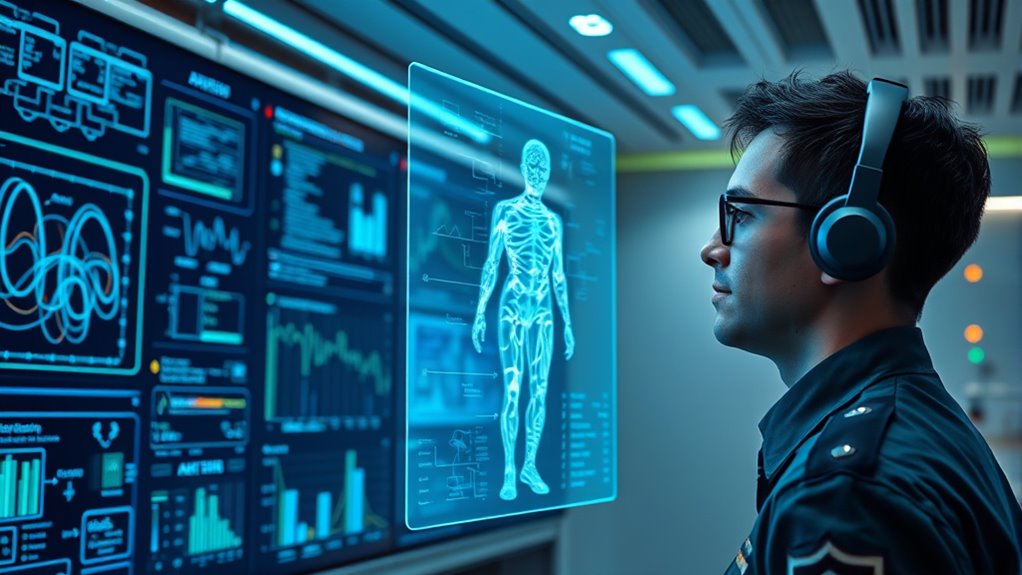
Machine learning is transforming military careers by integrating advanced AI technologies into everyday operations. As the U.S. Army introduces new occupational specialties, you’ll find yourself working alongside AI-driven systems that enhance decision-making, training, and operational efficiency. One of the most significant changes is the creation of the 49B Military Occupational Specialty, dedicated entirely to artificial intelligence and machine learning. This role isn’t just about understanding algorithms; it involves actively applying AI to solve complex military problems. A parallel warrant officer track is also in development, designed to embed technical expertise directly into units, ensuring AI knowledge is integrated at all levels. For officers across branches like cyber and signal, formalized AI career paths are emerging through specialized areas of concentration. These pathways allow you to pursue AI expertise without leaving your core community, blending traditional military duties with cutting-edge technology.
AI specialization is reshaping military careers through new roles, integrated expertise, and advanced operational capabilities.
This shift isn’t happening in isolation. The global military AI market continues to grow rapidly, projected to nearly double from $9.31 billion in 2024 to over $19 billion by 2030. This growth reflects the increasing investment from governments worldwide, especially in North America, which holds about 33% of the market, and in the Asia-Pacific region, where adoption is accelerating. Software, especially machine learning, dominates market revenue because of its essential role in processing vast amounts of battlefield data. As defense budgets expand in countries like the U.S., China, and India, AI systems are becoming indispensable across many domains, including intelligence, surveillance, and decision-making. For you, this means new opportunities to develop expertise in AI applications that directly influence military strategy and operations.
AI is also revolutionizing training and simulation. Instead of traditional models, AI enables more realistic, dynamic scenarios with intelligent opponents and teammates. This not only improves training quality but also reduces logistical costs and resource requirements. Longer, more complex training sessions become feasible, broadening access for servicemembers. Manufacturers utilize AI to simulate aerospace and combat platforms, speeding innovation and refinement. As a military professional, you’ll benefit from these advancements, gaining skills that are critical for modern warfare. However, it’s essential to understand that AI enhances traditional methods; it’s a tool to augment your capabilities, not replace human judgment.
In decision-making, AI acts as a silent adviser. It can analyze vast datasets from sensors, intelligence sources, and open sources much faster than humans, supporting rapid battlefield decisions. The Military Decision-Making Process (MDMP) integrates AI to improve speed and adaptability. Routine tasks like data collection and analysis can be automated, freeing your cognitive resources for strategic thinking. U.S. initiatives like CPCE and APF aim to provide better situational awareness through AI, though these systems are still evolving. The new AI occupational roles are also designed to ensure that the military workforce stays ahead of technological advances and maintains operational superiority. Ultimately, AI functions as a force multiplier, empowering you to make smarter, faster decisions while emphasizing that human oversight remains essential. As AI becomes a core part of military careers, your role will increasingly involve working alongside intelligent systems that silently advise, guide, and shape your missions.
Frequently Asked Questions
How Secure Is the Data Used for Machine Learning in Military Applications?
The data used for military machine learning is protected with advanced encryption, strict access controls, and regular audits to prevent breaches. You rely on secure networks and data anonymization techniques to safeguard sensitive information, but threats like cyberattacks and data poisoning still pose risks. Staying vigilant and continually upgrading cybersecurity measures is essential to maintaining the integrity and confidentiality of military data.
Can Machine Learning Replace Human Decision-Makers in Military Strategy?
You might think machine learning will fully replace human decision-makers, but it’s not happening yet. Currently, AI systems support and enhance strategic choices, but humans still oversee and validate decisions—especially in complex situations. With over 60% of military operations relying on AI insights, your role remains essential. AI acts as a force multiplier, not a substitute, ensuring strategic judgment and ethical considerations stay in your hands.
What Ethical Concerns Arise From Deploying AI in Military Career Guidance?
You should be aware that deploying AI in military career guidance raises ethical concerns like bias in training data, which can lead to unfair recommendations. You might also face transparency issues, making it hard to understand decision processes, and privacy worries if sensitive data isn’t handled properly. Additionally, over-reliance on AI could diminish human judgment, and accountability becomes unclear if mistakes happen, challenging responsible decision-making.
How Do Service Members Feel About AI Influencing Their Career Paths?
You might feel cautiously optimistic about AI influencing your career path, appreciating its potential to open new opportunities and bridge military-civilian gaps. However, you could also be wary of overreliance on technology, especially concerning oversight and ethical issues. Trust varies with experience and rank; younger personnel tend to embrace AI more readily, while senior officers remain skeptical. Overall, your attitude depends on how well you understand AI’s capabilities and limits.
What Training Is Provided to Military Personnel Regarding Machine Learning Tools?
You get targeted training in machine learning tools through formal programs like the Naval Postgraduate School’s 12-month AI for Military Use Certificate, which covers fundamentals, reasoning, and military applications. Short courses focus on defense-specific AI and machine learning models. Industry-led initiatives, like Google’s free virtual training for veterans, teach large language models and core concepts. Developing skills in programming languages and data visualization tools further enhances your ability to master machine learning in military contexts.
Conclusion
Just like a trusted compass guiding your way, machine learning quietly shapes your military career choices. It analyzes data faster than you can blink, helping you make smarter decisions about your future. As technology becomes more embedded in military life, you’ll find yourself steering a path clearer than ever before. Embrace this silent adviser, and let it steer you toward opportunities you might never have considered—because in this new era, your career’s next chapter is just a click away.