Artificial intelligence is transforming 3D design by streamlining workflows, boosting creativity, and enabling faster, more complex models. It helps you generate realistic textures, suggest design improvements, and automate routine tasks, freeing you to focus on innovation. AI tools like neural networks and generative models allow for real-time visualization and collaborative work, expanding what’s possible. Keep exploring to discover how these advancements are pushing the boundaries of 3D design even further.
Key Takeaways
- AI accelerates 3D concepting and prototyping through generative models that create detailed models from text prompts or images.
- Automated error detection and optimization streamline workflows, boosting efficiency and reducing manual effort.
- Real-time visualization powered by GPU technology enables instant model updates and immersive design exploration.
- AI-driven educational tools and immersive models enhance understanding and decision-making in complex design projects.
- Future trends include predictive modeling and customizable AI workflows that expand creative possibilities and collaboration.
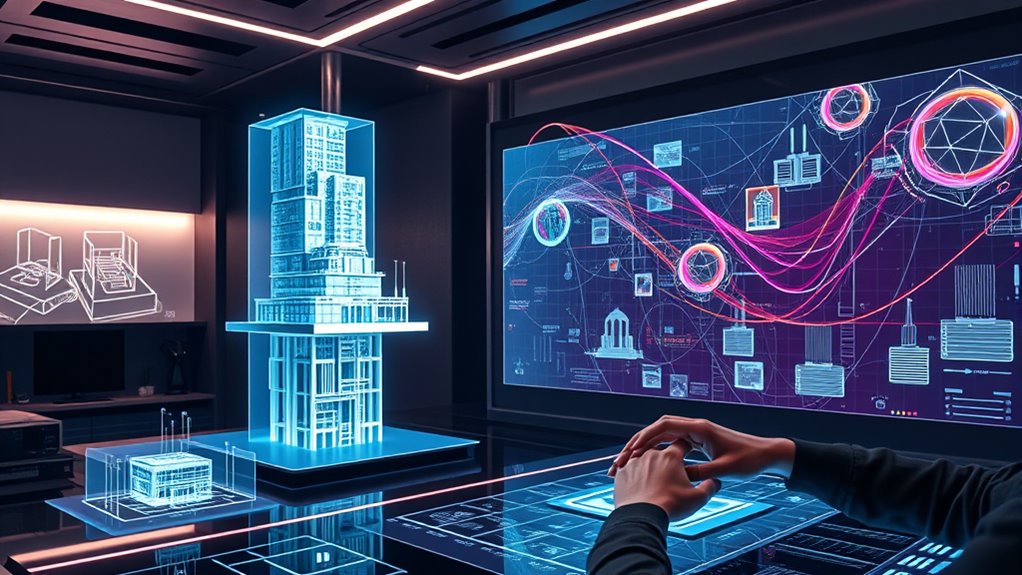
Have you ever wondered how artificial intelligence is transforming 3D design? The integration of AI into design workflows is revolutionizing the way you create, prototype, and visualize models. Today’s AI tools can assist you in sculpting intricate shapes and generating realistic textures with remarkable ease. Generative AI, like Meshy AI, allows you to produce 3D models from simple text prompts or images, making the concepting process faster and more intuitive. This means you can move from rough ideas to detailed prototypes much more quickly, reducing the manual effort involved. AI-assisted modeling is becoming increasingly common in professional pipelines, enabling faster iteration cycles. Autodesk is pushing the boundaries further with neural CAD models that generate designs based solely on text descriptions. This shift simplifies the design process and opens new possibilities for customization and rapid iteration. Cloud-based platforms equipped with AI foster real-time collaboration, allowing teams across different locations to work together seamlessly. You can now share, modify, and review models instantly, boosting productivity and reducing project turnaround times. Additionally, internal company hackathons can help identify creative solutions and challenges faced during the design process, enhancing collaboration and innovation. AI-driven design tools often prioritize sustainability by optimizing material usage and energy efficiency, aligning your work with eco-friendly practices.
Using AI in 3D design dramatically improves efficiency and speed. Tasks that once took hours, like error detection and optimization, are now automated, freeing you to focus on the creative aspects. AI offers valuable suggestions during the design process, acting as a collaborative partner that enhances your ideas and automates repetitive tasks. With advanced GPU technology, real-time visualization becomes achievable, enabling you to see changes instantly, refine details on the fly, and make better-informed decisions. AI’s role in education is also expanding, with immersive, interactive models helping students and beginners grasp complex concepts more effectively.
Looking ahead, AI will continue to redefine what’s possible in 3D design. Predictive modeling might suggest improvements based on data analysis, while customizable AI models will tailor workflows to your specific needs. Companies like Autodesk aim to develop integrated tools that blend manual and automated tasks seamlessly, making your workflow more versatile. Although AI will automate many routine tasks, it’s unlikely to replace you entirely; instead, it will augment your capabilities, allowing you to focus on higher-level creative problem-solving. As AI technology advances, so too will your options for innovation, pushing the boundaries of what you can create in 3D.
The key technologies driving this transformation include generative models, neural networks, GPU advancements, cloud computing, and machine learning. These tools work together to produce smarter, faster, and more collaborative design environments. With AI’s ongoing evolution, the future of 3D design promises to be more dynamic, efficient, and creatively limitless than ever before.
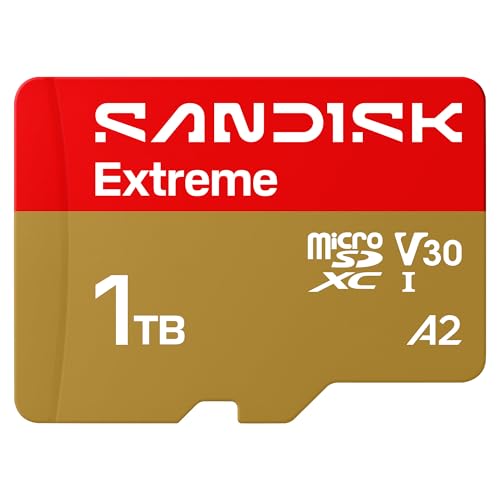
SANDISK 1TB Extreme microSD UHS-I Card - Up to 245MB/s Read Speed and 170MB/s Write Speed, 5.3K Video, 4K UHD Video, high-Performance for Action cams, Drones, Android Devices - SDSQXH9-1T00-GZ6MA
- High-Resolution Video Capture: Supports 5K and 4K UHD videos
- Fast Data Transfer Speeds: Up to 245MB/s read, 170MB/s write
- Large Storage Capacity: Up to 2TB for extended recording
As an affiliate, we earn on qualifying purchases.
Frequently Asked Questions
How Does AI Improve Collaboration in 3D Design Teams?
AI improves collaboration in 3D design teams by enabling real-time shared workspaces, which allow everyone to work simultaneously with instant updates. It streamlines communication through integrated chat, video calls, and centralized files, reducing misunderstandings. AI also facilitates seamless integration with other tools, offers quick feedback with auto-generated variations, and helps track progress. This accelerates decision-making, enhances transparency, and guarantees everyone stays aligned, making teamwork more efficient and creative.
Can AI Generate Entirely New 3D Design Concepts Automatically?
AI acts like a creative spark igniting new ideas in your mind, enabling you to generate entire 3D concepts automatically. It converts text prompts or images into detailed models, often without manual effort. You can explore countless variations quickly, pushing the boundaries of traditional design. This technology empowers you to innovate freely, making the impossible possible and transforming your creative process into an effortless, dynamic journey of discovery.
What Are the Limitations of AI in Complex 3D Modeling?
You’ll find that AI struggles with complex 3D modeling because it often lacks geometric precision and detailed control. It may hallucinate features or produce unrealistic results, especially for intricate organic or mechanical forms. You still need to do significant manual tweaking and validation to meet professional standards. Plus, current AI models are specialized, limiting versatility, and integration into high-precision workflows remains a challenge.
How Does AI Impact the Skill Set Required for 3D Designers?
You’ll find that AI shifts your skill set from solely mastering traditional 3D software to understanding AI-assisted tools like Sloyd.ai. You need to adapt, troubleshoot, and customize AI outputs, while honing your creative skills in storytelling and conceptual design. Collaboration with AI specialists becomes crucial, and staying updated on legal and ethical issues is essential. This blend of technical, creative, and professional skills keeps you competitive and innovative in evolving 3D design workflows.
Are There Ethical Concerns With Ai-Driven 3D Design Creations?
Imagine a delicate balance beam, where creativity and ethics walk hand-in-hand. You should know that AI-driven 3D design raises ethical concerns, like respecting artists’ rights and avoiding copyright infringement. You must guarantee proper attribution, prevent bias, and safeguard privacy. When you use AI responsibly, it becomes a tool that amplifies your vision without compromising moral standards, maintaining trust and integrity in your creative process.

SANDISK 1TB Extreme PRO SDXC UHS-II Memory Card - C10, U3, V60, 6K, 4K UHD, SD Card - SDSDXEP-1T00-GN4IN
- Target Users: Prosumers and professionals using MIL and cinema cameras
- Video Recording: Supports 6K and 4K UHD recording with V60 rating
- Video Speed: Sustained 60MB/s recording rate
As an affiliate, we earn on qualifying purchases.
Conclusion
So, as you marvel at AI’s ability to craft intricate 3D models in seconds, don’t forget—you’re still the one clicking “save” and imagining the final masterpiece. It’s ironic how machines now do the heavy lifting, yet your human touch remains essential to give it meaning. In this age of endless possibilities, perhaps the true art is knowing when to step back and let AI do what it does best—while you sit back and enjoy the show.

Lexar 1TB Play PRO Micro SD Express Card, 900MB/s Read, 4K, V30, UHS-I
- Compatibility with Nintendo Switch 2: Optimized for Nintendo Switch 2
- High read speeds: Up to 900MB/s read speed
- Fast write speeds: Up to 600MB/s write speed
As an affiliate, we earn on qualifying purchases.

SANDISK 1TB Extreme PRO SD UHS-II V90 Memory Card - Up to 310MB/s Read speeds, up to 305MB/s Write speeds, 8K, IP68 Water and dust Resistant - SDSDXDE-1T00-GN4IN
- High-Speed Write Performance: Up to 305MB/s write speeds
- Large Storage Capacity: Up to 2TB for 8K video
- Fast Data Transfer: Up to 310MB/s transfer speeds
As an affiliate, we earn on qualifying purchases.