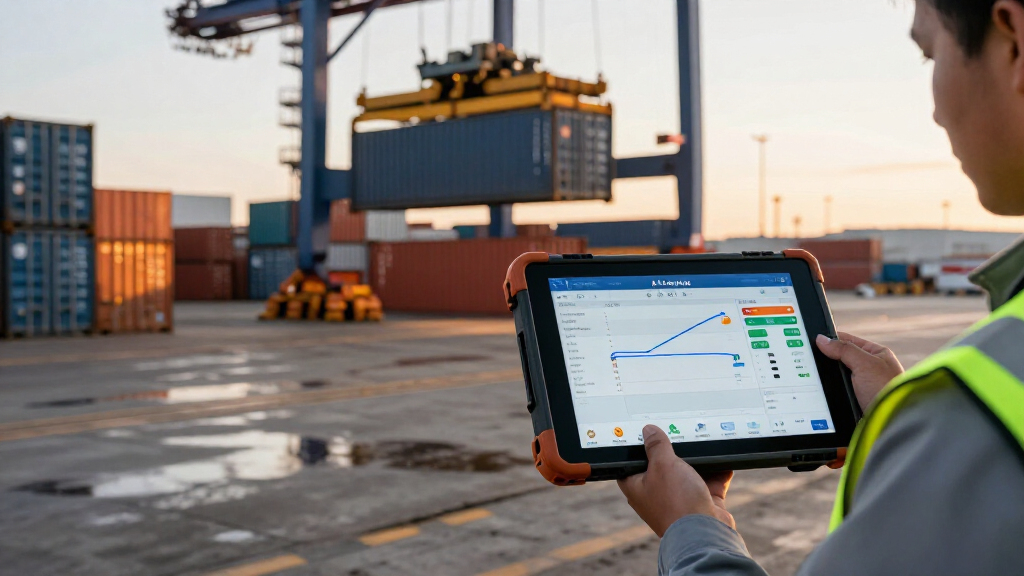

🔍 Read the full analysis: How AI Transforms Container Dock Operations on ThorstenMeyerAI.com

Get hardware and tech essentials delivered free with Prime
- Fast, free delivery on millions of items
- Prime Video, Amazon Music and more included
- Member-only deals all year
TL;DR
The source describes how containerization and port mechanization cut cargo-handling costs while sharply reducing demand for dock labor, and notes that modern terminal automation can bring slower moves and more breakdowns at some sites. It does not document a specific AI deployment or establish what AI is currently changing at container docks.
A November 23 article on ThorstenMeyerAI.com examines how containerization transformed dock work and cites a 2024 U.S. government report finding that automated terminals had denser stacking but, at some sites, slower container moves and more breakdowns. Despite the subject framing of AI and dock operations, the article provides no specific AI deployment, performance data or named port using AI; its main account is about the steel container and mechanization.
The report contrasts break-bulk shipping, in which dockworkers moved sacks, barrels and crates individually, with container transport, in which cargo travels in a standardized box from truck to ship without being unpacked. It recounts the Ideal X’s first container voyage: on April 26, 1956, a crane loaded 58 truck bodies onto the converted tanker in Newark, New Jersey. The ship reached Houston five days later, where trucks were ready to carry the containers onward. The article notes that containers existed before Malcom McLean’s system; the innovation was coordinating the box across transport modes.
Using figures attributed to historian Marc Levinson’s book The Box, the article says loose cargo handling cost about $5.83 per ton in 1956, compared with 15.8 cents per ton for the Ideal X. It calculates that difference as roughly 36 times cheaper. Those figures concern the costs reported for these two forms of cargo handling; they are not a measure of AI’s effect. The article also cites a roughly 1960 estimate that port charges made up 48.7% of the cost of shipping a truckload of medicine from Chicago to Nancy, France.
The changes had major labor consequences. The source says the Port of New York and New Jersey had more than 35,000 longshoremen in the early 1960s and about 3,500 in 2013, citing the Waterfront Commission. It also describes a 1960 West Coast labor agreement that exchanged flexibility for mechanization for protections and benefits for registered workers. In a separate modern example, the article cites a 2024 government report on terminal automation, but gives no terminal names or detailed measures in the supplied text.
Infographic 01 · Before the box
Why the port cost more than the ocean
Before the container, every sack and crate was handled one by one. The port, not the sea, was the expensive part of a trip.
One truckload of medicine, Chicago → Nancy (France) · estimate ca. 1960 · total $2,386
Cost of loading one ton · 1956
Roughly 36 times cheaper to load (5.83 ÷ 0.158, our calculation). The loading figures are from Levinson’s own article; other authors cite them to The Box, 1st ed. (2006), p. 52.
Sources: M. Levinson, The Box, 2nd ed. (Princeton UP, 2016), ch. 1, Table 1, p. 12 (American Association of Port Authorities data); M. Levinson, The Box That Shrank the World, Works That Work No. 2.
Powered by Thorsten Meyer AI
Automation’s Effects on Port Work
The account shows why automation at ports is a labor and logistics issue, not simply a technology upgrade. Containerization helped reduce handling costs and made it possible to move cargo between ships, trucks and trains in standardized units. At the same time, fewer tasks required workers to lift and sort individual pieces, contributing to a steep decline in dock employment in the examples cited.
For ports and shipping customers, the reported mixed results from automated terminals are a warning against treating automation as an automatic gain in speed. Denser stacking can change how much cargo a terminal stores, while slower moves and breakdowns can affect operations. The article does not establish whether AI caused or could address those outcomes. It gives readers historical context for evaluating claims about AI, but not evidence sufficient to measure AI’s current effect on port productivity, jobs or costs.
Products Worth Considering

Logitech MX Master 4 for Mac

LG UltraGear 27GR83Q-B 27-Inch QHD 240Hz IPS Gaming Monitor

Apple MacBook Pro 16.3-inch with PROLED XDR Display, Silver
As an affiliate, we earn on qualifying purchases.
From Break-Bulk to the Ideal X
Before container shipping, cargo was handled piece by piece, a process the source calls break-bulk. The article describes work as physically demanding and irregular, including New York’s “shape-up,” where dockworkers waited to be selected for a day’s work. It attributes its account of hiring abuses to the Waterfront Commission of New York Harbor, established in 1953. The 1954 film On the Waterfront later made the hiring practice widely known.
McLean’s system changed the unit of handling: instead of transferring each item separately, cranes moved containers between transport modes. The source says the West Coast’s ILWU and the Pacific Maritime Association signed a mechanization agreement on October 18, 1960. It provided a $29 million fund and income, retirement and other protections for eligible registered workers, alongside changes to work rules. The article also notes later labor conflict, including a 134-day strike in 1971 and an East and Gulf Coast dockworkers’ strike in 2024 over wages and automation.
““epochal in the annals of industrial relations””
— Thorsten Meyer’s article, citing the U.S. Bureau of Labor Statistics on the 1960 labor agreement
What the AI Evidence Shows
The supplied source does not identify an AI system used at a container terminal, describe a port’s AI rollout, or give results that isolate AI’s impact. Its discussion of modern technology concerns terminal automation generally. The 2024 report is summarized as finding denser stacking alongside slower moves and more breakdowns at some terminals, but the article does not provide the report’s title, sample, specific sites, measurement periods or figures.
It is also unclear how much of the employment decline cited in the historical examples is attributable specifically to containerization rather than other changes over the decades. The source presents the figures as evidence of a substantial reduction in dockworker numbers, but does not offer a causal breakdown. Its account of McLean waiting at a pier before developing the idea is explicitly described as a legend without a contemporary record.
Evidence Needed on AI at Ports
The source supplies no announced AI project, implementation schedule or upcoming decision at a named port. To establish what AI is changing in dock operations, further reporting would need to identify the systems in use and obtain data from port authorities, terminal operators, workers and technology providers. Useful measures would include container moves per hour, equipment downtime, safety incidents, labor requirements and costs, with clear comparisons against the same terminals before deployment.
For now, the grounded takeaway is narrower: containerization and mechanization reshaped port economics and work, while one cited assessment found mixed operational results from automated terminals. Whether AI improves those results, changes staffing, or introduces new reliability and safety concerns remains unanswered by the material provided.
Key Questions
Does the source report a specific AI system operating at a port?
No. It discusses containerization, mechanization and terminal automation, but names no AI system or port AI deployment.
What did the cited 2024 report say about automated terminals?
As summarized in the article, some terminals had denser stacking but also slower moves and more breakdowns. The supplied material does not identify the terminals or provide detailed measurements.
How did containerization change cargo handling costs in the article’s example?
The article attributes figures to Marc Levinson’s The Box: about $5.83 per ton for loose cargo handling in 1956 and 15.8 cents per ton for the Ideal X. It calculates the difference as roughly 36 times cheaper; these are historical handling-cost figures, not an estimate of AI savings.
What did the 1960 West Coast labor agreement provide?
The agreement allowed changes to work rules that constrained mechanization and created a $29 million fund for protections and benefits for eligible registered longshoremen, including income support and retirement provisions, according to the source.
Source: ThorstenMeyerAI.com