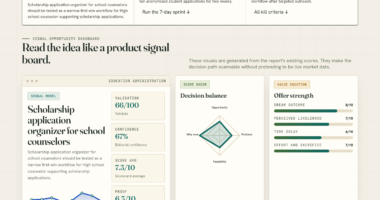
📊 Full opportunity report: An AI Guide To Resigning While Keeping Employee Benefits On Your Radar on IdeaNavigator AI — validation score, market gap, and execution plan.

Get hardware and tech essentials delivered free with Prime
- Fast, free delivery on millions of items
- Prime Video, Amazon Music and more included
- Member-only deals all year
TL;DR

IdeaNavigator AI has proposed testing an AI assistant that helps employees compare resignation dates against benefits and compensation rules. The concept is an early-stage product idea, not a launched service or a demonstrated source of savings; its proposed test would assess 100 planned resignations.
IdeaNavigator AI’s proposal describes testing an AI assistant that would compare possible resignation dates with an employee’s equity, bonus, retirement matching, insurance and paid-time-off rules. The concept targets workers planning to leave a job, but the company’s material reports no product launch, measured savings or completed trial.
According to IdeaNavigator AI’s description of the concept, users would upload benefits documents and equity grants. The assistant would compare candidate departure dates against provisions such as equity vesting schedules, bonus eligibility, 401(k) matching, health insurance timing and rules for unused paid time off. The proposed output is an “optimal-date memo” and a departure checklist.
The proposal frames the problem as one of timing: employees may choose a resignation date before checking whether it affects compensation or coverage. Those effects depend on each worker’s plan documents, employer policies and circumstances. IdeaNavigator AI presents the assistant as a way to organize and calculate possible impacts, not as a guarantee that a particular date will preserve benefits or produce a specific financial outcome.
IdeaNavigator AI says the concept would use a flat fee for each exit and be positioned as employer-neutral. The company also proposes testing it with 100 planned resignations, totaling documented savings against each participant’s initially intended resignation date. Its material provides no pricing, test schedule, results or evidence of a working system.
Resignation Dates Can Change Payouts
The proposal highlights a decision that can have financial and coverage consequences: the date a worker leaves may determine whether a benefit has vested, a bonus remains eligible, or employer-sponsored insurance ends before other coverage begins. As IdeaNavigator AI’s description notes, relevant rules may be spread across separate documents; a worker who overlooks a deadline may discover its effect only after setting a departure date.
An automated document review could make it easier to compare dates before giving notice, particularly when a worker has several benefit programs to check. But the usefulness of such a tool would depend on whether it can read plan language accurately, account for individual circumstances and show its assumptions. IdeaNavigator AI’s proposed test focuses on documented savings; the material does not establish that the tool can reliably find them or that any savings would outweigh its fee.
Employer-neutral positioning is also part of the concept: a worker considering departure may want guidance that is not tied to the current employer’s interests. This is a stated product aim in IdeaNavigator AI’s material, not an independently verified feature or policy of an operating service.
benefits analysis software for employees
As an affiliate, we earn on qualifying purchases.
As an affiliate, we earn on qualifying purchases.
A Proposed Single-Task Workflow
IdeaNavigator AI frames the assistant as a narrow first product for one audience: an employee already planning to resign. As described in the company’s proposal, the concept centers on comparing dates and producing a checklist from documents supplied by the user, within the consumer employment-tools market.
The proposal’s rationale is that job switching remains elevated, employee benefits are becoming more complex, and document-reading language models can parse benefits materials. These are claims presented as the opportunity’s rationale; the material provides no supporting labor-market figures, comparative analysis of existing products or technical test results.
IdeaNavigator AI proposes validating the concept by processing 100 planned departures and comparing documented money saved with each person’s original date. This is a proposed evaluation, not a completed study. The material does not say how participants would be recruited, what counts as a saving, how calculations would be checked, or how the assistant would handle incomplete or conflicting plan documents.
employee benefits document review tool
As an affiliate, we earn on qualifying purchases.
As an affiliate, we earn on qualifying purchases.
Accuracy and Savings Still Untested
IdeaNavigator AI’s material reports no working product or trial results. It does not say whether the assistant has been built, who would operate it, when testing might begin, or whether the proposed 100-person evaluation will take place. The proposal provides no example calculation or evidence that an AI system has correctly interpreted actual benefits documents.
Important implementation questions also remain open. Employer plans and equity awards can contain different definitions, deadlines and exceptions, and the material does not explain how the assistant would verify its interpretation, protect sensitive employment and financial documents, or respond when information is missing. It also does not specify how the tool would distinguish an estimate from a confirmed benefit entitlement or direct users to authoritative plan administrators.
The proposed comparison with each user’s intended resignation date would not by itself prove that the assistant caused a financial gain. An eventual evaluation would need to explain how it measures documented savings and accounts for other reasons a worker may choose a departure date. Until results are available, the product’s accuracy, value and user demand remain unknown.
retirement and bonus calculation calculator
As an affiliate, we earn on qualifying purchases.
As an affiliate, we earn on qualifying purchases.
A 100-Departure Test Is Proposed
IdeaNavigator AI identifies testing the concept on 100 planned resignations as its next stated step. The proposed evaluation would total the documented financial difference between the assistant’s date analysis and each user’s originally intended date. The company has not provided a start date, participant criteria, methodology or findings, so this remains a proposal rather than a completed milestone.
If the evaluation proceeds, useful details would include how benefit calculations are verified, how uncertainty is presented to users, what happens when plan documents conflict, and whether participants’ information is protected. Pricing and the boundaries of any financial or benefits guidance also remain unreported. IdeaNavigator AI has not specified a launch date or next public update.
Source: IdeaNavigator AI proposal
As an affiliate, we earn on qualifying purchases.
Key Questions
Has the resignation assistant launched?
No launch is reported. IdeaNavigator AI’s available description outlines a product concept and a proposed test, not an operating service.
What would the tool assess?
According to IdeaNavigator AI’s proposal, users would upload benefits documents and equity grants. The assistant is intended to compare candidate resignation dates against vesting, bonus eligibility, 401(k) matching, insurance transitions and PTO payout rules.
How would the proposed test measure results?
IdeaNavigator AI proposes running 100 planned resignations through the assistant and totaling documented savings against each person’s initially intended date. The company has reported no test results or detailed measurement method.
Can the assistant guarantee that a worker will keep benefits?
No such guarantee is established. IdeaNavigator AI’s concept aims to identify date-related effects, but benefit outcomes depend on individual plan terms and circumstances, and the proposed system’s accuracy has not been demonstrated.
Source: IdeaNavigator AI
Halloween Picks
halloween
As an affiliate, we earn on qualifying purchases.