

🔍 Read the full analysis: Top 10 Mirrorless Cameras With AI Features To Watch In 2026 on ThorstenMeyerAI.com

Get hardware and tech essentials delivered free with Prime
- Fast, free delivery on millions of items
- Prime Video, Amazon Music and more included
- Member-only deals all year
TL;DR
In 2026, the market for mirrorless cameras with AI features is expanding rapidly. This report highlights the top 10 models to watch, emphasizing their AI-driven capabilities and how they impact photography and content creation.
As the year 2026 approaches, the landscape of mirrorless cameras is increasingly dominated by models integrating advanced AI features. Several manufacturers have announced new releases that leverage artificial intelligence for autofocus, scene recognition, and video stabilization, making these cameras highly appealing to both professionals and amateurs. This article highlights the top 10 mirrorless cameras with AI capabilities to watch in 2026, emphasizing their technological innovations and market significance. For a detailed review, see the original analysis.
Leading the list is the Canon EOS R7 Mark II, which features a cutting-edge AI autofocus system capable of real-time eye and subject tracking. According to Canon, this model offers improved speed and accuracy, especially in dynamic shooting conditions. The Nikon Z9 II introduces an AI-driven scene recognition system that adapts settings automatically for optimal image quality, a move Nikon claims will streamline professional workflows.
Sony continues to push AI boundaries with the Sony Alpha ZV-E20 II, designed specifically for content creators. It incorporates AI-based facial recognition and automatic framing, reducing the need for manual adjustments during video shoots. Meanwhile, Fujifilm’s X-H2S II integrates AI-powered subject detection and tracking, enhancing its appeal for wildlife and action photography.
Other notable models include the Panasonic Lumix S5 II, which offers AI-assisted stabilization and scene analysis, and the Olympus OM-D E-M1 Mark III II, with AI-driven autofocus and subject recognition tailored for macro and landscape shooters. These models exemplify the trend toward smarter, more intuitive cameras that adapt seamlessly to user needs.
The 10 picks
- 1
 Canon EOS R6 Mark II Mirrorless Camera RF24-105mm F4-7.1 IS STM Lens KitView on Amazon →
- 2
 Nikon Z50 II with Two Lenses – Compact Mirrorless Camera with 20.9MP Sensor,…View on Amazon →
- 3
 Canon EOS R50 Mirrorless Camera with 18-45mm & 55-210mm Lenses BundleView on Amazon →
- 4
 Sony ZV-E10 APS-C Mirrorless Camera with 16-50mm LensView on Amazon →
- 5
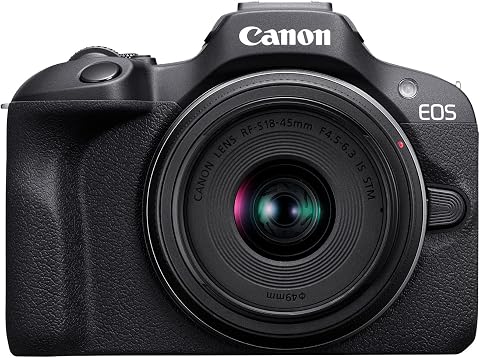 Canon EOS R100 Mirrorless Camera with RF-S18-45mm F4.5-6.3 IS STM Lens KitView on Amazon →
- 6
 Sony Alpha a6400 Mirrorless Camera with 16-50mm LensView on Amazon →
- 7
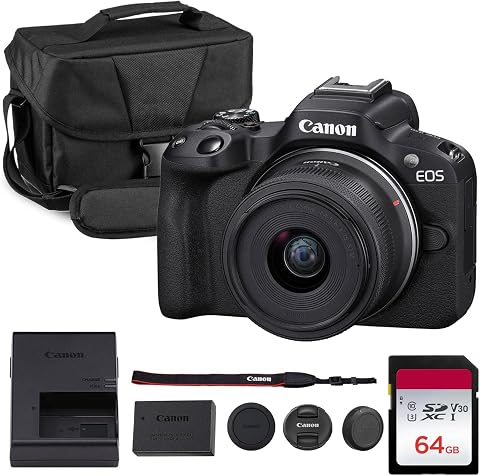 Canon EOS R50 Mirrorless Camera with 18-45mm Lens BundleView on Amazon →
- 8
 Canon EOS R50 Mirrorless Camera RF-S18-45mm F4.5-6.3 IS STM Lens KitView on Amazon →
- 9
 Canon EOS R100 Mirrorless Camera Kit with 18-45mm & 55-210mm Lenses, 24MP Sen…View on Amazon →
- 10
 Canon EOS R100 Mirrorless Camera with RF-S 18-45mm Lens BundleView on Amazon →
Why AI-Enabled Mirrorless Cameras Matter in 2026
The integration of AI features into mirrorless cameras signifies a major shift in photography technology, making advanced capabilities accessible to a broader audience. AI-driven autofocus, scene recognition, and stabilization improve image quality, reduce user effort, and enable new creative possibilities. For professionals, these enhancements can streamline workflows, while amateurs benefit from easier operation and better results in challenging conditions. As AI becomes more embedded in camera systems, the potential for innovation and improved user experience grows exponentially, influencing market dynamics and consumer expectations.
Products Worth Considering

Apple MacBook Air 13-inch Laptop with M5 Chip, 16GB Memory, 512GB SSD, Liquid Retina Display, and 12MP Center Stage Camera (2026, Silver)

Ledger Flex + Folio Crypto Hardware Wallet

Ledger Flex Crypto Wallet with 2.8-Inch E Ink Touchscreen
As an affiliate, we earn on qualifying purchases.
Evolution of AI in Mirrorless Camera Development
The use of AI in cameras has been gradually evolving over the past few years, with major brands progressively introducing smarter autofocus, scene recognition, and video stabilization technologies. In 2024, several models showcased AI capabilities that significantly improved performance, setting the stage for 2026’s anticipated innovations. Industry analysts predict that AI will become a core feature, not just an added bonus, as manufacturers compete for market dominance by offering increasingly intelligent and autonomous cameras.
Historically, mirrorless cameras have prioritized compact design, image quality, and speed. The latest wave of AI integration aims to enhance these attributes further, enabling cameras to adapt to complex shooting environments in real-time. Major announcements from Canon, Sony, Nikon, and others confirm that AI will be a defining feature in upcoming models, with some prototypes already demonstrating impressive capabilities at industry expos and press events.
Unconfirmed Details and Future AI Capabilities
While many manufacturers have announced upcoming models featuring AI, specific details about their full capabilities, reliability, and real-world performance remain unconfirmed. It is unclear how these AI features will perform under diverse shooting conditions or how quickly they will be adopted by the broader market. Additionally, the long-term durability and software support for these AI systems are still to be seen, and some experts question whether the current AI implementations will evolve as rapidly as promised.
Upcoming Launches and Industry Expectations for 2026
Manufacturers are expected to unveil several new AI-equipped mirrorless models at major industry events scheduled throughout 2025 and early 2026. Consumer and professional markets will closely monitor these launches for performance benchmarks and user feedback. Additionally, software updates and firmware improvements are anticipated to enhance AI functionalities over time, making initial models more capable and reliable. Industry analysts predict that AI will become a standard feature, prompting a shift in consumer expectations and professional workflows.
Key Questions
Which mirrorless cameras with AI features are expected to lead in 2026?
The top contenders include the Canon EOS R7 Mark II, Nikon Z9 II, Sony Alpha ZV-E20 II, Fujifilm X-H2S II, Panasonic Lumix S5 II, and Olympus OM-D E-M1 Mark III II, among others. These models are set to incorporate advanced AI functionalities that enhance autofocus, scene recognition, and stabilization.
How will AI features improve my photography in 2026?
AI features will enable faster, more accurate autofocus, intelligent scene adjustments, and better stabilization, resulting in higher-quality images with less effort. For video creators, AI-driven facial recognition and framing will simplify complex shoots.
Are AI features in mirrorless cameras reliable for professional work?
While AI technology has shown significant promise, its reliability in professional settings depends on software maturity and real-world testing. Manufacturers are actively refining these features, but some uncertainty remains about their performance in all scenarios.
Will AI features increase the cost of mirrorless cameras?
Typically, cameras with advanced AI capabilities are priced higher due to the added technology. However, as AI becomes standard, prices may stabilize or decrease, making these features more accessible.
What should I consider before choosing an AI-enabled mirrorless camera?
Evaluate your primary use—whether photography, videography, or content creation—and consider the camera’s AI capabilities, sensor size, lens ecosystem, and overall performance to ensure it meets your needs.
Source: ThorstenMeyerAI.com