
TL;DR

Get hardware and tech essentials delivered free — and shop member deals
- Fast, free delivery on millions of items
- Access to Prime Big Deal Days deals on October 6–7
- Prime Video, Amazon Music and more included
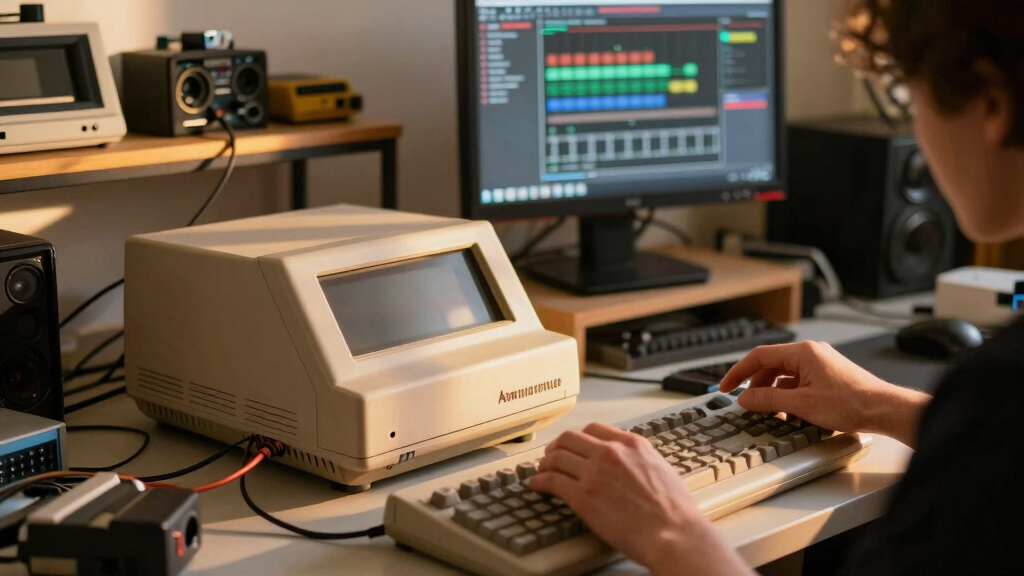
A developer has demonstrated a method to emulate Atari ST music on the Amiga using only the Amiga’s PAULA chip, eliminating CPU overhead. This breakthrough enables playing Atari music during demanding graphics demos without performance loss.
A developer has successfully used the Amiga’s PAULA chip to emulate Atari ST music without any CPU involvement, a feat that enables seamless music playback during graphics-intensive demos. This innovation matters because it preserves the Amiga’s processing power for visual effects while delivering authentic Atari sound.
The breakthrough was achieved by exploiting the Amiga’s PAULA sound chip, which is typically used for PCM sample playback, to emulate the Atari YM2149 sound chip. The developer stored a single cycle of a square wave as PCM samples and looped it on PAULA channels, effectively recreating Atari-style square wave sounds with zero CPU overhead. This approach was inspired by traditional demoscene techniques, particularly the use of precomputed state streams, but adapted to leverage the Amiga’s hardware directly.
The key innovation was to use the PAULA chip’s ability to playback four independent 8-bit PCM samples simultaneously. By precomputing the period and volume values of Atari music, the developer created a data stream that, when read each frame, updated the PAULA channels to produce the desired Atari sounds. This method avoids the CPU-intensive process of real-time emulation of the YM2149, which previously consumed about 50% of frame time, making it impossible to run complex graphics and music simultaneously.
Why It Matters
This development is significant because it enables the Amiga to play authentic Atari ST music during demanding visual demos without sacrificing performance. It opens new possibilities for demoscene productions, preserving both audio authenticity and visual complexity. For enthusiasts, it demonstrates a novel use of existing hardware, showcasing how creative hardware exploitation can overcome traditional limitations in real-time sound synthesis.
As an affiliate, we earn on qualifying purchases.
Background
Historically, the Amiga and Atari ST used different sound chips—PAULA and YM2149 respectively—each with distinct capabilities. Prior efforts to emulate Atari music on the Amiga involved CPU-heavy software synthesis, which limited multitasking during graphics demos. The recent demonstration builds on demoscene techniques, where precomputing data streams and hardware tricks are common, but applies them innovatively to achieve zero CPU load for music playback. This approach addresses longstanding challenges in combining authentic Atari sound with visually intensive Amiga demos.
“Using the Amiga’s PAULA chip to emulate Atari ST music without any CPU overhead is a game-changer for demo coding.”
— The developer behind the technique
“This approach cleverly exploits existing hardware in a way that was previously thought impossible without dedicated sound hardware.”
— Demoscene expert
As an affiliate, we earn on qualifying purchases.
What Remains Unclear
It is not yet clear how well this method reproduces complex Atari music effects beyond simple square wave tunes. The technique currently focuses on basic waveforms, and extending it to more intricate sounds like Digidrums or SID-like effects remains uncertain. Additionally, the long-term stability and compatibility of this approach across different Amiga models are still to be tested.
As an affiliate, we earn on qualifying purchases.
What’s Next
The next steps involve refining the technique to handle more complex Atari sounds, integrating it into demo productions, and exploring automation tools for easier music conversion. Further community testing will determine its robustness and performance across various hardware configurations. The developer plans to release detailed documentation and sample code for others to experiment with this hardware-based emulation.
retro computer sound synthesizer
As an affiliate, we earn on qualifying purchases.
As an affiliate, we earn on qualifying purchases.
Key Questions
Can this method emulate all Atari ST music effects?
Currently, it primarily reproduces basic square wave tunes. More complex effects like Digidrums or SID-like sounds are still under investigation.
Does this technique require special hardware modifications?
No, it utilizes the standard PAULA chip present in all Amiga models, making it compatible with existing hardware.
Will this method work on all Amiga models?
Theoretically, yes, since it relies on the standard PAULA chip, but performance may vary depending on the specific hardware and memory configuration.
Is the code for this technique publicly available?
The developer intends to release detailed documentation and sample code soon, but as of now, it remains in experimental stages.
Fall Picks
fall essentials
As an affiliate, we earn on qualifying purchases.