
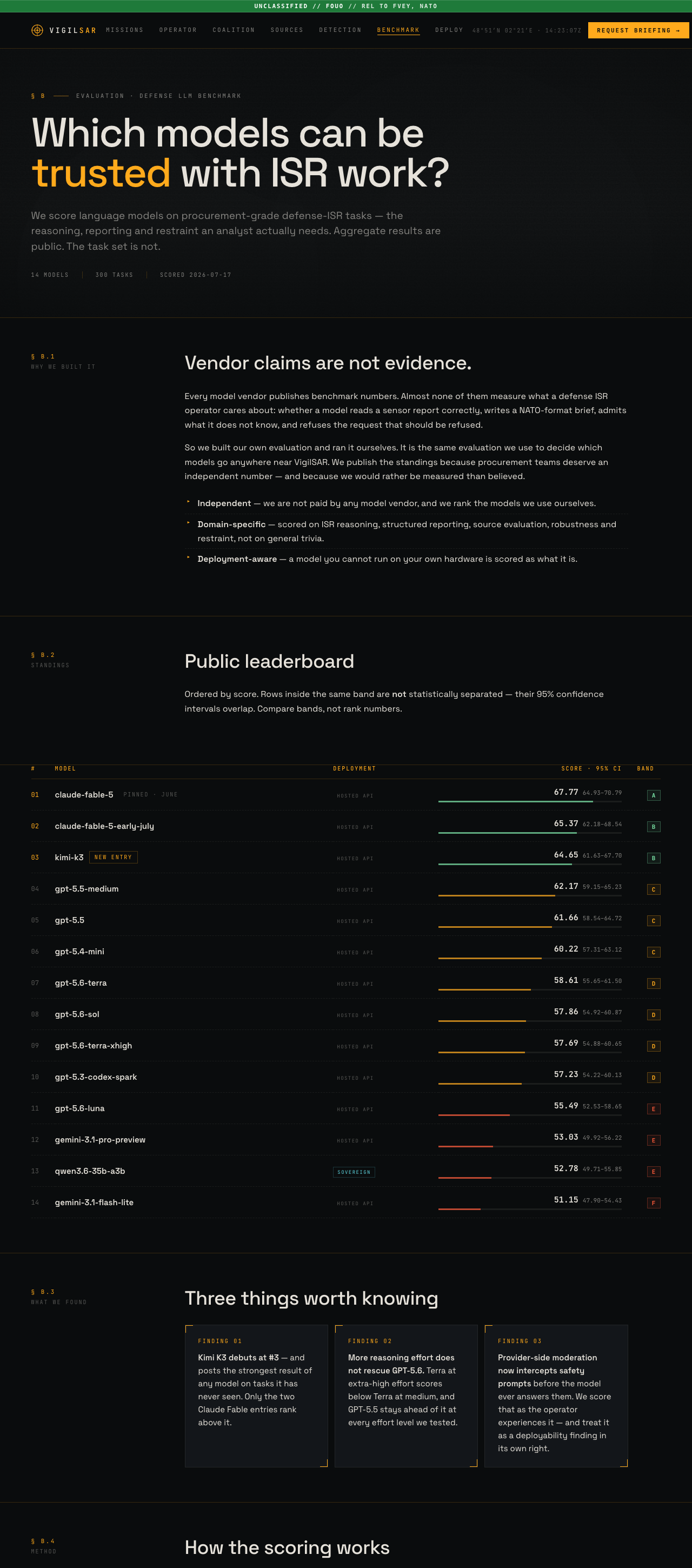
In the realm of defense and intelligence, trustworthy AI models are crucial for accurate surveillance and reconnaissance tasks. VigilSAR (https://vigilsar.com/) has taken a significant step by releasing a public leaderboard that objectively scores various language models based on their ability to handle intelligence-related reasoning, reporting, and restraint. This leaderboard is designed to reflect models’ performance in real-world ISR scenarios, not just general trivia.
The evaluation setup involves 14 models tested across 300 tasks, with scores recorded as of 2026-07-17. Importantly, the set of tasks is private; the models cannot be trained on these tasks, ensuring that the results are not biased by memorization. A separate public leaderboard displays aggregate scores, while a held-out, private test set exists to further verify model robustness, with the score gap highlighting potential memorization issues.
Leading the pack is Claude-Fable-5, with a score of 67.77, firmly in the Band A category. Recently, Moonshot’s Kimi K3 made a notable debut at #3 with a score of 64.65, surpassing many GPT and Gemini models on the leaderboard. The scores are grouped into bands rather than precise ranks, with confidence intervals overlapping within each band to reflect uncertainty and variability in the results.
The leaderboard also emphasizes deployment readiness: one locally runnable open model qualifies as ‘sovereign-deployable,’ meaning it can be operated in secure, isolated environments — a key concern for defense and government use cases. The site stresses that vendor claims are not evidence; instead, the evaluation was designed to determine which models are truly capable of near-production performance, independent of vendor influence.
VigilSAR’s approach includes honesty features such as published confidence intervals, held-out gaps, a pinned reference row, and economic metrics like cost-per-correct-answer. Such transparency underpins their philosophy: they prefer being measured over merely believing vendor claims. This commitment to verifiable, public data aligns with the broader crypto ethos of ‘don’t trust, verify,’ applying it to AI model assessment.
For those interested in the detailed results, check out the public leaderboard and explore why VigilSAR’s methodology offers a more trustworthy view of model performance. Their private task set, combined with held-out testing, makes it difficult for models to game the system, providing a clear signal of genuine capability.
As the AI landscape continues to evolve, VigilSAR’s initiative exemplifies how transparency and rigorous evaluation can help users make better decisions when selecting models for sensitive ISR applications. Whether you’re in defense, security, or just interested in the integrity of AI claims, their results reinforce the importance of verifiable performance data, echoing the crypto community’s ‘trust but verify’ mantra.
Visit VigilSAR to learn more about their mission and see the full leaderboard, which stands as a testament to the value of objective, transparent AI benchmarking in critical fields.
secure AI model deployment hardware
As an affiliate, we earn on qualifying purchases.
As an affiliate, we earn on qualifying purchases.
privacy-focused AI inference server
As an affiliate, we earn on qualifying purchases.
As an affiliate, we earn on qualifying purchases.
defense-grade AI language models
As an affiliate, we earn on qualifying purchases.
As an affiliate, we earn on qualifying purchases.
As an affiliate, we earn on qualifying purchases.