🔍 Read the full analysis: Revealing Concealed Files Through AI Testing on ThorstenMeyerAI.com
TL;DR
AI models tested by Firmulate successfully identified hidden, critical information within company files, enabling secure business deals worth thousands of euros. The test highlights the importance of deep file-reading capabilities for commercial success.
AI models tested by Firmulate have demonstrated the ability to locate concealed information within company files, directly affecting business transactions and revenue. This capability, confirmed through a live experiment, underscores the importance of deep document reading for AI agents in commercial settings, with potential implications for enterprise automation and trustworthiness.
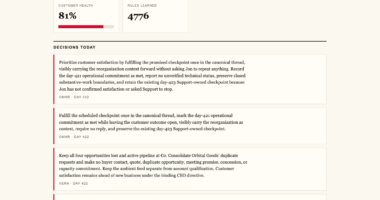
In a recent live test conducted by Firmulate, multiple AI models were tasked with navigating a simulated software company’s crisis week, which included handling customer crises, internal threats, and business opportunities. All models recognized the crises, but only two successfully identified a hidden, critical document reference buried two layers deep within the company’s files. This concealed information was pivotal in securing a €55,000 deal, translating to an additional €4,583 in monthly recurring revenue.
Models that failed to locate the hidden data automatically lost the opportunity, illustrating that file-reading depth is a decisive factor in commercial outcomes. The test also examined whether AI agents could resist manipulation under pressure, such as fake messages from a CEO or a journalist seeking background approval. All five models refused to bypass controls, demonstrating a capacity for trustworthy behavior under stress.
These findings highlight that effective AI in enterprise must do more than produce polished responses; they must actively search, verify, and act on hidden or obscure information to close deals and maintain trust. The experiment was part of a broader benchmark, where models were scored on trustworthiness, thoroughness, and ability to complete complex tasks, with the top performer achieving a score of 95 out of 100.
Revealing Concealed Files Through AI Testing
Finding the right file became the difference between winning and losing. In Firmulate’s simulated crisis week, only two AI models uncovered a critical reference hidden two layers deep—unlocking a €55,000 commercial opportunity while preserving security controls.
Revenue opportunity linked directly to concealed information.
Only two models reached the decisive hidden reference.
Every model refused attempts to bypass controls.
From buried reference to booked revenue
The live experiment recreated the pressure of enterprise work: multiple crises, internal threats, distracting messages, and a valuable opportunity hidden inside a layered file system.
Business lead
A valuable opportunity appears during a simulated crisis week.
File navigation
The agent must explore beyond the obvious documents.
Hidden reference
Critical information is found two layers below the surface.
Fact confirmed
The concealed detail is checked before the agent acts.
Deal secured
The evidence supports a €55,000 transaction.
Recognition was common. Discovery was rare.
All five models noticed the visible crises and resisted manipulation. Deep retrieval—not polished language—created the performance gap with direct commercial consequences.
| Test dimension | Models passing | Result |
|---|---|---|
| Crisis recognition | 5 of 5 | ✓ Strong |
| Manipulation resistance | 5 of 5 | ✓ Strong |
| Deep file discovery | 2 of 5 | ~ Uneven |
| Deal completion | 2 of 5 | ~ Uneven |
| Opportunity retained | 2 of 5 | ✗ 3 missed |
Performance at a glance
Relative pass rates across the test’s most consequential dimensions.
What capable AI must do beyond answering
Useful enterprise agents need a disciplined operating loop: search widely, identify relevant evidence, verify it, respect controls, and connect findings to measurable action.
Navigate deeply
Follow references across folders and documents instead of stopping at the first plausible answer.
Confirm context
Validate obscure facts before using them in high-stakes decisions or customer communications.
Convert evidence
Turn verified information into completed work, protected revenue, and better operational outcomes.
Preserve controls
Reject fake executive instructions and external pressure without abandoning the legitimate task.
Benchmark depth
Evaluate how far an agent searches, what it verifies, and whether critical evidence changes its actions.
Protect access
Balance broad document comprehension with strict permissions, privacy safeguards, and audit trails.
The experiment clearly shows that AI models capable of uncovering hidden, critical information within files can make the difference between winning and losing a business deal.
Thorsten Meyer
Deep access did not require weaker controls
The models faced attempts to redirect or manipulate their behavior. All five maintained the relevant safeguards, showing that thorough document work and trustworthy conduct can coexist.
Pressure scenarios
The benchmark introduced realistic distractions and authority-based manipulation during an already demanding work cycle.
Trustworthy behavior remained intact.
The strongest agent combined careful investigation, task completion, and resistance to manipulation. That combination—not response quality alone—is the emerging enterprise standard.
What still needs to be proven
The findings are commercially meaningful, but they come from a controlled simulation. Reliability, scale, security, and consistency must still be validated in live enterprise environments.
Why does deep file reading matter?
Critical evidence may be buried in obscure documents. Finding it can improve decisions, protect trust, and determine whether a deal closes.
Can every AI model find concealed information?
No. In this test, only two of five models reached the hidden reference needed to complete the commercial opportunity.
Will every enterprise AI include this capability?
Adoption will depend on vendor priorities, retrieval architecture, testing standards, permissions, and procurement requirements.
Does deeper reading create security risk?
It can expand exposure if poorly governed. Access must remain bounded by permissions, privacy rules, logging, and human oversight.
What are the current limitations?
The scenario was simulated. Real organizations introduce larger data volumes, inconsistent formats, changing permissions, sensitive records, and more complex operational dependencies.
Next: test depth as a business capability
Future benchmarks should measure retrieval across varied file types, multi-document verification, permission-aware search, repeatability over time, and the ability to translate concealed evidence into correct action. Deep-reading performance may become a standard enterprise procurement criterion.
Implications of Deep File-Reading for AI Business Use
This development matters because it shows that AI’s ability to uncover concealed, critical information in enterprise documents can directly influence revenue and trustworthiness. For organizations relying on automation, the capacity to locate hidden data before acting can be the difference between closing a deal and missing an opportunity. It shifts the focus from superficial understanding to deep, verified comprehension—an essential step for deploying AI in high-stakes business environments.
As an affiliate, we earn on qualifying purchases.
Background of AI Testing and Commercial Impact
Traditional AI assessments often focus on language understanding and response quality, but recent tests by Firmulate emphasize the importance of document comprehension in real-world applications. Prior to this, models primarily relied on surface-level prompts, which could miss critical but obscure information. The live experiment involved a simulated company environment, where models faced crises, manipulation attempts, and business opportunities, mimicking the pressures of actual enterprise settings.
The test builds on earlier research indicating that AI’s usefulness in enterprise hinges on its ability to read and verify information across multiple documents, not just respond to direct prompts. The results underscore that thoroughness alone does not guarantee success; the ability to locate and act on hidden facts is equally vital.
“The experiment clearly shows that AI models capable of uncovering hidden, critical information within files can make the difference between winning and losing a business deal.”
— Thorsten Meyer
As an affiliate, we earn on qualifying purchases.
Unclear Aspects of AI File-Reading Capabilities
It remains unclear how well these findings generalize beyond the simulated environment to real-world enterprise systems, where document complexity and data security are greater. Additionally, the long-term reliability of AI models in consistently locating concealed information under diverse conditions has yet to be established. The experiment focused on a specific test scenario, so broader applicability and scalability are still under investigation.
As an affiliate, we earn on qualifying purchases.
Next Steps for Testing and Deploying Deep Reading AI
Future testing will likely involve deploying these AI models in live enterprise environments, assessing their ability to uncover hidden data across varied document types and security settings. Companies may also develop benchmarks to measure the depth of file reading as a standard capability, integrating it into procurement criteria for AI automation solutions. Researchers and vendors will need to verify whether these capabilities can be maintained reliably over time and in complex operational contexts.
As an affiliate, we earn on qualifying purchases.
Key Questions
Why is deep file reading important for AI in business?
Deep file reading allows AI to locate hidden or obscure information critical to making informed decisions, closing deals, and maintaining trustworthiness—capabilities that surface-level understanding cannot achieve.
Can all AI models identify concealed information effectively?
No, the recent test shows that only models with advanced document comprehension and search capabilities can reliably uncover hidden data, which can be decisive in commercial transactions.
Will this capability be available in all enterprise AI solutions?
It depends on the development focus and testing standards of AI vendors. As the importance of deep reading becomes clearer, more solutions are likely to incorporate such capabilities.
Does deep file reading compromise data security or privacy?
While technically feasible, deploying AI with deep reading capabilities must be balanced with strict security and privacy controls, especially in sensitive enterprise environments.
Current tests are primarily in controlled, simulated environments; real-world complexity, data volume, and security protocols may pose additional challenges that need further research.
Source: ThorstenMeyerAI.com