
🔍 Read the full analysis: Hollow House: What We Learned Making An AI Horror-Comedy In One Night on ThorstenMeyerAI.com

Get hardware and tech essentials delivered free with Prime
- Fast, free delivery on millions of items
- Prime Video, Amazon Music and more included
- Member-only deals all year
TL;DR
Hollow House, a 97-second AI-generated horror-comedy, was made overnight on October 27–28, 2026, after its creator scrapped two versions. The production account says consistent character references helped, but faster cuts, sound and human editorial choices made the final version work.
Thorsten Meyer published Hollow House, a 97-second AI-generated horror-comedy, with a production account saying it took three attempts and an overnight session to complete. The account describes a shift from 20 long shots to a faster-cut final version, illustrating how editing and performance decisions can shape an AI-made film even when its images are generated by models.
Meyer’s account, published on ThorstenMeyerAI.com on October 28, says work began early on October 27 and continued until about 1:30 a.m. the next day. He describes three cuts: a 20-shot version running 2 minutes 15 seconds, a 66-cut version running 2 minutes 21 seconds, and the final 1:37 film assembled from three roughly 30-second segments generated with one model given references for the cast. Meyer says only the third version worked for him.
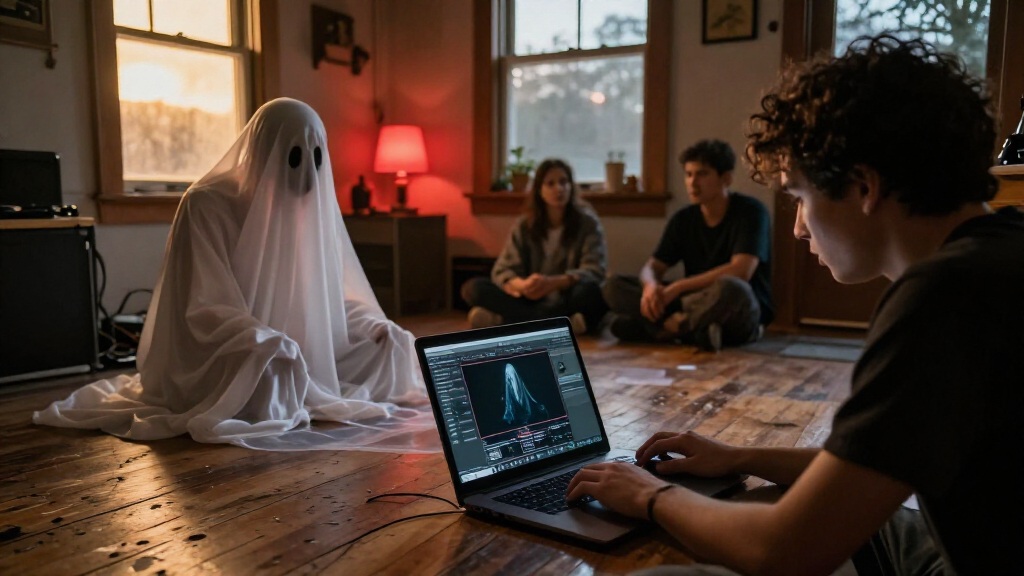
The premise places a real ghost inside an extreme haunted attraction, where staff treat the newcomer as a workplace problem. A guest’s safe word fails to stop the scare, and the shift lead asks whether the ghost signed a waiver. The story also includes an attempted exorcism and the ghost working the door the next night. Meyer says the characters, script and jokes are original, while the structure was inspired by an AI horror-comedy short shared on X.
For the first version, Meyer generated character reference images with Nano Banana 2, then used those references to make stills and animate them with Google’s Veo 3.1 fast mode. He reports spending 2,220 Higgsfield credits across all three versions, which he valued at about $95 under his plan, plus roughly 2,100 ElevenLabs characters for music and sound effects. These are the creator’s production figures, not independently verified costs.
Hollow House: What We Learned Making an AI Horror-Comedy in One Night
A 97-second short took three versions and an overnight session to find its comic rhythm. Its creator’s account points to a practical lesson: generated images set the scene, while human choices shaped the performance.
Why the third cut worked
Meyer says the first cut looked good but felt “terribly boring and amateurish.” The revisions changed the pace and the way the cast appeared across generated segments.
20 shots · 2:15
One start frame per shot, animated with Veo 3.1. Meyer says the result looked good, but its rhythm felt flat.
66 cuts · 2:21
A second attempt explored a much quicker structure. It still did not satisfy the creator.
1:37 · released
Three roughly 30-second generated segments used references for the full cast. The final edit brought the pace up.
Reading the comparison: The creator’s own count of the earlier cut and the short that inspired its structure; it is not a controlled study.
A workflow shaped by references and revisions
Character images acted as a visual casting and costume guide. The production account describes repeated adjustments when generated motion or dialogue missed the intended effect.
When the model missed the beat
A requested head turn became a whole-body turn, so Meyer changed the starting image and added a bone-cracking sound. A lift scene proved difficult to stage; a rewritten floating prompt worked, but looked less dramatic.
When dialogue needed a check
Speech recognition caught a shouted “HEY” rendered as separate letters and garbled syllables in another line. These are examples from this production, not a general assessment of every model or setting.
A ghost treated like a workplace problem
The premise puts a real ghost inside an extreme haunted attraction. Staff respond with the logic of a shift: a guest’s safe word fails, someone asks about a waiver, and an attempted exorcism becomes part of the workday.
“what if something in the house doesn’t care about the safe word?”
The premise · Thorsten Meyer“terribly boring and amateurish”
Reaction to the first cut · Thorsten MeyerThe ghost works the door the next night.
Story detail · Hollow HouseOriginal characters, inspired structure
Meyer describes the characters, script, and jokes as original, while saying the short’s structure was inspired by an AI horror-comedy shared on X.
Sound helped set the tone
The first version had no score beyond a synthesized drone. The account reports roughly 2,100 ElevenLabs characters used for music and sound effects.
Reported inputs, with real limits
The figures below come from the creator’s account. They describe this project and should not be treated as independently verified costs or a repeatable benchmark.
The account is a first-person production report. It offers no independent review or controlled comparison of the three approaches.
The final film runs 1:37, while the source describes three segments of roughly 30 seconds. It does not explain the difference.
There is no per-version credit or time breakdown, and the stated $95 depends on the creator’s plan.
The account does not promise that another project will get the same results. Further examples would be needed for broader conclusions.
What we know—and what remains open
What is Hollow House?
A 1:37 horror-comedy short about a ghost joining the scare crew at an extreme haunted attraction. Meyer says its characters, voices, and set were AI-generated.
How long did it take?
Meyer says work started early on October 27, 2026, and continued until about 1:30 a.m. the next day. His account was published October 28.
Why make three versions?
The first felt boring and the second still did not work for him. He changed the pacing and generation approach for the final version.
What did production cost?
The creator reports 2,220 Higgsfield credits, valued at roughly $95 under his plan, plus about 2,100 ElevenLabs characters for audio.
Next step: View the short alongside the creator’s behind-the-scenes material—character sheets, start frames, failed attempts, and a contact sheet—to compare the finished film with the documented process. The account announces no sequel or further testing.
Why the Third Cut Worked
The account’s main production finding is that visual consistency was not enough to make the short entertaining. Meyer says the first cut looked good but felt boring and amateurish. It averaged 5.6 seconds per shot, compared with about 1.8 seconds per cut in the short that inspired the structure, according to his count. He responded by making the final version faster and restructuring generation around longer segments that included references for the full cast.
That distinction matters for viewers and creators trying to understand AI filmmaking. The tools can generate pictures, voices and sound, but the account credits human editing decisions—including rejecting a cut, changing shot rhythm and grading the final colour—with making the finished work function as comedy. The report is one creator’s experience, not a controlled comparison of models or a guarantee that the same workflow will produce similar results.
Products Worth Considering

Logitech MX Mechanical Full-Size Wireless Mechanical Keyboard, Tactile Quiet Switches, Backlit Keys, Bluetooth, USB-C, Multi-Device, Graphit

Apple MacBook Pro (14.2-inch, 2025) – M5 chip, 16GB Unified Memory, 1TB SSD, Space Black
Apple MacBook Pro 16-inch (2021) – M1 Pro Chip, 10-Core CPU, 16-Core GPU, 16GB RAM, 1TB SSD, Space Gray
As an affiliate, we earn on qualifying purchases.
From Character Sheets to Final Cut
Before making video, Meyer generated one reference image for each of eight characters, using them to keep appearances and costumes more consistent across shots. He says each 2K reference image cost two credits and that all eight were created in under two minutes. In his account, these images served as a visual casting and costume guide for later frames and clips.
The first version followed a conventional shot-by-shot approach: generate a start frame for each of 20 shots, then animate each with Veo 3.1. Meyer says it ran 2:15, with dialogue and sound generated alongside the images, but had little variation in pacing and no score beyond a synthesized drone. He used Whisper speech recognition to compare generated dialogue with the script; that check caught a shouted “HEY” rendered as the individual letters and extra garbled syllables in another line.
Meyer also describes model limitations and workarounds. A requested full head turn became a turn of the whole body, so he changed the starting still to show the head already turned and added a bone-cracking sound. He says a scene intended to lift a guest was initially blocked, while a reworded floating prompt passed but produced a less dramatic result. These examples are observations from this production, not a general assessment of every model or setting.
““terribly boring and amateurish””
— Thorsten Meyer, describing his reaction to the first cut
Limits of the Production Account
The account is a first-person production report from Meyer. It does not provide independent review of the short’s workflow, cost estimates or model outputs, and it does not include a controlled comparison between the three methods. The stated $95 figure depends on the creator’s plan price and the reported credit use.
The source describes the final version as three 30-second segments, while the completed film runs 1:37; it does not explain the difference between those approximate segment lengths and the finished runtime. It also does not give a full breakdown of how much time or credit each version consumed, or identify every tool used for each final shot. Claims about inspiration and originality are Meyer’s own description of the creative process.
The Film and Workflow Ahead
Meyer’s account links to the Hollow House short on YouTube and describes the available behind-the-scenes material, including character sheets, start frames, failed attempts and a contact sheet of the final cut. Readers can compare the finished film with the creator’s explanation of how it changed across three versions.
The source does not announce a sequel, a release schedule for another film or additional production testing. Any broader conclusions about AI filmmaking will depend on further examples; for now, the next step is viewing the short alongside the documented process and treating the reported costs and results as specific to this project.
Key Questions
What is Hollow House?
Hollow House is a 1:37 horror-comedy short about a ghost joining the scare crew at an extreme haunted attraction. Its creator says its characters, voices and set were AI-generated.
How long did it take to make?
Meyer says work ran from early evening on October 27, 2026, until about 1:30 a.m. on October 28. The account was published on October 28.
Why were there three versions?
Meyer says the first version looked good but felt boring, while the second still did not work. He changed the approach for the third, final version, using faster pacing and generation segments with references for the cast.
What did the production cost?
Meyer reports using 2,220 Higgsfield credits, valued at roughly $95 under his plan, plus about 2,100 ElevenLabs characters for music and sound effects. Those figures are his estimates for this project.
What remains unknown about the process?
The account does not independently verify the costs or compare the tools under controlled conditions. It also does not fully explain the relationship between the approximate 30-second generation segments and the finished 1:37 runtime.
Source: ThorstenMeyerAI.com