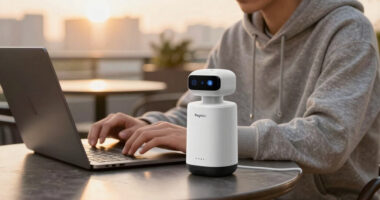
📊 Full opportunity report: Gender-affirming Voice Training Made Easy With Pocket Voice Lab on IdeaNavigator AI — validation score, market gap, and execution plan.

Get hardware and tech essentials delivered free with Prime
- Fast, free delivery on millions of items
- Prime Video, Amazon Music and more included
- Member-only deals all year
TL;DR
Pocket Voice Lab has been introduced as a mobile app providing real-time acoustic feedback for gender-affirming voice training. It aims to help individuals without easy access to in-person speech therapy improve pitch and resonance objectively. The app is currently in pilot testing, with plans for a freemium model and clinical partnerships.
Pocket Voice Lab has launched a mobile application designed to provide real-time acoustic biofeedback for gender-affirming voice training. The app aims to address the accessibility gap faced by individuals seeking to modify their voice without frequent in-person sessions with speech-language pathologists (SLPs) or vocal coaches. This development is significant because it offers a scalable, affordable tool for those undergoing voice feminization or masculinization, as well as for public speakers and singers seeking ongoing voice improvement.
The app, currently in a pilot phase, records a short voice sample and displays visual feedback on fundamental pitch and resonance, with additional strain indicators based on harmonic-to-noise ratio. Users can perform guided exercises, track their progress over time, and generate shareable reports for clinicians. The platform is designed to support a freemium subscription model, offering limited daily exercises for free and paid tiers (~$8-15/month) for unlimited access and detailed progress tracking. The initiative responds to a documented gap in accessible, objective voice training tools for transgender and gender-nonconforming individuals, who often lack affordable, consistent feedback options.
According to sources, the technology leverages advances in smartphone microphones and on-device acoustic analysis, which now make real-time feedback feasible outside of specialized labs. Academic research supports using voice metrics such as pitch and resonance as clinical biomarkers, and peer-reviewed prototypes like TruVox and Attuned validate the demand for such tools. The developers plan to run a 4-week pilot with targeted recruitment from trans voice-training and public-speaking communities, measuring user engagement and willingness to pay.
Transforming Access to Gender-Affirming Voice Care
This development could significantly improve access to gender-affirming voice training by providing an objective, scalable, and affordable alternative to traditional in-person therapy. It addresses a critical gap for many individuals who face geographic, financial, or scheduling barriers. The app also offers a means for users to monitor their progress longitudinally, which could enhance motivation and facilitate more effective voice modification. If successful, the platform may influence clinical practices by integrating app-based tools into standard care and expanding the reach of voice therapy services.
As an affiliate, we earn on qualifying purchases.
Growing Demand for Accessible Voice Training Tools
There is a well-documented need for accessible gender-affirming voice care, with many individuals unable to access consistent speech therapy due to cost or location. Existing services often rely on intermittent in-person sessions, leaving users without objective feedback or progress tracking between visits. Recent advances in smartphone hardware and acoustic analysis have enabled the development of AI-powered voice coaching apps, with some, like Vocal Image, already demonstrating consumer willingness to pay for such services. Academic work increasingly treats voice as a clinical biomarker, supporting the scientific foundation for app-based interventions.
The launch of Pocket Voice Lab builds on this momentum, aiming to serve a large unmet market segment while also exploring broader applications such as public speaking and singing. The platform’s initial focus on a single voice persona allows for targeted development, with plans to expand into additional voice types and features based on user feedback and clinical validation.
“Advances in smartphone microphone technology and acoustic analysis now make real-time biofeedback outside of lab settings feasible.”
— an anonymous researcher
gender-affirming voice training device
As an affiliate, we earn on qualifying purchases.
As an affiliate, we earn on qualifying purchases.
Uncertainties About App Efficacy and Adoption
It is not yet clear how effective the app will be in producing measurable voice changes or how well users will adopt and sustain its use over time. The pilot phase will provide initial data, but broader clinical validation and long-term outcomes remain to be seen. Additionally, questions about data privacy, user engagement, and integration into professional care pathways are still developing.
speech therapy resonance training tools
As an affiliate, we earn on qualifying purchases.
As an affiliate, we earn on qualifying purchases.
Next Steps in Pilot Testing and Broader Deployment
The project team plans to complete a 4-week pilot with targeted recruitment, measuring user engagement, completion rates, and willingness to pay. Successful results could lead to further development, larger-scale testing, and eventual commercialization. They also aim to establish partnerships with clinics and advocacy groups to integrate the technology into existing care frameworks and expand functionality to include additional voice types and features based on user feedback.
As an affiliate, we earn on qualifying purchases.
Key Questions
How accurate is the biofeedback provided by the app?
The app uses on-device acoustic analysis validated by peer-reviewed research, but its accuracy compared to clinical lab equipment is still being evaluated during pilot testing.
Can the app replace in-person speech therapy?
While it offers objective feedback and progress tracking, it is designed as a supplementary tool. Users seeking comprehensive voice therapy should consult with a qualified clinician.
Is the app available for all smartphones?
The app leverages standard smartphone microphones and is compatible with most recent devices, but full functionality depends on hardware quality and software updates.
What is the cost of the app after the free trial?
The paid subscription tier is expected to cost approximately $8-15 per month, offering unlimited sessions and detailed reports.
Will the app support multiple voice types in the future?
Initially, the focus is on a single voice persona for targeted development, but future updates may include additional voice types and customization options based on user demand.
Source: IdeaNavigator AI
Halloween Picks
halloween
As an affiliate, we earn on qualifying purchases.