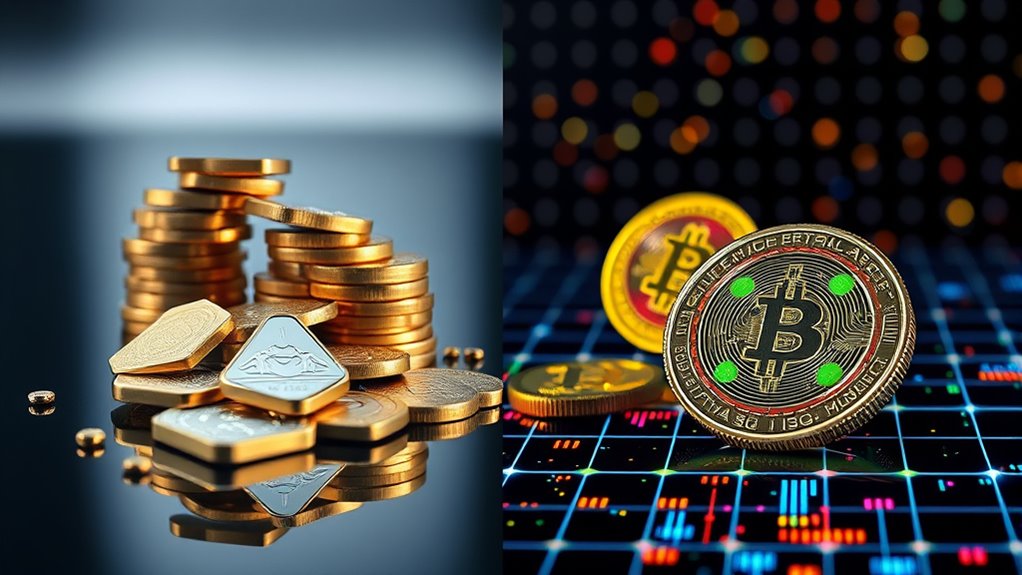

Crypto coins run on their own blockchain platforms, like Bitcoin or Ethereum, and act as digital money for transferring value and storing wealth. Tokens, on the other hand, are built on existing blockchains using smart contracts, representing assets like art or gaming items. While coins rely on their native infrastructure, tokens leverage popular networks and standards like ERC-20. Understanding these differences can help you navigate the crypto world more confidently as you explore further details.
Prime for Young Adults — start your free trial
Fast free delivery, streaming and member deals for eligible 18–24 year olds.
As an affiliate, we earn on qualifying purchases.
Key Takeaways
- Coins operate on their own blockchain platforms, serving as native assets, whereas tokens are built on existing blockchains via smart contracts.
- Coins primarily facilitate value transfer and storage, while tokens can represent diverse assets like art, gaming items, or shares.
- Tokens follow specific standards (e.g., ERC-20, ERC-721) for interoperability, unlike coins which have unique protocols of their native blockchains.
- Creating coins requires building a new blockchain, whereas tokens leverage existing infrastructure of established platforms like Ethereum or BSC.
- Security depends on the underlying blockchain; coins’ security is tied to their native platform, tokens depend on the security of the host blockchain.
When exploring the world of cryptocurrency, understanding the difference between tokens and coins is fundamental. Coins are digital currencies that operate on their own independent blockchain platforms. Think of Bitcoin, Ethereum, and Litecoin—they serve as the native assets of their respective networks. These coins are primarily used for transferring value, acting as a medium of exchange, or storing wealth. They often have their own protocols, security models, and consensus mechanisms that keep the network running smoothly.
Tokens, on the other hand, are built on existing blockchain platforms. They don’t have their own independent blockchains but instead leverage the infrastructure of established networks like Ethereum, Binance Smart Chain, or Solana. When you create a token, you’re essentially programming a set of rules within a smart contract that lives on a blockchain platform. This means tokens can represent a variety of assets—anything from digital art and gaming items to shares in a company or access rights. Because of this flexibility, tokens are often used in decentralized applications (dApps) and initial coin offerings (ICOs).
To understand tokens more deeply, it’s helpful to know about token standards. Token standards are a set of rules or protocols that define how tokens behave on a blockchain platform. For example, on Ethereum, the ERC-20 standard is the most common for creating fungible tokens—those that are interchangeable like dollars or bitcoins. There’s also ERC-721 for non-fungible tokens (NFTs), which represent unique assets like digital collectibles. These standards ensure interoperability between tokens and wallets, making it easier for developers to create, transfer, and manage tokens seamlessly across various platforms and applications.
Blockchain platforms are vital because they provide the foundation for both coins and tokens. They offer the infrastructure, security, and consensus mechanisms that keep these digital assets functional. Coins rely on their native platforms, which are built from scratch, while tokens depend on the platform’s existing capabilities. For example, Ethereum’s robust smart contract functionality allows developers to create a wide array of tokens using standards like ERC-20 and ERC-721. Similarly, BSC offers BEP-20 tokens that are compatible with Ethereum’s ERC-20 tokens, allowing for easier cross-platform integration. Additionally, platform security is crucial to prevent vulnerabilities and ensure user trust in both coins and tokens.
As an affiliate, we earn on qualifying purchases.
Frequently Asked Questions
Can Tokens Be Converted Into Coins Easily?
Yes, tokens can often be converted into coins, but it depends on token interoperability and the specific blockchain networks involved. You might need to use a crypto exchange or a bridge that supports both tokens and coins. Keep in mind, coin security is vital during conversions to protect your assets. Always verify the platform’s reliability and make certain you’re following best practices for safe and smooth token-to-coin transfers.
Are All Tokens Built on Ethereum?
Not all tokens are built on Ethereum; some are crafted on other blockchains like Binance Smart Chain or Solana. Think of token standards like ERC-20 or ERC-721 as the blueprint ensuring interoperability and security. While Ethereum’s blockchain security is robust, tokens on different platforms may vary in safety. You should check the specific token’s blockchain foundation to understand its compatibility and security features before investing or transacting.
Do Coins Have Intrinsic Value Like Traditional Money?
Coins do have a form of intrinsic value, often supported by digital scarcity and monetary backing, like Bitcoin’s limited supply. This scarcity helps maintain value similar to traditional money, backed by trust and network security. While not backed by physical assets, coins’ value relies on their scarcity and network consensus, giving them a monetary backing that influences their worth in the digital economy.
How Do Tokens Impact Blockchain Scalability?
Think of tokens as traffic on a busy highway, adding to the congestion. When you introduce many tokens, it can cause blockchain congestion, slowing down transactions and reducing scalability. Token proliferation increases network load, making it harder for the blockchain to process all activities efficiently. This impacts scalability, requiring solutions like layer 2 protocols to manage the rising number of tokens and keep transactions smooth.
Can a Coin Also Function as a Token?
Yes, a coin can also function as a token, but it depends on its purpose and how it’s categorized. Coins are usually categorized as a native asset of a blockchain, like Bitcoin or Ethereum, while tokens follow specific token standards, such as ERC-20 or BEP-20, to operate on existing blockchains. Some projects create tokens that act like coins, but generally, coins are designed to serve as digital currencies.
As an affiliate, we earn on qualifying purchases.
Conclusion
Now that you understand the difference between crypto tokens and coins, you’re better equipped to navigate the blockchain world. Remember, “a chain is only as strong as its weakest link,” so choose your investments wisely and do your homework. Whether you’re dealing with coins or tokens, staying informed helps you make smarter decisions and avoid pitfalls. Keep learning, stay cautious, and you’ll build a solid foundation in the ever-evolving crypto landscape.
As an affiliate, we earn on qualifying purchases.
As an affiliate, we earn on qualifying purchases.
NFL season / tailgating Picks
team gear
As an affiliate, we earn on qualifying purchases.