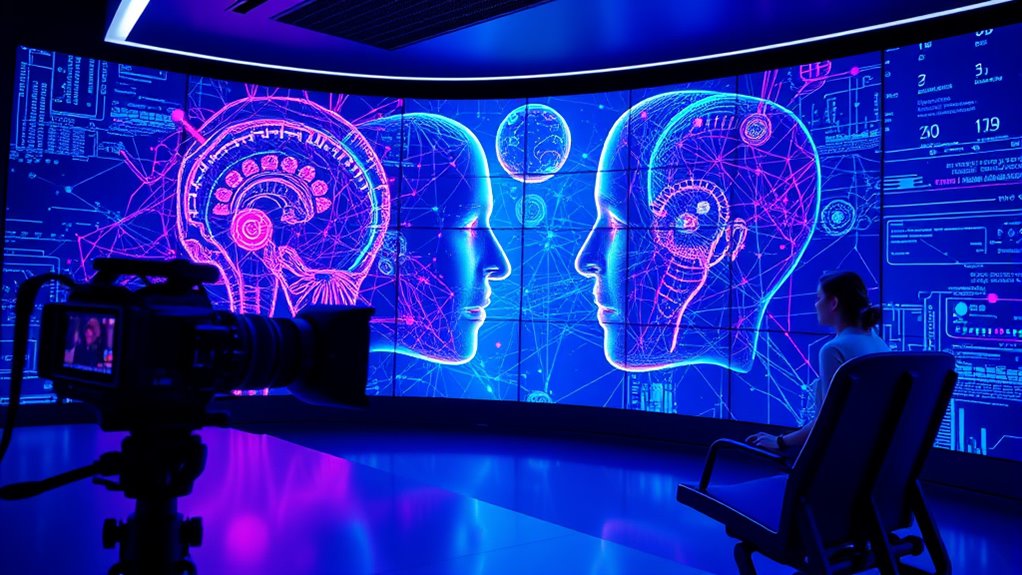

Artificial intelligence maps emotion through visual data by detecting faces and analyzing facial features like expressions, landmarks, and micro-expressions. It uses advanced techniques like deep learning, convolutional neural networks, and texture analysis to identify subtle cues that reveal feelings such as happiness, anger, or surprise. These systems often combine data from images, videos, and sometimes physiological signals for higher accuracy. If you keep exploring, you’ll discover even more about how these methods enable AI to understand human emotions.

Get hardware and tech essentials delivered free with Prime
- Fast, free delivery on millions of items
- Prime Video, Amazon Music and more included
- Member-only deals all year
Key Takeaways
- AI detects faces and preprocesses images to normalize features for accurate emotion analysis.
- Facial expression recognition uses deep learning models to identify subtle changes and key indicators like Action Units.
- Extracted facial features are classified with algorithms such as SVMs or CNNs, achieving high accuracy in emotion detection.
- AI identifies micro-expressions and quantifies emotion intensity for nuanced understanding of feelings.
- Demographic considerations and multimodal data integration enhance AI’s ability to map emotions reliably across diverse populations.
Artificial Intelligence is transforming how we comprehend human emotions by analyzing visual and behavioral cues. When you interact with AI-powered systems, they often start by detecting faces in images or videos, pinpointing where faces are located despite challenging conditions like poor lighting or partial occlusion. This step, known as face detection, is essential for subsequent analysis. Once faces are identified, preprocessing kicks in, which involves cropping, resizing, correcting rotation, reducing noise, and normalizing images to guarantee consistent and accurate feature extraction. These steps prepare the visual data for the core process: interpreting facial cues to determine emotional states. Recent advancements in facial recognition algorithms have significantly improved detection accuracy and processing speed. At the heart of AI emotion recognition are techniques like Facial Expression Recognition (FER). These systems analyze both static images and dynamic video frames to identify subtle changes in facial expressions associated with specific emotions. Deep learning models, especially Convolutional Neural Networks (CNNs), are widely used for this purpose because of their ability to recognize complex patterns in visual data. They extract features such as facial landmarks—key points like the corners of the mouth or eyebrows—and Action Units (AUs), which describe muscle movements linked to emotions. Texture analysis also helps capture fine details like wrinkles or skin tension that signal particular feelings. These features, once extracted, are fed into classifiers like Support Vector Machines (SVMs) or CNNs to label emotions such as happiness, anger, sadness, fear, surprise, disgust, or neutrality. Accuracy of these systems varies, but some methods achieve impressive results. For instance, using techniques like Stationary Wavelet Transform, facial emotion recognition can reach nearly 99% accuracy. In a similar way to how researchers assess the effectiveness of newborn sunscreens, combining visual data with physiological signals or speech analysis further boosts performance, with some multimodal systems reporting accuracy rates above 99%. These high-performance metrics demonstrate how refined and reliable AI can be at mapping emotions through visual cues alone. Additionally, AI models can recognize not just basic emotions but also subtle micro-expressions and nuanced feelings, providing a deeper understanding of human sentiment. Modern AI systems also quantify emotion intensity, measuring how strongly someone feels a particular emotion. This adds a layer of depth to emotion mapping, enabling more personalized and precise insights. As technology advances, AI increasingly considers demographic and gender variations to improve accuracy across diverse populations. Overall, by integrating face detection, feature extraction, and sophisticated classification algorithms, AI maps human emotions with remarkable precision, transforming how machines interpret and respond to our emotional states in real time.
Top picks for "artificial intelligence maps"
As an affiliate, we earn on qualifying purchases.
Frequently Asked Questions
How Accurate Is AI in Detecting Complex Human Emotions?
AI’s accuracy in detecting complex human emotions varies. It performs well with microexpressions and multimodal data, reaching up to 82% accuracy. However, it struggles with nuanced, mixed, or ambiguous emotions, especially across different cultures. Subtle contextual cues and internal emotional states often elude AI, making its detection less reliable for deep or mixed feelings. Despite advances, human insight remains essential for interpreting truly complex emotional experiences.
Can AI Differentiate Between Genuine and Fake Emotional Responses?
Like Sherlock Holmes uncovering hidden clues, AI can differentiate genuine from fake emotions with remarkable precision. By analyzing subtle facial micromovements, muscle patterns, and physiological signals, you’re empowered to see beyond superficial expressions. With accuracy reaching up to 95%, AI detects inconsistencies in emotional responses, revealing whether feelings are authentic or fabricated. Combining visual and biometric data, AI acts as your investigative partner, revealing truth hidden in the smallest, most fleeting signs of human emotion.
What Ethical Concerns Arise From Emotion-Mapping AI Systems?
You should be aware that emotion-mapping AI systems raise significant ethical concerns. They often collect sensitive data without clear consent, risking privacy violations. These systems can create false emotional connections, leading users to over-rely on AI for support. Biases and cultural insensitivity may cause misclassification, and misuse of emotional data can lead to manipulation or discrimination. Additionally, they might impair genuine human interactions, raising questions about authenticity, autonomy, and the potential for psychological harm.
How Do Cultural Differences Impact AI Emotion Recognition?
Cultural differences impact AI emotion recognition because facial expressions and emotional cues vary widely across cultures. You might find AI struggles with implicit signals in high-context societies or misinterprets restrained emotions in collectivist cultures. When AI relies on generic expressions, it often oversimplifies or misses subtle cues, leading to inaccuracies. To improve, you need culturally sensitive models that incorporate multimodal data like voice, posture, and contextual understanding.
Can AI Adapt to Individual Emotional Expression Styles?
Yes, AI can adapt to individual emotional styles, but it’s an immense challenge. You might think it’s just a simple tweak, yet it requires handling infinite subtle nuances, cultural quirks, and personal quirks. With multi-modal analysis, real-time tracking, and ongoing learning, AI is slowly getting better at this. Still, it’s an evolving frontier—one where continuous data, diverse datasets, and sophisticated models are essential for true personalization.
Conclusion
As you explore how AI gently reads the subtle cues in your expressions, it’s clear this technology is quietly opening new doors to understanding human emotion. While it’s still early days, these innovations promise a future where machines can better appreciate the nuances of your feelings, making interactions more natural and empathetic. So, as you continue to share your moments, remember that this evolving dance between humans and AI is gently guiding us toward deeper connection.
Columbus Day / Indigenous Peoples' Day Picks
long weekend sales
As an affiliate, we earn on qualifying purchases.