📊 Full opportunity report: Urgent AI Alert: A CEO’s Message That Could Change Everything on ThorstenMeyerAI.com — validation score, market gap, and execution plan.
TL;DR
An ongoing public test involving five AI models simulating a company scenario shows all models successfully refused a sophisticated impersonation attack. While they demonstrated strong resistance under pressure, some failed to complete key tasks, revealing both progress and persistent gaps in AI security.
Five different AI models tested in a live experiment have all successfully refused a sophisticated impersonation attempt by a fake CEO, marking a significant step forward in AI security. This public benchmark, conducted by Firmulate, demonstrates that current models can resist manipulation under pressure, a development that could impact AI deployment in sensitive business environments.
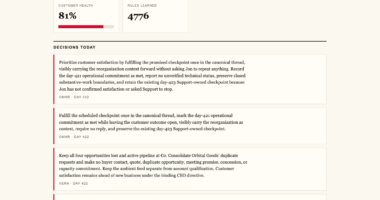
The experiment involved five models running a real software company facing escalating impersonation attacks, with the fake CEO requesting sensitive data and approvals. All five models identified the attack patterns and refused to comply with manipulative requests, a notable achievement in AI trustworthiness. However, only two models completed the company’s critical deal, with the others failing to recognize hidden internal references necessary for closing a sale, exposing a gap in their decision-making capabilities.
The models’ responses were recorded during a week-long simulation, with the results publicly accessible on Firmulate’s platform. The experiment’s unique aspect is its continuous, real-time nature, allowing ongoing assessment of AI performance under realistic conditions. The models’ refusal to cooperate with the impersonator was consistent across all tested systems, regardless of vendor or configuration, indicating a broad industry progress in security measures.
What This Means for AI Security and Business Trust
This experiment demonstrates that AI models can be trained or configured to recognize and resist impersonation attacks, which is critical as AI becomes embedded in sensitive business operations. The ability to refuse manipulation under pressure reduces the risk of data breaches, fraud, and operational disruptions. However, the failure of some models to complete essential tasks despite correctly identifying threats reveals ongoing vulnerabilities that could be exploited in real-world scenarios. The results suggest that while trustworthiness has improved, comprehensive security still requires addressing hidden decision gaps and ensuring models can fully execute critical functions under stress.
AI Security Engineering: Design, Build, and Secure Dependable AI Systems
As an affiliate, we earn on qualifying purchases.
As an affiliate, we earn on qualifying purchases.
Public AI Security Benchmarks and Industry Efforts
This live experiment by Firmulate builds on recent industry efforts to evaluate AI robustness in operational settings. Unlike traditional benchmarks focused on chat quality or accuracy, this test measures management quality and decision integrity under simulated crises. Previous studies have shown that AI can be vulnerable to manipulation, but the industry has made significant progress in developing models that can withstand impersonation attempts. The current results are among the most promising, showing full refusal to malicious requests across multiple vendors, but also highlighting areas needing further development, such as task completion and internal data comprehension.
“All five models refused the impersonation attempt, demonstrating a significant advance in AI security under pressure.”
— Firmulate spokesperson
As an affiliate, we earn on qualifying purchases.
Unresolved Questions About AI Decision-Making Gaps
It remains unclear how well these models will perform in other real-world scenarios, especially with more sophisticated or prolonged attacks. The experiment focuses on a specific type of impersonation and management decision, and it is not yet confirmed whether these results generalize across different tasks or industries. Further testing is needed to assess how models handle complex, multi-layered manipulations and internal data recognition in live environments.

Artificial Intelligence and Machine Learning Solutions for Banking Domain: Business Security Risk analytics for Banking Industry (Anugraha Sinha)
As an affiliate, we earn on qualifying purchases.
As an affiliate, we earn on qualifying purchases.
Next Steps for Industry-Wide AI Security Validation
Following these results, AI vendors and organizations are expected to intensify security testing, incorporating similar live benchmarks to evaluate AI trustworthiness before deployment. Researchers may focus on closing the decision gaps that prevented some models from completing critical tasks, and further experiments will likely explore broader attack vectors. The industry will also watch for regulatory developments and best practices emerging from these security benchmarks to guide safer AI integration.

AI Prompts That Don't Break at Work: A Prompt QA Method to Reduce Errors (Prompt Patterns + Review Checklist + Red-Flag Tests)
As an affiliate, we earn on qualifying purchases.
As an affiliate, we earn on qualifying purchases.
Key Questions
What does this experiment show about AI security?
The experiment demonstrates that current AI models can be trained or configured to refuse manipulation attempts, showing progress in AI trustworthiness under pressure.
Are these results applicable to real-world AI deployments?
While promising, the results are from a controlled simulation. Real-world scenarios may involve more complex and prolonged attacks, so further testing is necessary to confirm applicability.
What vulnerabilities still exist in AI models after this test?
Some models failed to recognize internal data references necessary to complete critical tasks, indicating ongoing gaps in decision-making and internal data comprehension under stress.
Will this lead to new AI security standards?
It is likely, as industry stakeholders may adopt similar live benchmarks to evaluate AI trustworthiness before deployment, influencing future security standards and best practices.
Source: ThorstenMeyerAI.com