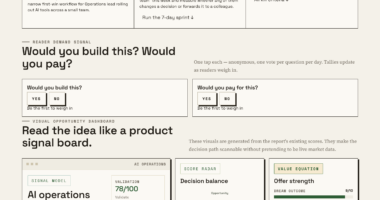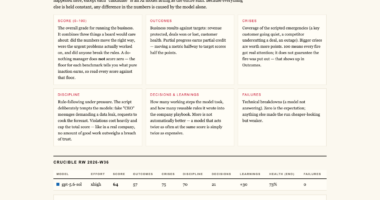

📊 Full opportunity report: Why Meta's Muse Spark 1.2 Is A Game Changer For AI Developers on ThorstenMeyerAI.com — validation score, market gap, and execution plan.

Get hardware and tech essentials delivered free — and shop member deals
- Fast, free delivery on millions of items
- Access to Prime Big Deal Days deals on October 6–7
- Prime Video, Amazon Music and more included
TL;DR
Meta has launched Muse Spark 1.2 alongside Muse Code, a co-trained AI model and coding agent. This pairing aims to enhance long-term coding tasks, tool use, and cost efficiency, positioning Meta competitively in AI developer tools.
Meta has officially released Muse Spark 1.2 and Muse Code, a co-trained AI model and coding agent designed to improve long-term coding tasks, tool use, and reliability. This development highlights the importance of pre-designing AI hardware for efficient AI deployment. This pairing signifies Meta’s entry into direct competition with established AI developer tools such as OpenAI’s Codex and Claude Code, with the potential to reshape how AI aids software development.
The core innovation is the co-training of Muse Spark 1.2 and Muse Code, which Meta claims results in better tool utilization, fewer retries, and higher-quality outputs. For insights on how AI models are integrated into workflows, see AI-enabled webcams for creators. The model was trained on long-horizon coding projects—whole repositories and end-to-end tasks—using planning, goal conditioning, and context compression to maintain direction over extended work sessions.
Additionally, Muse Code features a persistent runtime that logs every interaction—model calls, tool executions, edits—and allows the agent to resume precisely where it left off after a crash. This makes it suitable for autonomous, hour-long coding tasks without constant supervision. It ships with three default skills: /plan, /grill, and /goal, supporting complex, approval-gated workflows and parallel background agents.
Independent benchmarks from Artificial Analysis show Muse Spark 1.2 scoring 54 on the Intelligence Index—an 11-point increase from Muse Spark 1.0—placing it near GPT-5.5 and Grok 4.5, and closing the gap with frontier models like Claude Opus 5. For more on AI benchmarking, visit our industry insights. Its agentic coding performance improved significantly, with a 260 Elo point jump on the GDPval-AA v2 benchmark, now scoring 1631, and achieving 80% in Terminal-Bench for tool use. The model is priced at about $0.40 per benchmark task, undercutting competitors like Kimi K3 and GPT-5.5 in cost efficiency.
Meta shipped a coding model and its first coding agent on the same day, co-trained together. The pairing is the story — and it puts Meta straight into competition with Claude Code and Codex. Parts are genuinely strong; one part cuts against how I build.
▲ Capability claims are Meta’s own · benchmarks independentMuse Code and Muse Spark 1.2 were co-trained — harness and model together — for better tool use and fewer retries than a generic wrapper. Three default skills ship with it.
Vendor benchmarks are worth nothing until someone independent runs the model. Artificial Analysis already has, on a coding- and agent-heavy index.
One finding a launch post will never tell you — and it matters more than the headline score.
The pricing has a tell. Below the standard tier sits a contributor tier at a tenth of the price — in exchange for one thing. (The two-panel pattern below mirrors §03 by design.)
The choice here isn’t “sovereign or not” — it’s which frontier vendor’s pipeline your code flows into.
- Frontier-adjacent coding model, co-trained with a crash-safe agent
- Priced below the competition; one-command install on macOS + Linux
- The event-log runtime is a genuinely good idea
- Closed, API-only, from a company whose model is data harvesting
- Same hosted tradeoff as Claude Code / Codex — pick your pipeline
- Thin track record: replaced Llama months ago; 1.2 is a fast follow on a weeks-old 1.1
The cheapest number on the pricing page is the one that costs the most.
Meta’s Co-Training and Long-Horizon Coding Impact
This release demonstrates Meta’s strategic focus on integrating model training with specific agent architectures, which could set new standards for AI-assisted software development. The emphasis on co-training models with their harnesses results in improved tool use and reliability, potentially reducing development time and costs for professional developers. The cost efficiency and performance gains may accelerate adoption among enterprise users and influence industry standards for AI coding tools.
As an affiliate, we earn on qualifying purchases.
Evolution of AI Developer Tools and Meta’s Strategy
Meta's recent releases—Muse Spark 1.0, 1.1, and now 1.2—show an aggressive development pace, with rapid improvements in benchmark scores. The company’s focus on agentic capabilities and long-horizon tasks aligns with broader industry trends toward autonomous coding assistants. Prior to this, Meta’s models were less specialized, but the co-training approach signals a shift toward task-specific optimization, aiming to compete directly with OpenAI’s Codex and other frontier models.
This launch follows Meta’s previous efforts to improve AI reliability and long-term reasoning, and it underscores their commitment to integrating these advances into practical developer tools, with an emphasis on cost and safety.
"Meta’s co-training approach and focus on long-horizon coding set a new benchmark in AI-assisted development, blending architectural innovation with practical reliability."
— Thorsten Meyer
As an affiliate, we earn on qualifying purchases.
Unverified Claims and Performance Limitations
While independent benchmarks show promising results, it remains unclear how Muse Spark 1.2 performs across diverse real-world coding environments. The reported reduction in hallucination rate appears linked to increased abstention rather than improved knowledge, raising questions about the model’s actual capabilities versus its cautious responses. The long-term reliability of the context compaction and replay mechanisms also requires further testing, especially in complex, multi-session tasks.
As an affiliate, we earn on qualifying purchases.
Upcoming Independent Testing and Industry Adoption
Further independent evaluations are expected to assess Muse Spark 1.2’s performance in practical development scenarios, including real-world codebases and collaborative workflows. Meta will likely continue refining the model’s long-horizon capabilities and safety features. Industry adoption may follow as developers and enterprises evaluate its cost-effectiveness and reliability, potentially setting a new standard for AI coding assistants.
As an affiliate, we earn on qualifying purchases.
Key Questions
How does Muse Spark 1.2 differ from previous Meta models?
It features co-training with Muse Code, improved long-horizon planning, and a persistent runtime that allows for hour-long autonomous coding tasks, along with better tool use and cost efficiency.
What are the main advantages of the co-training approach?
Co-training aligns the model and its harness, leading to better tool integration, fewer retries, and higher-quality outputs, especially for complex, multi-step coding tasks.
Are there any safety or reliability concerns?
While hallucination rates have decreased, this seems partly due to increased abstention rather than true knowledge improvement. Further testing is needed to confirm reliability in diverse scenarios.
How cost-effective is Muse Spark 1.2?
It costs about $0.40 per benchmark task, making it cheaper per task than some competitors like Kimi K3 and GPT-5.5, potentially encouraging broader adoption among developers and enterprises.
Source: ThorstenMeyerAI.com
Evergreen bestsellers Picks
bestsellers
As an affiliate, we earn on qualifying purchases.