

Crypto has trained a generation of readers to ask a blunt question: can the claim be verified? A confident statement is not evidence. A polished interface is not evidence. A promise about what happened, who approved it or which work was completed remains only a promise until it can be checked against a reliable record.
Crypto & Finanzen · Construction evidence
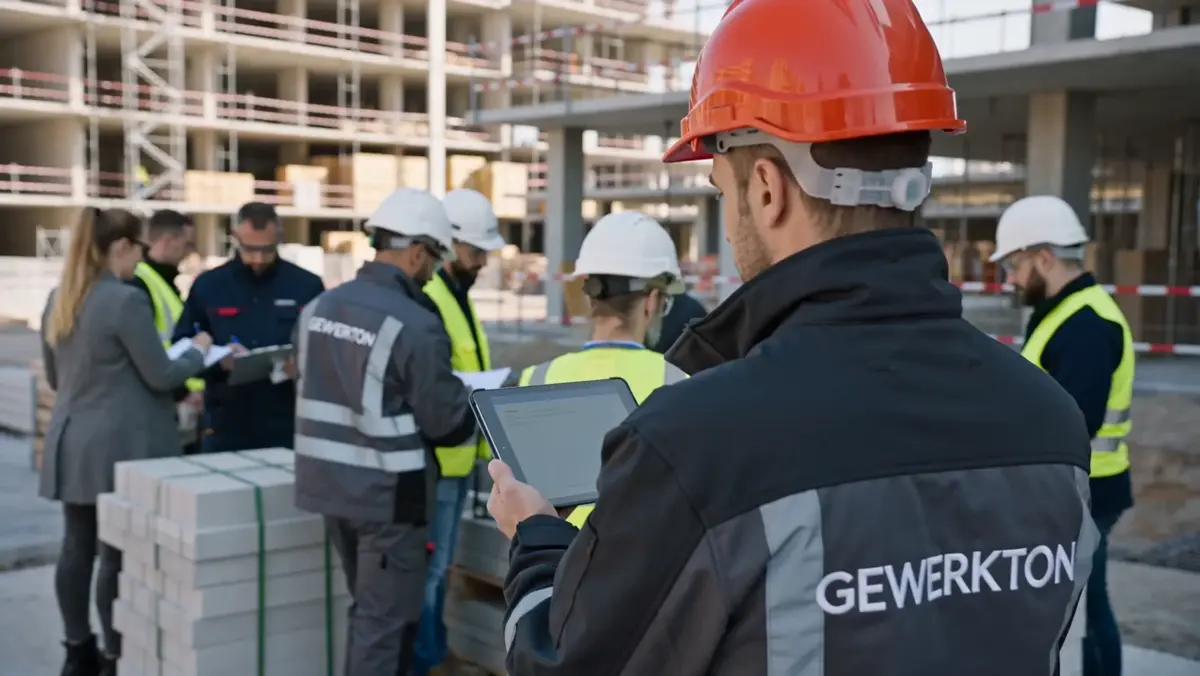
On site, what counts is what’s proven.
Gewerkton’s specific proposition is not more documentation. It is a record that begins close to the physical event and remains useful as it moves into plans, reports, invoices and change-related processes.
Product status
Beta now
Public beta is planned for fall 2026—keeping what exists today distinct from what is planned.
Global capture
27
content languages
Cross-border teams can work in their own languages while the evidence original remains unambiguous.
The continuity architecture
Three distinct jobs, one travelling record
Evidence meets money
4
German commercial bridges
Site records can continue towards invoicing instead of ending inside an isolated notes application.
Regional choice
13
AI providers
BYO-AI lets users bring their own keys and choose providers across the EU, US and Asia, including mainland China. Data can reside in an EU cloud or on the user’s infrastructure.
That instinct applies just as strongly to construction. Sites generate a constant stream of claims: a defect was reported, an instruction was given, extra work was requested, a deadline was agreed, a handover took place. The practical problem is not producing more statements about those events. It is capturing what happened in a form that can move through the project instead of disappearing into memory, an isolated message or a notes app.
This is the premise behind Gewerkton, a voice-first construction documentation and defect management platform for global markets. Its marketing line is unusually direct: “On site, what counts is what’s proven.” For an audience accustomed to distrusting unverifiable claims, that is less a slogan than an operating principle.
Gewerkton is in beta now. A public beta is planned for fall 2026. That status matters because the distinction between what exists today and what is planned should be stated plainly, especially in a story centred on evidence rather than promotional certainty.

FCMEZRVPNIG 4K/1080P WiFi Waterproof Mini Digital Recorder, Recessed Night Vision Device for On-Site Law Enforcement Recording(1080P No WiFi Nocard)
- Wide-Angle Lens: 170° ultra-clear 4K recording
- Infrared Night Vision: 8 IR LEDs for all-weather monitoring
- Illumination & Laser: White light and laser positioning
As an affiliate, we earn on qualifying purchases.
As an affiliate, we earn on qualifying purchases.
Construction has its own verification problem
Physical work is visible, but the commercial and operational history surrounding it is often fragmented. A crew can see that something was installed. That does not automatically produce a usable record of when the work happened, which instruction preceded it, whether a defect was attached to it or how it should enter the commercial process.
The evidence chain therefore matters beyond the site diary. Documentation has to remain useful when the project reaches daywork reporting, invoicing, handover, model coordination or a discussion about change orders. If the original observation cannot travel into those later stages, the team has captured information without building continuity.
Gewerkton was born in the German market and has its deepest German commercial integration through GAEB, REB, XRechnung and DATEV. That combination gives the evidence discussion a concrete financial dimension. Site records are not treated merely as an archive of what crews said and saw. They can flow towards invoicing through the commercial formats and systems used around the work, rather than ending their useful life inside an isolated notes application.
This is where construction documentation meets the scepticism familiar to crypto. The decisive question is not whether someone can make a plausible claim. It is whether the underlying record survives the journey from capture to commercial use. Evidence that cannot leave the point of capture may be informative, but it is operationally stranded.

72GB Magnetic Voice Activated Recording Device – BUKUCCETA (9800 Hour) Digital Voice Recorder with AI Noise Reduction, Portable Audio Recorder for Lectures, Meetings, and Interviews
- Large Storage Capacity: Stores up to 9800 hours of audio
- Extended Recording Time: Up to 70 hours per charge
- AI Noise Reduction: Eliminates background noise for clarity
As an affiliate, we earn on qualifying purchases.
As an affiliate, we earn on qualifying purchases.
Voice as the start of the record
Construction sites do not resemble quiet offices. The person closest to an event may be moving between trades, inspecting work, handling a handover or standing in a location with no reliable connection. A documentation system has to begin where the evidence appears, under the conditions in which the work is actually performed.
Gewerkton Field is the voice-first construction site app. It turns dictation into evidence, defects, daywork reports and takt information, and includes a portal. The emphasis on voice is practical: the spoken account becomes the entry point for a structured project record rather than remaining an informal recollection that must be reconstructed later.
The distinction is important. A voice note sitting in a generic application is still an isolated object. Dictation connected to evidence, defects, reports and project processes can become part of a record that other people can use. The value lies not simply in recording sound, but in connecting capture with what the project needs to do next.
The deployment fields show why that matters. Wind farms and renewable projects involve distributed sites, rotating crews and field acceptance, with offline capture required in dead zones. Data centres and industrial plants put many trades in parallel under tight deadlines; meeting decisions can become trade-sorted task lists. Housing and building construction require defects with a photo and deadline, dictated daywork reports, and a signature on the device during handover.
Infrastructure and tunnel projects add long durations and many change orders. Instructions can be backed by the original audio, preserving the source behind the later record. Across these settings, the principle remains the same: capture should begin close to the event, while the people, context and physical conditions are still present.
![Express Schedule Free Employee Scheduling Software [PC/Mac Download]](https://m.media-amazon.com/images/I/41yvuCFIVfS._SL500_.jpg)
Express Schedule Free Employee Scheduling Software [PC/Mac Download]
- User-friendly drag & drop interface: Simple shift planning
- Manage time-off and leave: Add sick leave, breaks, holidays
- Email schedules to staff: Send schedules directly via email
As an affiliate, we earn on qualifying purchases.
As an affiliate, we earn on qualifying purchases.
From field evidence to plans and models
A site record gains meaning when it can be related to the wider project. Plans and models provide that context, but not every team begins with a model ready for use. A system built around verification cannot assume ideal inputs if the site itself has to deal with a less orderly reality.
Gewerkton Studio is the browser workspace for plans and models. Where no model exists, the site team can create one in the browser. That allows the project record to develop around the work even when a model was not supplied at the outset.
Gewerkton Cloud handles operations and model or data coordination between Field, Studio and third parties. In practical terms, the three parts have distinct jobs: Field captures and organises what happens on site, Studio provides the browser environment for plans and models, and Cloud coordinates the operational and data movement around them.
The relevant measure is continuity. A defect, instruction or daywork report should not become less useful each time it crosses from site work to a browser workspace or an external process. Evidence thinking asks whether the record retains its connection to the event as it moves, rather than being reduced to another unsupported summary.
construction progress reporting app
As an affiliate, we earn on qualifying purchases.
As an affiliate, we earn on qualifying purchases.
Commercial integration is where evidence meets money
Evidence on a construction project is not an abstract virtue. It affects whether work can be processed commercially. Dictated daywork, instructions and change-related records sit close to questions of quantities, invoices and accounting. That is why Gewerkton’s integration with GAEB, REB, XRechnung and DATEV is central to the story rather than a regional footnote.
The construction and finance sides often describe the same work in different forms. The field begins with an observed event: work completed, an instruction received, a defect found or an additional task recorded. The commercial process needs that event to arrive in formats that can support subsequent handling. German commercial integration provides the bridge through which site evidence can continue towards invoicing.
For a crypto-literate audience, the useful analogy is methodological, not technological. No blockchain is required to understand the point. Claims should be tied to records, and records should remain available when value changes hands. The more financially important the statement becomes, the less satisfactory an unverifiable recollection is.
That also explains the importance of original audio in long-running infrastructure and tunnel work. A later report may organise the information, but the source remains relevant when instructions and change orders accumulate over time. The organised output and its underlying evidence serve different purposes; retaining the relationship between them makes the record more useful.
Multilingual capture without a single-region assumption
Global construction adds another layer to verification. A project may include teams from the EU, US and APAC, with each participant working in their own language. Chinese, Korean and Vietnamese crews may need multilingual handling from capture through to the report. If evidence becomes ambiguous as it crosses a language boundary, the project has exchanged one documentation problem for another.
Gewerkton supports 27 content languages. Cross-border teams can work on the same project in their own languages while the evidence original remains unambiguous. For projects in Asia, the platform supports multilingual handling from capture to report, alongside a choice over data residency.
Its BYO-AI approach includes 13 AI providers. Users bring their own keys and can select providers by region across the EU, US and Asia, including mainland China. The stated aim is to avoid vendor lock-in while allowing regional provider choice. Data can reside in an EU cloud or on the user’s own infrastructure.

Those choices matter because a global evidence system cannot treat provider location, infrastructure and language as afterthoughts. The same project may span jurisdictions, teams and operational requirements. A fixed provider assumption would sit awkwardly beside a product intended for regional deployment across global markets.
A product built through software verification
The platform’s development story echoes its evidence-centred position. Gewerkton is built by a solo founder directing a fleet of coding agents using Codex and Claude. In one night, that fleet shipped 21 software packages. The notable part is not only the speed: the packages were verified with negative controls and mutation tests.
That verification detail matters. Output volume by itself proves little about reliability. Negative controls and mutation tests are methods for challenging whether checks can detect failure, rather than merely reporting success under friendly conditions. In an article about distrust of unsupported claims, the development process belongs in the argument because it treats testing as an attempt to disprove confidence, not decorate it.
The same restraint is visible in the marketing site. It operates in 27 languages, uses zero trackers, has no cookie banner and follows a fully egress-free architecture. Its media bank contains more than 51 self-produced clips and posters. These facts describe the scope of the presentation without replacing the more important question of what the beta product can demonstrate in use.
Evidence should survive the whole project
The strongest interpretation of “On site, what counts is what’s proven” is not that every disagreement disappears once documentation exists. It is that a project works from records that can be examined instead of forcing participants to depend on unsupported memory. That is a more modest claim, but also a more useful one.
A field record should be able to retain its relevance as it passes through defects, daywork, takt, plans, models, coordination and commercial processing. On distributed renewable sites, it may begin offline in a dead zone. In a data centre, it may start with a meeting decision assigned by trade. In housing, it may combine a defect, photo and deadline. In a tunnel, it may preserve the original audio behind an instruction. Across borders, it may move from capture to report while teams work in different languages.
Gewerkton Cloud connects the operational and model or data coordination layer between Field, Studio and third parties. Together, the three product lines address different parts of the same evidence path without pretending that capture alone solves the problem.
For readers shaped by financial scepticism, the conclusion is familiar. Interface polish cannot substitute for a verifiable record. A claim about completed work, a defect, an instruction or additional effort acquires practical weight when the supporting evidence remains connected, understandable and usable at the point where the project acts on it.
Gewerkton’s beta is an attempt to apply that discipline to construction: voice-first capture on site, browser-based work with plans and models, coordination across systems, multilingual operation, regional AI choice and German commercial integration extending into invoicing. The public beta planned for fall 2026 will put that proposition before a wider audience. Until then, the most appropriate standard is the platform’s own: what counts is not what is promised, but what is proven.