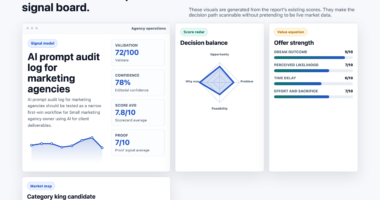

📊 Full opportunity report: AI’s Next Move: Interpreting The Inkling From Thinking Machines on ThorstenMeyerAI.com — validation score, market gap, and execution plan.
TL;DR
Thinking Machines launched Inkling, a large open-weight multimodal AI model, openly available on Hugging Face under Apache 2.0. The release emphasizes transparency but raises questions about licensing restrictions and data sources.
Thinking Machines has officially released the full weights of its new multimodal AI model, Inkling, making it openly accessible on Hugging Face under the Apache 2.0 license. This move represents a notable shift in how large language models are distributed and owned, emphasizing transparency and ownership over rental or API-based access.
Inkling is a 975-billion-parameter mixture-of-experts transformer supporting multimodal inputs, including text, images, and audio. It was pretrained on 45 trillion tokens across various media, with a 1-million-token context window. The model’s architecture routes tokens through 66 layers, with 41 billion active parameters, and supports native multimodal input without additional vision adapters, processing audio as spectrograms and images as pixel patches.
In addition to the flagship model, a smaller version, Inkling-Small, with 276 billion total parameters and 12 billion active, was introduced, showing competitive performance on several benchmarks. The full weights for Inkling are now available openly on Hugging Face, licensed under Apache 2.0, allowing download, modification, and deployment by anyone.
Thinking Machines emphasized its honesty about the model’s strength: Inkling is not the top-performing model currently available, either openly or commercially. The company also disclosed that the training involved synthetic data from other open models like Kimi K2.5, and that a separate Model Acceptable Use Policy (AUP) restricts certain applications, such as surveillance and deception, raising questions about the scope of its open licensing.
The weights came first: what Inkling actually signals
Mira Murati’s lab shipped its first foundation model — and the model isn’t the story. The order of operations is: full weights, Apache 2.0, day one, before any closed API. Plus a rare concession — the lab says it’s not the strongest model available, open or closed.
- AIME 2026 97.1%
- GPQA Diamond 87.2%
- MCP Atlas (Nemotron 44.7%) 74.1%
- VoiceBench · open-weight audio frontier 91.4%
- FORTRESS adversarial · best open 78.0%
- ForecastBench · calibration 61.1
- HLE text-only (GLM-5.2 40.1%) 29.7%
- SWE-bench Pro (GLM-5.2 62.1%) 54.3%
- Terminal-Bench 2.1 (GLM-5.2 82.7%) 63.8%
- SWE-bench Verified (Fable 5 95.0%) 77.6%
- Design Arena · 2nd open, behind GLM-5.2 ~10th
A 0.2 → 0.99 effort setting trades reasoning tokens against cost & latency, so you get a curve, not a point. On Terminal-Bench 2.1 it reportedly matches Nemotron 3 Ultra at ~⅓ the tokens. Peak score is a vanity metric when you serve millions of calls; the cost curve is what ships. (Bonus: its chain of thought compressed on its own during RL — nobody rewarded it; efficiency did.)
Pitched as the Western alternative to Chinese open weights (censorship-resistance training is the differentiator). But GLM-5.2 still wins on agentic/reasoning and Kimi K2.6 often on multimodal: best American open model, second in the open field. The irony — post-training was bootstrapped on synthetic data from Kimi K2.5.
BF16 needs ≥2 TB aggregate VRAM (8× B300 / 16× H200). NVFP4 still needs ≥600 GB. Not a workstation model — a 512 GB fleet falls just short. “Open” ≠ “runnable.” Mitigations: 1-bit GGUFs (~74% acc.), hosted eval routes, and Inkling-Small (12B active) — the release local-first builders actually want.
Open weights used to be a consolation prize. Inkling is a strategic open release — Apache 2.0, natively multimodal, honestly marketed, published complete on day one, optimized for deployment rather than headlines (the model isn’t the product; the fine-tuning platform is). It doesn’t need to win every benchmark for that to matter. The frontier is learning that owning the base beats renting the API — arriving now from the inside. For the sovereignty buyer: ① a real Western hedge against being switched off · ② verify the use policy before you build · ③ check the VRAM, then benchmark vs GLM-5.2 & Kimi K2.6 on your task.
Implications of Open-Weight Release for AI Ownership
The release of Inkling’s full weights under an open license marks a significant shift toward ownership and transparency in large AI models. It enables organizations to fine-tune, inspect, and deploy the model independently, reducing dependency on API-based access. This approach could influence industry standards, especially amid concerns over model misuse, licensing restrictions, and control over AI technology.
However, the accompanying Model Acceptable Use Policy suggests restrictions on certain applications, which complicates the narrative of full openness. This raises important questions about the true nature of “open source” in AI and the potential for layered restrictions that limit use cases.
For industries like public safety, geospatial analysis, and research, the ability to own and modify models like Inkling could accelerate innovation but also necessitates careful review of licensing and ethical policies.
multimodal AI models for developers
As an affiliate, we earn on qualifying purchases.
As an affiliate, we earn on qualifying purchases.
Industry Trends Toward Open AI Models
Over the past year, there has been a growing push within the AI community for more open models that allow ownership, inspection, and modification, contrasting with proprietary API-based models from major tech firms. Notable examples include Meta’s Llama 2 and OpenAI’s open releases of earlier models. The release of Inkling by Thinking Machines continues this trend, emphasizing transparency and user control.
Prior to this, most large models were distributed with restrictions or only accessible via APIs, raising concerns over transparency, safety, and commercial control. The industry is increasingly aware of the risks and benefits associated with open models, including the potential for misuse but also fostering innovation and democratization of AI technology.
Thinking Machines’ decision to publish full weights openly, while maintaining a separate AUP, reflects ongoing debates about how best to balance openness with responsible use.
“Our goal is to promote transparency and ownership in AI, enabling users to fine-tune and deploy models independently, while adhering to our use policies.”
— Thinking Machines spokesperson
open-weight AI models on Hugging Face
As an affiliate, we earn on qualifying purchases.
As an affiliate, we earn on qualifying purchases.
Open Questions About Licensing and Usage Restrictions
It remains unclear how the Model Acceptable Use Policy (AUP) will be enforced in practice and whether it will limit the open-source nature of Inkling. The specifics of the restrictions and their scope are not publicly verified, raising questions about how much control Thinking Machines retains over modified versions.
Additionally, the extent to which the training data and pipeline are disclosed remains uncertain, which could impact assessments of the model’s transparency and potential biases.
Further details are expected to clarify these issues, but at present, uncertainties about licensing enforcement and data transparency persist.
AI model training datasets
As an affiliate, we earn on qualifying purchases.
As an affiliate, we earn on qualifying purchases.
Next Steps for Adoption and Oversight of Inkling
Expect further analysis from the AI community regarding Inkling’s licensing and ethical use policies. Organizations interested in deploying the model will need to review the AUP closely and conduct independent testing to verify compliance. Regulatory and industry bodies may also scrutinize the layered restrictions, influencing future open-source practices.
Additionally, further benchmarks and independent evaluations are anticipated to assess Inkling’s performance across diverse tasks, especially in safety-critical domains. The ongoing development of smaller, optimized versions like Inkling-Small may also expand accessibility for research and commercial applications.
Overall, the next phase involves balancing transparency, control, and responsible deployment as the AI ecosystem adapts to these new open-weight models.

AI Engineering and Agentic AI: Designing Autonomous Language Model Systems with Memory, Tools, and Safe Deployment
As an affiliate, we earn on qualifying purchases.
As an affiliate, we earn on qualifying purchases.
Key Questions
What makes Inkling different from other large language models?
Inkling is notable for its full open weights under Apache 2.0, supporting multimodal inputs, and being openly available for download, modification, and deployment. It also emphasizes transparency about its strength and training data.
Does the open release mean anyone can use Inkling freely?
While the weights are openly available under Apache 2.0, the Model Acceptable Use Policy (AUP) may impose restrictions on certain applications, such as surveillance or deception. Users should review the policy before deploying.
Why is the layered restriction on the model significant?
The combination of an open license with a separate use policy raises questions about the true openness of the model and how enforceable restrictions will be in practice, especially for sensitive applications.
Will this influence other AI companies to release open weights?
Potentially, yes. The move by Thinking Machines could set a precedent for more transparency and ownership-focused releases, though industry norms and legal considerations will shape future actions.
What are the main risks associated with open large models like Inkling?
Risks include misuse for malicious purposes, biases inherent in training data, and difficulties in enforcing restrictions. Responsible deployment and oversight will be critical.
Source: ThorstenMeyerAI.com