
📊 Full opportunity report: DDR5 Now, DDR6 Soon: A Buyer’s Field Guide on ThorstenMeyerAI.com — validation score, market gap, and execution plan.
TL;DR
DDR5 memory remains the best choice for most users in 2026, with prices stable at the DDR5-6000 CL30 level. DDR6 is not yet ready for mainstream adoption and will arrive around 2027, with significant platform and cost implications.
DDR5 memory remains the recommended standard for mainstream builds in 2026, with no immediate price drops expected and DDR6 still several years away from mass adoption, according to recent industry forecasts.
Market analysts confirm that prices for DDR5-6000 CL30 kits have stabilized and are the optimal choice for most users, balancing cost and performance. The common misconception that waiting for DDR6 will save money is challenged by forecasts indicating that DDR6 will not be widely available until 2027, at a significantly higher cost—potentially 2-3 times more per gigabyte—on new platforms.
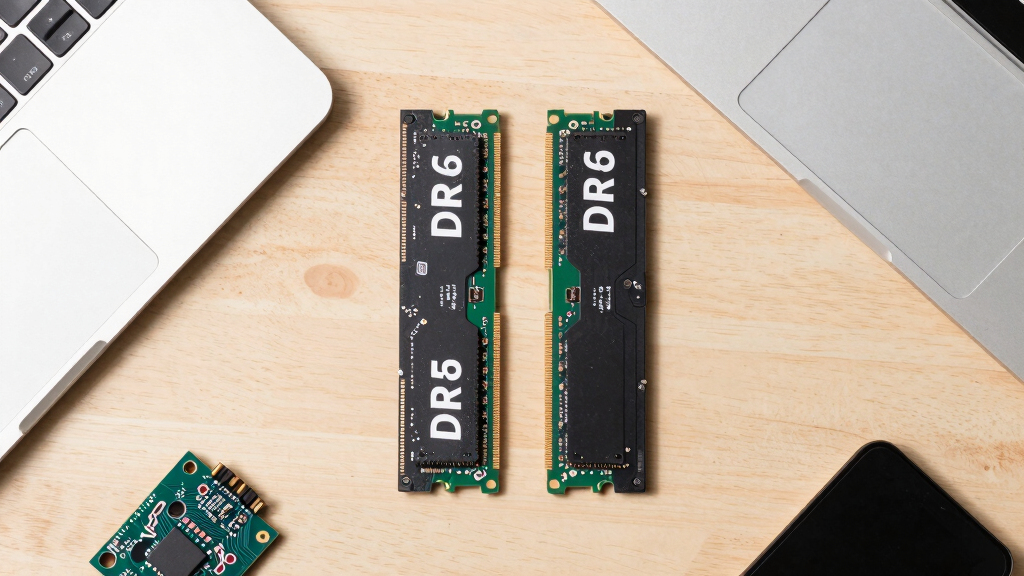
Manufacturers have begun rolling out DDR6 modules, but these are primarily targeted at enterprise and AI server markets initially, with mainstream desktop adoption expected around 2027. DDR6 introduces a new architecture with four 24-bit sub-channels, higher speeds (up to 17,600 MT/s), and a new physical form factor (CAMM2), but it requires entirely new CPUs and motherboards, making early adoption costly and complex.
Experts advise consumers against investing in DDR4 for new builds, as DDR4 is effectively phased out and now comparable in price to DDR5, with no future upgrade path. Instead, building on DDR5 now ensures compatibility, performance, and future-proofing, especially since DDR6 will not be backward compatible with DDR5 or DDR4.
DDR5 now, DDR6 soon
A buyer’s field guide. The 20-year instinct — wait for prices to drop, or wait for the next generation — is broken this cycle. Buy the DDR5 you actually need now; don’t wait for DDR6. Here’s the reasoning.
Driven to end-of-life, production slashed. Same money, dead-end socket. Leave a working DDR4 box alone — but never start a new build on DDR4 to “save.”
A framework, not a gamble. Buy the DDR5 you need now, at the sweet spot, in the capacity you’ll actually use — don’t buy DDR4, don’t wait for DDR6. The two costliest mistakes in this market are the ones that feel prudent: waiting for a price drop that isn’t coming, and waiting for a next-gen part that launches dearer than what’s on the shelf. Next: The SSD Squeeze.
Why DDR5 Is the Best Choice for 2026 Builds
For most consumers, choosing DDR5 now means better value and performance without the premium costs and compatibility issues associated with DDR6. Delaying upgrades in anticipation of DDR6 could result in missing out on platform improvements and incurring higher expenses later. Understanding the current market helps buyers avoid overpaying and ensures they select components that will remain relevant for several years.
DDR5-6000 CL30 RAM kit
As an affiliate, we earn on qualifying purchases.
As an affiliate, we earn on qualifying purchases.
The 2026 Memory Market and Future Outlook
The memory market has experienced significant volatility, with prices rising sharply due to supply shortages and increased demand. While DDR5 was introduced in 2021, widespread adoption has been slow, partly due to high costs and limited availability. DDR6, announced in late 2023, promises higher speeds and better performance but will require new hardware platforms, with initial releases focused on enterprise and AI applications. Consumer adoption is not expected before 2027, and early-stage DDR6 modules may face issues like limited capacity and stability problems.
“DDR6 is on the horizon, but it will take at least two more years before it becomes mainstream, and initial prices will be significantly higher.”
— Memory manufacturer spokesperson
high performance DDR5 memory
As an affiliate, we earn on qualifying purchases.
As an affiliate, we earn on qualifying purchases.
Uncertainties Around DDR6 Adoption Timeline and Compatibility
While DDR6 standards are finalized and modules are beginning to appear, it remains unclear exactly when mainstream CPUs and motherboards will fully support DDR6 at scale. Early DDR6 modules may face issues like limited capacities and stability challenges, and the cost premium is expected to be high initially. The precise timing and market penetration of DDR6 in consumer desktops are still developing, with no confirmed launch date for broad availability.
DDR6 RAM modules
As an affiliate, we earn on qualifying purchases.
As an affiliate, we earn on qualifying purchases.
Key Milestones for DDR6 and Market Shifts
Next steps include watching for JEDEC standard finalization and motherboard compatibility lists confirming DDR6 support. Consumers should monitor announcements from major CPU and motherboard manufacturers, as well as early DDR6 module releases. The transition to DDR6 will be gradual, with initial enterprise and high-end desktop adoption in 2027, followed by broader availability around 2030. Meanwhile, DDR5 remains the recommended choice for most users.
motherboard compatible with DDR5
As an affiliate, we earn on qualifying purchases.
As an affiliate, we earn on qualifying purchases.
Key Questions
Should I buy DDR4 or DDR5 in 2026?
Buy DDR5 for new builds or upgrades in 2026, as DDR4 is phased out and offers no future upgrade path. DDR5 provides better performance and future compatibility.
When will DDR6 be available for mainstream desktops?
DDR6 is expected to arrive in mainstream desktops around 2027, initially targeting high-end and enterprise markets, with widespread adoption possibly not until 2030.
Is it worth waiting for DDR6 to save money?
No. Forecasts indicate DDR6 will be more expensive initially, and waiting could delay your upgrade by years, costing more in the long run.
What should I look for when buying DDR5 in 2026?
Focus on DDR5-6000 CL30 kits, which are optimal for current platforms. Avoid paying extra for higher speeds that offer little real-world benefit.
Will DDR6 be backward compatible with current systems?
No. DDR6 requires new CPUs and motherboards, and cannot be used with existing DDR5 or DDR4 platforms.
Source: ThorstenMeyerAI.com