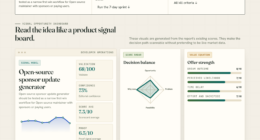

📊 Full opportunity report: India: Build the Rails First on ThorstenMeyerAI.com — validation score, market gap, and execution plan.
TL;DR
India has prioritized building scalable digital infrastructure—Aadhaar, UPI, and DBT—over large benefit payouts. This strategy aims to deliver targeted welfare efficiently at scale, with ongoing challenges at the last mile.
India has built the world’s most ambitious digital public infrastructure, including Aadhaar, UPI, and Direct Benefit Transfer (DBT), to deliver social benefits efficiently to over a billion people. This approach shifts focus from large benefit payments to creating scalable, low-cost digital systems that minimize leakage and target aid effectively. The development highlights a strategic move by India to address its economic constraints while expanding social welfare.
Over the past decade, India has established a digital ecosystem that connects biometric identity (Aadhaar), real-time payments (UPI), and targeted subsidy delivery (DBT). These systems are designed to be interoperable, scalable, and low-cost, enabling the government to transfer approximately ₹49–50 lakh crore directly to citizens while reducing leakage by an estimated ₹3.48 lakh crore. The infrastructure is built from the ground up, prioritizing the plumbing—identity, banking, and payment rails—over the benefit amounts themselves.
India’s strategy contrasts with wealthier nations, which often prioritize generous welfare benefits before developing the delivery infrastructure. The Indian model aims to leapfrog traditional bureaucratic middlemen, focusing on digital identity and payment systems that can be scaled as fiscal capacity increases. Recent initiatives include strengthening rural employment programs and launching a sovereign AI layer to support informal workers, further extending the digital infrastructure’s reach.
Build the Rails First
The Global South’s answer is infrastructure: the plumbing, not the payment. India built the world’s best welfare-delivery rails — thin benefits, but delivered to a billion-plus people, with the leakage squeezed out.
Aadhaar~1.42B biometric IDs
UPI payments + Jan Dhan accounts185B+ txns/yr · ~577M accounts
Direct Benefit Transfer (DBT)450+ schemes
Reaches 1.4B citizens directly~₹3.48L cr leakage squeezed out
Independent commentary, produced with AI assistance under human editorial oversight. The views are the author’s own and may change. This is analysis, not policy, economic, investment, or legal advice. Descriptions of Aadhaar, UPI, the JAM trinity and DBT, the rural employment guarantee and its 2025 successor act, the IndiaAI Mission, and BharatGen reflect publicly reported information as of mid-2026 and may change; figures are indicative and several are official self-reported estimates. This phase maps differing approaches and endorses none; characterizations of contested arrangements present competing views, not a verdict. Country, program, and company names are referenced for analysis and imply no affiliation.
Implications of India’s Infrastructure-First Welfare Strategy
This approach demonstrates a pragmatic solution for low- and middle-income countries to deliver social benefits at scale without the heavy costs of traditional welfare bureaucracies. It also highlights how digital infrastructure can be a foundation for broader social programs, potentially reducing corruption and leakage. However, the strategy’s success depends on the effective flow of benefits at the last mile, which remains a challenge, especially for vulnerable populations who may be excluded due to biometric or technological barriers.

Fingerprint Reader Biometric Authentication – DigitalPersona URU4500 USB – Fingerprint Scanner – Original HID Brand
New replacement old Red Logo Digital persona URU4500, HID , USB reader. Original HID Brand
As an affiliate, we earn on qualifying purchases.
As an affiliate, we earn on qualifying purchases.
Background of Digital Welfare Initiatives in India
India’s digital welfare infrastructure started gaining prominence around 2014 with the rollout of Aadhaar, followed by the development of UPI and DBT systems. These innovations aimed to address issues of leakage, ghost beneficiaries, and inefficient manual delivery of subsidies. The strategy was driven by the need to deliver targeted benefits efficiently in a country with nearly 1.4 billion people, many of whom are unbanked or lack formal identification. Recent developments include the expansion of rural employment guarantees and the launch of AI-driven fraud detection systems to improve security and inclusion.
“Our goal is to reach every citizen with targeted benefits through robust digital systems, reducing leakage and ensuring transparency.”
— Indian government official
UPI payment device
As an affiliate, we earn on qualifying purchases.
As an affiliate, we earn on qualifying purchases.
Challenges at the Last Mile and Exclusion Risks
While the infrastructure is world-class, it remains uncertain how effectively benefits reach the most vulnerable populations. Exclusion errors—such as biometric lockouts or lack of access to technology—pose ongoing challenges. The effectiveness of recent AI fraud detection and inclusion measures is still being evaluated, and it is unclear how quickly these will resolve last-mile delivery issues.

BioScrypt/L-1 Identity 4GFXS V-Flex 4G (S) Fingerprint Reader w/Secugen Sensor
As an affiliate, we earn on qualifying purchases.
As an affiliate, we earn on qualifying purchases.
Future Plans for Expanding and Improving Digital Welfare Systems
India plans to further expand its AI-driven systems, including multilingual models for inclusive AI and enhanced fraud detection. The government is also working on scaling the rural employment guarantee and broadening benefit coverage, aiming to improve last-mile access. Monitoring and evaluation of these initiatives will determine their effectiveness in reaching all intended beneficiaries.

Square Terminal – Credit Card Machine to Accept All Payments | Mobile POS
With Square Terminal, you can ring up sales, accept payments, and print receipts, all with one device. Use…
As an affiliate, we earn on qualifying purchases.
As an affiliate, we earn on qualifying purchases.
Key Questions
Why did India focus on building digital infrastructure first?
India prioritized scalable, low-cost digital systems to deliver benefits efficiently and reduce leakage, especially given its limited fiscal capacity compared to wealthier nations.
What are the main components of India’s digital welfare system?
The core components include Aadhaar (biometric ID), UPI (real-time payments), and DBT (direct subsidy transfers), all interconnected to deliver targeted benefits.
What challenges does India face with this approach?
Last-mile delivery remains problematic, with risks of exclusion for vulnerable groups due to biometric or technological barriers. Effectiveness of AI fraud detection and inclusion strategies is still being assessed.
Can this model be replicated in other countries?
Potentially, especially for countries with similar resource constraints, but success depends on local infrastructure, governance, and population needs.
What are India’s plans for future expansion?
The government aims to scale AI systems, improve last-mile access, and expand benefit coverage, focusing on more inclusive and secure digital welfare delivery.
Source: ThorstenMeyerAI.com