For most small flocks, I’d start with the Harris Farms Nurture Right 22-egg incubator, which offers more room than the 12-egg models without jumping to a large-batch unit. The VEVOR 18-egg incubator stands out for its clear viewing window and automatic water refill, while the ZEMIRO CHARGE 12-egg incubator is a compact choice for beginners. The main tradeoffs are capacity versus footprint, and convenience features versus the need to monitor temperature and humidity yourself. No automatic control can compensate for a poor location, unstable power, or incorrect setup. Read on for how the 15 options compare and which one fits your hatching plans.

Get hardware and tech essentials delivered free with Prime
- Fast, free delivery on millions of items
- Prime Video, Amazon Music and more included
- Member-only deals all year
Key Takeaways
- The 22- to 24-egg models offer a useful middle ground: they hold more than the many 12-egg units without requiring the capacity of the 56-egg Sailnovo.
- Automatic turning is common across this lineup, so differences in capacity, humidity access, and monitoring matter more than the presence of a turner alone.
- Water refill access separates convenience-focused picks: several VEVOR units and the 30-egg model with a no-opening-lid refill reduce the need to disturb the chamber.
- LED candlers and viewing windows help monitor eggs, but they do not replace a separate, reliable thermometer and humidity check.
- Small-batch buyers have the most choice: the 12-egg models vary in their stated beginner focus, controls, and visibility, while larger models make more sense when a full set of eggs is planned.

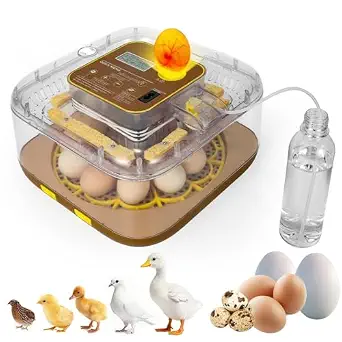


| incubator for chicken egg | Egg turning | Capacity | Dimensions | Weight |
|---|---|---|---|---|
| IBKINXX DLN-12 Egg Incubator | Automatic, adjustable intervals | 12 eggs | 10.4 × 10.4 × 6.4 inches | 1.66 kg |
| GleeGearNex Gen IV 12-Egg Full | — | 12 chicken eggs or 24 quail eggs | — | — |
| VEVOR 12 Egg Incubator with Au | Automatic | 12 eggs | 11.81 × 11.61 × 8.46 inches | 2.8 lb |
| 12-Egg Incubator with Automati | — | 12 eggs | 12.6 × 11.89 × 7.2 inches | 3.3 lb |
| ZEMIRO CHARGE Series I 12-Egg | Automatic every two hours | 12 chicken eggs or 24 quail eggs | 11 × 8 × 11 inches | 3.23 lb |
| MATICOOPX 20 Egg Incubator wit | Automatic, every 60 minutes | 20 eggs | — | 6.8 pounds |
| Egg Incubator for Hatching Egg | — | — | 6.21 x 11 x 11 inches | 4.33 pounds |
| 30 Egg Incubator with Auto Egg | Automatic, every two hours | 30 eggs | 17 x 18 x 6 inches | 4 pounds |
| MATICOOPX 30-Egg Incubator wit | Automatic; stops three days before hatch | 30 eggs | 14.1 x 14.1 x 9.1 inches | 9.15 pounds |
| 18 Egg Incubator | Automatic with adjustable intervals and pre-hatch pause | 18 eggs | 11.73 x 11.73 x 6.85 inches | 5.43 pounds |
| VEVOR 18 Egg Incubator | Automatic 360° turning | 18 eggs | 13.39 x 12.01 x 8.27 inches | 4.41 pounds |
| Sailnovo 56-Egg Incubator with | Automatic every 2 hours; stops 3 days before hatch | 56 eggs | 18.7 x 16.1 x 6.3 inches | — |
| Harris Farms Nurture Right Egg | Automatic, with auto-stop feature | — | — | — |
| 24 Eggs Incubator with Auto Wa | Automatic every 60–210 minutes | — | — | — |
| VEVOR 24 Egg Incubator | Automatic | — | 17.13 x 11.02 x 8.46 inches | 4.1 pounds |
More Details on Our Top Picks
IBKINXX DLN-12 Egg Incubator – 12 Egg Capacity with Automatic Turning, Temp/Humidity Control, and 360° Viewing
The IBKINXX DLN-12 is a strong fit for chicken keepers who want to check eggs often without repeatedly opening the incubator. Its built-in candler and 360° transparent body make observation straightforward, while the external water refill system helps maintain humidity without disturbing the chamber. Automatic temperature and humidity control, plus adjustable turning intervals, reduce routine hands-on work compared with the simpler ZEMIRO CHARGE Series I, whose humidity is self-regulating rather than presettable. The tradeoff is scale: 12 chicken eggs suits a small home hatch, not flock expansion or frequent larger batches. Its ABS housing is light and easy to clean, but buyers seeking a more robust-feeling build may prefer another option. I’d choose it for visibility and access to routine controls, not for capacity.
Pros:- Automatic temperature and humidity control with an LED display
- External water refill helps limit chamber disturbance
- Built-in candler and 360° view support routine egg checks
- Disassemblable design makes cleaning more manageable
Cons:- 12-egg capacity limits batch size
- ABS construction may feel less durable than sturdier materials
- No temperature or humidity ranges are supplied in the product data
Best for: Small-flock keepers who want to candle and observe a 12-egg chicken batch while keeping the incubator closed for water refills.
Not ideal for: Hobby farmers incubating more than 12 chicken eggs at a time or buyers prioritizing a heavier-duty housing.
- Capacity:12 eggs
- Model:DLN-12
- Material:ABS
- Dimensions:10.4 × 10.4 × 6.4 inches
- Weight:1.66 kg
- Egg turning:Automatic, adjustable intervals
- Monitoring:LED display, built-in candler, 360° view
- Water access:External refill system
- Warranty:2 years
Our verdict“Choose the IBKINXX DLN-12 if clear viewing and external water access matter more than capacity or a heavier-duty build.”
GleeGearNex Gen IV 12-Egg Fully Automatic Incubator
For buyers who want the incubator to manage more of the daily routine, the GleeGearNex Gen IV has the most elaborate automation in this group. Sensor-based temperature and humidity control, customizable turning intervals, and auto-lockdown reduce manual adjustments across the hatch cycle. It also accommodates up to 24 quail eggs, giving it more flexibility for small eggs than the chicken-focused 12-egg count suggests. Compared with the ZEMIRO CHARGE Series I, which turns every two hours and relies on self-regulating humidity, this model offers more control over turning and humidity conditions. That added automation comes with a setup caveat: its specified operating conditions include an ambient temperature of 64–86°F and humidity above 40% RH. The one-year limited warranty is also shorter than the IBKINXX DLN-12’s two-year coverage.
Pros:- Sensor-based temperature and humidity control reduces routine adjustments
- Customizable turning intervals and auto-lockdown add cycle control
- Holds up to 24 quail eggs as well as 12 chicken eggs
- Built-in candler, transparent 360° view, and quiet operation below 30 dB
Cons:- Performance depends on the stated ambient temperature and humidity conditions
- One-year limited warranty is shorter than the IBKINXX DLN-12 warranty
- Capacity remains limited to 12 chicken eggs
Best for: First-time hatchers who want customizable turning, automated lockdown, and room to incubate either chicken or quail eggs.
Not ideal for: Keepers whose incubation room falls outside the stated ambient conditions, or buyers who prefer a longer warranty.
- Capacity:12 chicken eggs or 24 quail eggs
- Temperature range:68–104°F (20–40°C)
- Humidity range:20–75% RH
- Turning intervals:60, 90, 120, 150, or 210 minutes
- Noise level:Below 30 dB
- Material:Flame-retardant ABS
- Monitoring:Built-in LED candler and transparent 360° view
- Ambient conditions:64–86°F and above 40% RH
- Warranty:1-year limited
Our verdict“Pick the GleeGearNex Gen IV for its extensive automation if your room can meet its operating conditions.”
VEVOR 12 Egg Incubator with Automatic Egg Turner, LED Candler, Temperature & Humidity Control, 360° View Window
The VEVOR 12 Egg Incubator is the most relevant pick here for chicken keepers who want to plan for a power interruption: its 110V supply supports a 12V battery backup. That is a useful distinction from the IBKINXX DLN-12 and WONEGG 12-egg model, whose supplied details do not list backup-power support. Automatic turning, real-time temperature and humidity monitoring, 360° air circulation, and a built-in light cover the core incubation tasks, while the transparent design allows checks without lifting the lid. The compromise is that the product data identifies normal temperature fluctuations of 0.9°F, which buyers monitoring sensitive eggs may want to factor into their setup. It still holds only 12 eggs, so this is a small-batch choice rather than a step-up option for larger chicken hatches.
Pros:- 110V operation supports a 12V battery backup
- Automatic egg turning reduces manual rotation
- Real-time temperature and humidity monitoring
- 360° air circulation, clear viewing, and built-in lighting
Cons:- Capacity is limited to 12 eggs
- A 0.9°F temperature fluctuation is listed as normal
- Power backup requires a compatible 12V battery, which is not specified as included
Best for: Small-scale chicken keepers who want automatic turning and a listed battery-backup option for power disruptions.
Not ideal for: Buyers needing more than 12 eggs per batch or those seeking a specified temperature stability tighter than the stated 0.9°F fluctuation.
- Capacity:12 eggs
- Dimensions:11.81 × 11.61 × 8.46 inches
- Weight:2.8 lb
- Power:110V
- Backup compatibility:Supports 12V battery backup
- Egg turning:Automatic
- Monitoring:Real-time temperature and humidity monitoring, LED candler
- Air circulation:360°
- Listed temperature fluctuation:0.9°F
Our verdict“Choose this VEVOR if backup-power planning matters for a small batch and you can accommodate its stated temperature variation.”
12-Egg Incubator with Automatic Egg Turner and Temperature Control for Chicken, Duck, Quail
This WONEGG 12-egg incubator keeps the routine uncomplicated: automatic turning runs every two hours, digital controls cover temperature and humidity, and an external water refill bottle lets you add water without opening the chamber. That makes it a practical alternative to the ZEMIRO CHARGE Series I for buyers who want an explicit external refill method rather than humidity that varies with ambient conditions. Its clear lid also supports quick visual checks. The main drawback arrives at lockdown: the turntable must be removed manually during the final three days, so it is not as hands-off as the GleeGearNex Gen IV, which lists auto-lockdown. Capacity is still just 12 eggs, and the product data does not specify temperature or humidity ranges. I’d favor it for basic control and refill access, not for the most automated hatch cycle.
Pros:- External water bottle allows refilling without opening the incubator
- Automatic egg turning every two hours
- Digital temperature and humidity controls
- Transparent lid supports visual monitoring
Cons:- Turntable must be removed manually for the final three days
- Limited to 12 eggs per cycle
- Temperature and humidity ranges are not specified in the product data
Best for: Small-batch chicken keepers who want scheduled turning and external water access but do not mind a manual lockdown step.
Not ideal for: Beginners seeking a fully automated final hatch phase or keepers who need a capacity beyond 12 eggs.
- Brand:WONEGG
- Capacity:12 eggs
- Dimensions:12.6 × 11.89 × 7.2 inches
- Weight:3.3 lb
- Material:ABS
- Color:White
- Turning schedule:Automatic, every two hours
- Water access:External refill bottle
- Lockdown step:Turntable must be removed manually for the final three days
Our verdict“Choose the WONEGG for straightforward controls and external refilling if you are comfortable handling lockdown manually.”
ZEMIRO CHARGE Series I 12-Egg Incubator for Beginners
The ZEMIRO CHARGE Series I is the simplest entry point in this set for a first chicken hatch: it turns eggs automatically every two hours, provides digital temperature control, and has a clear lid for checks without opening the incubator. Its capacity also reaches 24 quail eggs, though chicken keepers should plan around the 12-egg limit. Compared with the IBKINXX DLN-12, it has fewer listed humidity controls and no built-in candler or external refill system; the IBKINXX is better for keepers who want more direct monitoring and humidity management. ZEMIRO’s self-regulating humidity can keep operation simple, but it is not presettable and varies with ambient conditions. The Fahrenheit-only display may also frustrate users who prefer Celsius. This is a modest, small-batch starter rather than a control-rich model.
Pros:- Automatic turning every two hours reduces manual rotation
- Supports up to 24 quail eggs as well as 12 chicken eggs
- Clear lid allows monitoring without opening the chamber
- Detachable parts simplify cleaning
Cons:- Humidity is not presettable and varies with ambient conditions
- Temperature display is Fahrenheit-only
- Small 12-chicken-egg capacity and no listed built-in candler
Best for: First-time keepers hatching a small chicken batch who value basic automatic turning and a simple viewing lid.
Not ideal for: Users who need adjustable humidity settings, Celsius display, a built-in candler, or capacity above 12 chicken eggs.
- Model:KCA0013
- Capacity:12 chicken eggs or 24 quail eggs
- Temperature range:68–104°F (20–40°C)
- Humidity:Approximately 55–65% RH, self-regulating
- Egg turning:Automatic every two hours
- Weight:3.23 lb
- Dimensions:11 × 8 × 11 inches
- Display:Fahrenheit only
- Warranty:1-year limited
Our verdict“Choose the ZEMIRO CHARGE Series I for a straightforward first hatch if basic automation matters more than adjustable humidity controls.”
MATICOOPX 20 Egg Incubator with Humidity Display, Egg Candler, Automatic Egg Turner for Hatching Chickens
I’d choose this MATICOOPX when 20 chicken eggs is enough and I want key checks and routine turning built into the same unit. Its automatic turner runs hourly and stops three days before hatch, while the external water refill lets me top up humidity without lifting the lid and disturbing the environment. Circulating airflow is intended to spread heat through the chamber, and the built-in candler makes embryo checks more convenient than using a separate light.
Compared with the MATICOOPX 30-Egg Incubator, this model takes less space but gives up ten egg positions. It also offers more clearly specified turning timing than the Onsju 18-egg model, though the Onsju lists automatic humidity regulation. The tradeoff is capacity: this is aimed at a modest hatch, not repeated larger batches, and its powered automatic functions depend on a steady electrical supply.
Pros:- Hourly automatic turning stops three days before hatch
- External water refill helps avoid opening the incubator during humidity adjustments
- Built-in egg candler supports embryo checks without a separate tool
- Circulating airflow is designed to distribute warmth through the chamber
Cons:- Capacity is limited to 20 eggs
- Automatic turning and other powered functions require an electrical supply
Best for: Backyard keepers and families hatching a single modest batch of up to 20 chicken eggs who want automatic turning and convenient candling.
Not ideal for: Keepers planning batches above 20 eggs or anyone who needs automatic functions to continue through power interruptions.
- Capacity:20 eggs
- Temperature system:Circulating airflow
- Humidity display:Yes
- Egg candler:Built-in
- Egg turning:Automatic, every 60 minutes
- Turner stop:Three days before hatching
- Water refill:External
- Weight:6.8 pounds
Our verdict“Choose this MATICOOPX for a small-to-medium chicken hatch where external refilling and built-in candling matter more than extra capacity.”
Egg Incubator for Hatching Eggs, 12 Egg Capacity, One-Touch Smart Hatching
The QVKHPCL M12H is the most specification-rich small-capacity choice here for buyers who prioritize stated control ranges. It lists ±0.5°F temperature stability and humidity regulation from 40–80% RH, giving careful keepers concrete operating figures to work with. Automatic turning stops 72 hours before hatch, and the LED candler allows checks without handling eggs. Its dual 500 ml water tanks support humidity management, although they still need periodic refills.
Compared with the MATICOOPX 20 Egg Incubator, the M12H holds fewer chicken eggs but provides a stated temperature tolerance and humidity range. Its 12-egg capacity also suits a classroom demonstration better than the 30-egg WONEGG if batch size matters more than viewing a larger group. The tradeoff is a relatively broad footprint for its capacity, plus ongoing water checks rather than a refill-free cycle.
Pros:- Specified ±0.5°F temperature stability
- Humidity regulation range of 40–80% RH
- Automatic turning stops 72 hours before hatch
- LED candler and dual water tanks support monitoring and humidity maintenance
Cons:- Holds only 12 chicken eggs
- Water tanks require periodic refilling
- The stated dimensions may take up substantial space relative to its capacity
Best for: Classroom instructors and small-flock keepers who want stated temperature and humidity ranges for a controlled hatch of up to 12 chicken eggs.
Not ideal for: Keepers seeking a larger chicken batch or a compact unit with minimal water monitoring.
- Chicken egg capacity:12 eggs
- Quail egg capacity:40+ eggs
- Temperature range:77–103°F
- Temperature stability:±0.5°F
- Humidity range:40–80% RH
- Water tanks:Two 500 ml tanks
- Dimensions:6.21 x 11 x 11 inches
- Weight:4.33 pounds
Our verdict“Pick the M12H for a small chicken batch when documented control ranges matter more than capacity or reduced refill attention.”
30 Egg Incubator with Auto Egg Turner, Automatic Temperature Control, LED Light, No-Opening Lid Water Refill, 360° View – for Chicken, Quail, Parrot Eggs
The WONEGG 30H3RD makes the most sense when seeing a larger batch at a glance is part of the appeal. Its clear 360-degree lid and LED light make monitoring accessible, while the no-opening water refill avoids lifting the cover during routine humidity top-ups. The turner rotates eggs every two hours, a less frequent schedule than the hourly cycle specified for the 20-egg MATICOOPX, so buyers should weigh that difference rather than treating the turning systems as equivalent.
Against the MATICOOPX 30-Egg Incubator, WONEGG emphasizes broad visibility and refill access; MATICOOPX explicitly adds a built-in candler and circulating airflow. WONEGG is a better fit for someone who values viewing access and a 30-egg layout, but its listed four-pound weight does not erase its substantial 17-by-18-inch footprint. It is intended for indoor use, and the provided information does not specify a humidity range or temperature tolerance.
Pros:- Capacity for up to 30 eggs
- Clear 360-degree lid and LED light aid visual monitoring
- Water can be added without opening the lid
- Automatic turning rotates eggs every two hours
Cons:- Large 17-by-18-inch footprint may be awkward in tight spaces
- Listed for indoor use only
- Provided specifications do not state temperature tolerance or humidity range
Best for: Home chicken keepers who want room for up to 30 eggs and easy visual monitoring without opening the lid for water refills.
Not ideal for: Keepers with limited counter or shelf space, outdoor incubation needs, or a preference for clearly stated temperature and humidity tolerances.
- Brand:WONEGG
- Model:30H3RD
- Capacity:30 eggs
- Egg turning:Automatic, every two hours
- Viewing:Clear 360-degree lid with LED light
- Water refill:Accessible without opening the lid
- Dimensions:17 x 18 x 6 inches
- Weight:4 pounds
- Use:Indoor
Our verdict“Choose WONEGG if a 30-egg capacity and easy viewing outweigh its large footprint and less-detailed control specifications.”
MATICOOPX 30-Egg Incubator with Humidity Display, Egg Candler, and Automatic Turner
For a chicken keeper who regularly aims beyond a dozen eggs, this MATICOOPX offers 30-egg capacity without dropping the practical monitoring features found on its 20-egg sibling. Circulating airflow supports temperature distribution, the built-in candler simplifies embryo checks, and external water refilling lets me maintain humidity without opening the lid. Its turner stops three days before hatch, so the final stage does not depend on remembering to switch turning off manually.
Compared with the WONEGG 30H3RD, this model spells out the candler and airflow features, while WONEGG highlights a 360-degree viewing lid and two-hour turning. The MATICOOPX is the more compelling fit for buyers who want specific hatch-management functions, but it weighs 9.15 pounds and does not list backup power or emergency heating. Its 30-egg ceiling also makes it a home-scale option rather than a high-volume unit.
Pros:- Holds up to 30 eggs
- Built-in candler allows embryo checks without a separate light
- External water refill helps limit lid opening during incubation
- Automatic turner stops three days before hatch
Cons:- No backup-power or emergency-heating option is specified
- At 9.15 pounds, it is heavier than the listed WONEGG 30H3RD
- Thirty eggs may not meet the needs of larger operations
Best for: Backyard poultry keepers hatching batches approaching 30 chicken eggs who want an integrated candler, external refill, and automatic turner cutoff.
Not ideal for: Large-scale hatchers, buyers needing stated backup-power support, or anyone who prefers a particularly lightweight incubator.
- Capacity:30 eggs
- Model:MEI-30
- Manufacturer:MATICOOPX
- Temperature system:Circulating airflow
- Egg candler:Built-in
- Egg turning:Automatic; stops three days before hatch
- Water refill:External
- Dimensions:14.1 x 14.1 x 9.1 inches
- Weight:9.15 pounds
Our verdict“Choose this MATICOOPX for home-scale 30-egg batches when candling and external water access are priorities, not backup power.”
18 Egg Incubator – Automatic Turning & Humidity Control for Chicken, Duck, Quail, Pigeon, Pheasant, Partridge
The Onsju 18H-OO sits between the 12-egg M12H and 20-egg MATICOOPX in stated chicken capacity, making it a useful middle ground for keepers who need more room than a small classroom unit but do not want a 30-egg chamber. Its adjustable turning intervals and automatic pause before hatch offer more stated control over turning than the fixed hourly schedule on the smaller MATICOOPX. A 360-degree clear dome and built-in LED candler also make progress checks straightforward.
The key distinction is humidity: Onsju describes automatic humidity regulation, whereas the MATICOOPX 20 Egg Incubator specifies external water refill and a humidity display. The source does not give Onsju a humidity range or temperature tolerance, so buyers who want numerical control limits may prefer the QVKHPCL M12H. Its 11.73-inch square footprint is more compact than either 30-egg option, though it remains a powered appliance with an orange finish.
Pros:- 18-egg capacity bridges the gap between 12- and 20-egg options
- Adjustable automatic turning intervals with a pause before hatch
- Built-in LED candler and clear 360-degree dome support monitoring
- Automatic humidity regulation reduces the need for manual humidity adjustments
Cons:- No specific temperature tolerance or humidity range is listed
- Orange is the only listed finish
- Smaller than the two 30-egg options for larger batches
Best for: Small-flock keepers seeking an 18-egg chicken capacity, adjustable turning intervals, and a built-in candler in a smaller format than 30-egg models.
Not ideal for: Buyers who need stated temperature and humidity tolerances, a neutral color, or capacity for batches above 18 eggs.
- Brand:Onsju
- Model:18H-OO
- Capacity:18 eggs
- Temperature control:Digital
- Humidity control:Automatic regulation
- Egg turning:Automatic with adjustable intervals and pre-hatch pause
- Viewing and candling:360-degree clear dome with built-in LED candler
- Dimensions:11.73 x 11.73 x 6.85 inches
- Weight:5.43 pounds
Our verdict“Pick the Onsju for a mid-sized chicken batch and adjustable turning, but choose the M12H if stated control ranges matter more.”
VEVOR 18 Egg Incubator – Automatic Egg Turner with LED Candler, Temperature & Humidity Control, 360° View Clear Window, Auto Water Refill
For chicken keepers who need an outage plan, this 18-egg VEVOR stands apart from the Harris Farms Nurture Right 22 because it supports an optional 12V battery backup. That can help protect an active hatch when household power fails, while the auto water refill and window-mounted LED lighting reduce the need to open the lid for routine checks. Automatic turning and live temperature and humidity readings also make daily care less hands-on than a basic manual setup. The tradeoff is capacity: it holds fewer chicken eggs than the 24-egg VEVOR, and the listed temperature fluctuation of up to 0.9°F may not suit buyers seeking tighter precision. Its roughly 13-inch footprint is also fairly broad for an 18-egg unit.
Pros:- Optional 12V battery backup can keep incubation running during a power interruption.
- Automatic 360° egg turning reduces routine manual handling.
- Auto water refill helps maintain humidity without frequent lid opening.
- Clear viewing window with LED lighting supports checks without disturbing the chamber.
Cons:- Capacity is limited to 18 eggs, below the 24-egg VEVOR and 56-egg Sailnovo.
- Temperature fluctuations of up to 0.9°F may concern keepers seeking tighter control.
- The listed footprint may be awkward on a small countertop.
Best for: Small-flock keepers who want automatic turning and humidity monitoring with an optional battery backup for power interruptions.
Not ideal for: Buyers filling larger batches or seeking tightly specified temperature stability; the 24-egg VEVOR offers more capacity, and this model lists fluctuations up to 0.9°F.
- Capacity:18 eggs
- Dimensions:13.39 x 12.01 x 8.27 inches
- Weight:4.41 pounds
- Model:18H
- Power supply:110V; optional 12V battery backup
- Egg turning:Automatic 360° turning
- Monitoring:Temperature and humidity sensors; clear window with LED lighting
- Watering:Automatic water refill
Our verdict“Choose this VEVOR if backup-power support matters more than maximizing egg capacity.”
Sailnovo 56-Egg Incubator with Automatic Egg Turning – Gray
The 56-egg capacity makes this Sailnovo the batch-size choice in this group: it holds more than twice as many chicken eggs as the Harris Farms Nurture Right 22. That scale suits a small farm, classroom, or group hatch, while automatic turning every two hours and an external-tank humidification system cut down on repeated hands-on tasks. The transparent cover, built-in candler, and adjustable temperature and humidity alerts make it easier to monitor a crowded hatch without lifting the lid. Its size is the obvious compromise at 18.7 x 16.1 inches, and the supplied product details do not specify a heating range. Compared with the smaller Elitevia 24-egg model, Sailnovo favors capacity over compact placement and one-touch species programs.
Pros:- 56-egg capacity accommodates substantially larger batches than the other listed models.
- Automatic turning stops three days before hatch, reducing manual work through most of incubation.
- External-tank auto humidification and a transparent cover limit routine lid opening.
- LED status display and adjustable temperature and humidity alerts help flag changing conditions.
Cons:- The 18.7 x 16.1-inch footprint can be difficult to place in a small home.
- The product details do not specify a heating element temperature range.
- Its large capacity may be unnecessary for a household hatching only a few eggs.
Best for: Small farms, poultry clubs, and educators hatching a large batch of chicken eggs at once.
Not ideal for: Apartment keepers or occasional hatchers with limited counter space, or buyers who want a stated heating range and compact capacity.
- Capacity:56 eggs
- Dimensions:18.7 x 16.1 x 6.3 inches
- Model:SL-5390-G
- Color:Gray
- Egg turning:Automatic every 2 hours; stops 3 days before hatch
- Humidification:Automatic, with external water tank
- Display and alerts:LED temperature and humidity display; adjustable alerts
- Candler:Built-in LED candler
- Warranty:12 months
Our verdict“Pick the Sailnovo for high-volume chicken hatches when you have dedicated space for a larger incubator.”
Harris Farms Nurture Right Egg Incubator with Auto Turner, Holds 22 Eggs
The Harris Farms Nurture Right is a straightforward middle-capacity option for chicken keepers who value seeing the full chamber. Its 360° view and induced airflow let hobbyists or educators observe eggs and circulation without relying on a narrow inspection window. Automatic turning, including an auto-stop feature, and temperature and humidity controls cover the core tasks. Compared with the VEVOR 18-egg model, it fits four more chicken eggs, but it lacks that model’s stated battery-backup option and auto water refill. Humidity also depends on an external water channel, so it is less hands-off than the Elitevia 24, which adds auto refill and species programs. Capacity is still modest for group hatches, and dimensions are not provided, making placement harder to plan.
Pros:- 360° visibility makes it easy to inspect the chamber from different sides.
- Automatic turning with an auto-stop feature reduces manual egg handling.
- Temperature and humidity controls provide the core settings for incubation.
- Induced airflow circulates air through the incubator.
Cons:- A 22-chicken-egg capacity is limited for larger batches.
- Humidity requires water to be added through an external channel.
- Dimensions and weight are not specified, so placement planning is less certain.
Best for: Hobby poultry keepers and educators who want a mid-size chicken batch and broad visibility of eggs during incubation.
Not ideal for: Large-batch hatchers or buyers prioritizing automated water replenishment and backup power; other listed models offer those features.
- Chicken egg capacity:22 eggs
- Other listed capacities:12–18 duck eggs; 22–24 pheasant eggs
- Egg turning:Automatic, with auto-stop feature
- Temperature control:Yes
- Humidity control:Yes; external water channel required
- Viewability:360°
- Airflow:Induced airflow circulation
- Material:Plastic
Our verdict“Choose the Nurture Right if broad visibility and a manageable 22-egg chicken capacity matter more than automated water refill.”
24 Eggs Incubator with Auto Water Refill & Humidity Control, Automatic Egg Turner, Built-in LED Candler, Species Pre-Programs for Chicken Duck Quail Turkey — Beginner Friendly
New chicken hatchers may appreciate this Elitevia’s species-specific programs, which offer a simpler starting point than setting every control from scratch. Auto water refill, a built-in candler, and a quiet fan also keep routine checks less disruptive than on the Harris Farms Nurture Right, which uses an external water channel. The capacity claim needs careful reading: although listed as 24 eggs, the product data says large chicken eggs may reduce the load to about 16–18, while small or bantam eggs fit more. That makes its practical chicken capacity similar to the VEVOR 18-egg model, not a clear step up. The supplied humidity range is 55–60% RH, but the description also notes two water fills during an incubation cycle, so refill-free operation should not be assumed.
Pros:- Species-specific programs provide a simpler setup path for new keepers.
- Automatic water refill reduces the need to open the lid during routine monitoring.
- Built-in LED candler allows egg checks without separate equipment.
- Fan noise is listed below 30dB.
Cons:- Large chicken eggs may reduce practical capacity to around 16–18.
- The product details say two water fills are still required during an incubation cycle.
- The stated humidity range of 55–60% RH may offer less adjustment detail than buyers seeking broader control.
Best for: First-time keepers hatching a modest chicken batch who want species presets, an integrated candler, and quieter operation.
Not ideal for: Buyers planning a full batch of 24 large chicken eggs or seeking to avoid all mid-cycle water refills.
- Listed capacity:24 eggs; up to 48 quail eggs
- Large chicken egg capacity:Approximately 16–18 eggs
- Temperature:99.5°F
- Humidity:55–60% RH
- Egg turning:Automatic every 60–210 minutes
- Water refill:Automatic via external bottle
- Species programs:Chicken, duck, quail, turkey, pigeon
- Candler and fan noise:Built-in LED candler; below 30dB
Our verdict“Choose this Elitevia for guided controls and quiet operation, but plan around fewer than 24 large chicken eggs.”
VEVOR 24 Egg Incubator, Automatic Egg Turner with LED Candler, Temperature & Humidity Control, 360° View Clear Window, Auto Water Refill, Poultry Eggs Incubators for Hatching Chicks Ducks Goose Quail
This VEVOR offers a useful middle ground between the 18-egg VEVOR and the much larger Sailnovo 56: it provides a 24-egg format without taking on the Sailnovo’s nearly 19-inch length. Automatic turning, temperature and humidity control, 360° air circulation, and auto water refill cover the main tasks while reducing the need to open the lid. Its clear window and LED lighting also make egg checks easier. The tradeoff is that the supplied specs do not state a precise temperature tolerance, while the related VEVOR 18-egg model is noted to fluctuate by up to 0.9°F; buyers who need tightly documented stability should seek clearer performance details. It also lacks the Elitevia’s species programs, so its appeal rests more on capacity and automated basics than guided setup.
Pros:- 24-egg format offers more room than the 18-egg VEVOR.
- Automatic egg turning and auto water refill reduce routine manual tasks.
- 360° air circulation is designed to distribute heat and humidity throughout the chamber.
- Clear window with LED lighting supports observation without opening the lid.
Cons:- No precise temperature fluctuation tolerance is provided in the supplied product data.
- It does not list species-specific pre-programs like the Elitevia 24.
- Capacity remains well below the 56-egg Sailnovo for large batches.
Best for: Chicken keepers who want more room than an 18-egg incubator while keeping the unit smaller than a high-capacity batch model.
Not ideal for: Buyers needing a documented temperature tolerance, species-specific presets, or capacity for a large flock hatch.
- Dimensions:17.13 x 11.02 x 8.46 inches
- Weight:4.1 pounds
- Model:24H
- Power supply:110V; optional 12V battery backup
- Egg turning:Automatic
- Air circulation:360°
- Monitoring:Temperature and humidity control; clear window with LED lighting
- Watering:Automatic water refill
Our verdict“Pick this VEVOR for automated care and a moderate chicken batch when 56-egg capacity would be excessive.”

How We Picked
I ranked these incubators around the needs of someone hatching chicken eggs: a usable capacity for the intended batch, automatic turning, temperature and humidity controls or displays, access for adding water, and visibility for checking progress. I also weighed practical usability, such as whether an incubator offers an egg candler, a clear window, or controls described as beginner-friendly. Those features can make routine checks easier, but they are not proof of temperature accuracy or consistent hatch results, so buyers should plan to verify conditions independently.
The ranking favors balanced choices over a single headline feature. The 22- to 24-egg options rank well for buyers who want more capacity without going straight to a high-volume unit; compact 12-egg models suit small batches but differ in how much guidance and monitoring they promise. Larger models earn their place for repeated or bigger hatches, though their capacity is less useful if a buyer does not need it. Product descriptions alone do not establish reliability, so I treat claims such as automatic control, species programs, and humidity management as useful design features rather than guarantees.
Factors to Consider When Choosing Incubator For Chicken Eggs
Before choosing an incubator, I’d match the machine to the number of eggs you expect to set and the attention you can give it during a hatch. The feature list matters, but setup conditions, monitoring, and what happens after chicks emerge can shape the result just as much.
Choose Capacity for Your Typical Batch
Capacity labels describe how many eggs a unit may hold, not how many chicks you should expect to hatch. A 12-egg incubator can suit a small flock or an occasional classroom hatch, while 18- to 24-egg models leave room to set a larger batch without moving to a high-volume machine. Bigger units such as the 30- and 56-egg options are most useful when you can source and manage that many eggs at once. Avoid buying extra capacity solely for a future possibility: a larger chamber takes up more space and can make a small hatch feel inefficient. Also check whether the stated capacity applies to chicken eggs, since larger or unusually shaped eggs may change how many fit comfortably.
Treat Automatic Turning as One Part of the Routine
An automatic turner reduces the need to turn eggs by hand during the turning phase, but it does not remove the need to follow the incubator’s instructions. Check how turning is started and stopped, and confirm that the trays fit the egg sizes you plan to set. Buyers sometimes assume that a turner also handles every late-hatch adjustment; many hatching routines call for turning to stop before chicks emerge. Make sure you can access or remove the turning mechanism without disrupting the rest of the setup. If you plan to hatch mixed species, verify the tray layout rather than assuming chicken, duck, and quail eggs all fit the same way.
Plan How You Will Verify Temperature and Humidity
A display makes readings easier to see, but a built-in sensor is still just one measurement point inside the incubator. I’d compare its readings with a separate, dependable thermometer and humidity monitor before setting eggs, then watch for differences once the chamber is running. Small changes in room temperature or airflow can affect stability, especially in a location near a window, vent, or exterior door. Avoid frequent lid opening to check conditions; each opening can disturb the chamber and slow recovery. A candler is useful for viewing egg development, but it does not verify whether the incubator is holding the right environment.
Decide Whether Easier Water Access Is Worth Prioritizing
Humidity management often requires adding water, so refill design affects how much the incubator must be opened during a hatch. External or no-opening-lid refill access can reduce disturbance, but buyers should still learn how the water channels work and how to clean them. A humidity display is helpful for tracking change; it does not automatically correct humidity unless the model has a working control system that does so. Consider your room’s usual humidity, the guidance supplied for the eggs, and how often refills may be needed. Do not add water based only on a general rule if the incubator’s instructions call for a different method.
Check the Viewing and Cleaning Tradeoff
A clear lid or 360-degree window lets you observe the eggs without opening the incubator, which can discourage unnecessary checks. That visibility is convenient, but it cannot replace careful monitoring or make a difficult-to-clean interior easier to maintain. Before buying, look for removable trays and accessible water channels, since shells and hatch residue can make cleanup a real chore. A built-in LED candler is convenient for occasional checks, while a separate candler may offer more flexibility across egg sizes. Choose the setup that makes routine cleaning practical, not only the one that looks easiest to watch.
Match the Feature Set to Your Experience and Hatch Plan
Beginner-oriented controls and species presets can make setup feel less complicated, but they are starting points rather than substitutes for reading the instructions. New hatchers benefit most from clear operating guidance, stable placement, independent checks, and a plan for caring for chicks after they hatch. More experienced keepers may prefer capacity, refill access, or a flexible tray layout over extra presets. Before setting eggs, consider backup power and where the incubator will sit if the room’s conditions change. Paying for convenience makes sense when it addresses a task you will repeat; extra features offer less value if you will not use them.
Frequently Asked Questions
Is a 12-egg incubator enough for a small backyard flock?
It can be, if you expect to set a small batch and do not need room for several groups at once. The 12-egg models in this roundup include different control and visibility features, so compare those details instead of treating capacity as the only difference. A larger 18- or 22-egg unit gives you more flexibility if you often have extra fertile eggs or want to account for eggs that do not develop. Remember that capacity is not a hatch guarantee, and you may not want to fill every space. Pick a size based on the batch you can care for through hatching and brooding.
Should I choose a model with automatic water refill?
Automatic or external refill access can help if you want to limit lid openings while maintaining water levels. It does not mean humidity is fully hands-off: you still need to check readings, follow the manual, and confirm the refill system is working as intended. A model with a humidity display but no convenient refill may still suit someone who is comfortable checking and adding water manually. Compare the refill design and cleaning access, since narrow channels can be harder to maintain. Choose this feature for reduced disturbance, not as a promise of a successful hatch.
Can I trust the incubator’s built-in temperature and humidity readings?
Use the built-in display as a reference, not as your only check. Sensor placement and calibration can affect readings, and the conditions near the eggs may differ from those elsewhere in the chamber. Before setting eggs, run the incubator and compare its display with separate monitoring equipment placed according to the manufacturer’s guidance. If readings disagree, check the instructions and contact the manufacturer rather than changing settings repeatedly based on guesswork. Independent monitoring is especially useful when you are learning how a new incubator behaves in your room.
Is a larger incubator better if I am new to hatching?
Not automatically. A 30- or 56-egg model makes sense when you have a steady supply of eggs and the space to operate it, but extra capacity can add cost, storage needs, and unused room for a small batch. A compact incubator may be easier to place and manage, while a 22- to 24-egg option offers a middle path if your flock could grow. New hatchers should prioritize understandable controls, accessible cleaning, and reliable independent monitoring over maximum capacity. Match the unit to the number of eggs you can set and the chicks you can care for afterward.
Can one incubator handle chicken, duck, and quail eggs?
Some models are described as suitable for several species, but shared support does not mean every egg uses the same settings or tray arrangement. Species differ in incubation timing and care requirements, so follow species-specific instructions rather than relying on a single preset name. Check whether the turner accommodates the sizes and shapes you plan to hatch, especially if you want to set different species together. Mixed hatches can also complicate timing and humidity management. If you are new to incubation, separate batches are generally easier to monitor than eggs with different schedules in one chamber.
Conclusion
For most chicken-egg buyers, I’d choose the Harris Farms Nurture Right 22-egg incubator as the best overall middle-ground pick: it offers more capacity than the 12-egg units without pushing into large-batch territory. For a small hatch, the ZEMIRO CHARGE 12-egg incubator is the beginner-focused choice, while the 12-egg VEVOR is a practical value alternative if you want a candler and clear viewing window. Buyers who want more capacity and convenient monitoring should compare the VEVOR 24-egg and the 24-egg model with species presets and refill access; those looking for a premium-feeling feature set should favor useful extras over capacity they will not use. For repeated larger batches, the Sailnovo 56-egg or a 30-egg MATICOOPX or refill-equipped model fits the job better. Whichever one you choose, plan to verify temperature and humidity independently and follow the model’s instructions before setting eggs.